





ArdorComm Media Bureau
February 24, 2026
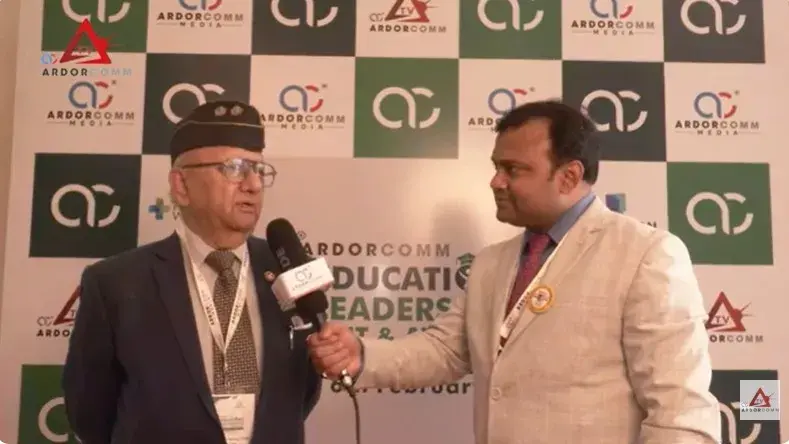
We have a very senior academician and a defence personnel, Major General B. D. Wadhwa, AVSM, Pro-Chancellor (Emeritus), IILM University, Greater Noida. We welcome you to today’s event.
Thank you so much. I’m happy to be here for two reasons. Firstly, because I have served here for long, long years, so I was looking forward to coming here. Secondly, from the academic point of view, Assam means a lot to us. And of course, your platforms have always been a source of learning. That’s why I thought I must attend this platform.
A person of your stature — from defence to academia — what was the thought process behind this transition, and how has the journey been so far?
You see, I was always bent more towards academics. I left home at the age of 15 years and 10 months when I had just passed Class 11. After four years of training, somehow I did well. Thanks to the Government of India and the people of India — I’ll put it that way — I did my B.Tech in Mechanical Engineering, my M.Tech in Mechanical Engineering, another M.Tech in Instrumentation Technology, and my Master’s in Management.
I was also a faculty member for a good 11 years while serving in the Army. Therefore, I always wanted to come into the academic sector.
If you ask me what the difference is — well, there is a lot of difference. The way we teach and the way we impart knowledge to our students differs. Outside, at least in the private sector of higher education in India, there is, in my thinking, some laxity. In my university, therefore, I have tried to remove that laxity.
Everybody is talking about digitalisation and skilling. What initiatives is your institute taking under your leadership?
That is moving towards Artificial Intelligence. You spoke about robotics. The days have come when, in my College of Engineering, we have removed the traditional streams of Mechanical Engineering, Chemical Engineering, Automobile Engineering, and Electrical Engineering.
There are hardly any students in those streams. If you have 1,000 admissions, out of those, 920 want to go into Computer Science alone. So that is the thought process in the environment, and we are tuning ourselves and changing ourselves by inducting more and more technology into our curriculum.
Now, you asked me about skilling. Today, there is no other way. The way the Indian corporate sector has changed — until you are perfect in your soft skills, your hard skills, and your personality is above standard and above average — you are nowhere.
Gone are those days when a CGPA of 9 or 90% marks could help you get a job. No. I may have 70%, but if my personality is better than yours, I could get a job and even a higher salary than you.
I have seen these changes over the last 20 years. Accordingly, we have brought in a lot of training infrastructure focused on skills and personality building for our students. That is important.
How is the participation in terms of admissions happening, sir? Is it from Central India, South India, or the Northeast?
As far as Greater Noida is concerned, there are about six universities and around two dozen standalone institutions. Nobody comes from New Delhi to Greater Noida. Nobody comes from Mumbai, the South, or Ahmedabad. Why would they come to Greater Noida?
So where are the crowds coming from? There are about 60,000 students in Greater Noida. The bulk — 90% to 95% — come from West Bengal, distant places of Uttar Pradesh, distant places of Madhya Pradesh, Odisha, and Assam.
I have tried to go beyond Odisha and Assam. The efforts I have put in have brought some results, but we are still lacking a little. It will take time to bring about that kind of awakening — more so among the parents and faculty.
The Northeast is going to take time to come up to the level of the corporate sector that we have elsewhere. So these are the places that are feeding students to Greater Noida.
In forums like the ArdorComm Education Leadership Summit and Awards, where we see academicians, corporate leaders, and government representation — how does this help the larger community?
It is very important for corporate people to tell the students and academicians what exactly they are looking for. This hasn’t yet been fully brought out. I’m sure in the subsequent panels it will be.
It is equally important for academicians to understand what corporates are looking for, go back, and train their students accordingly.
Like I said, those days of relying only on high percentages are over.
What are your takeaways from today’s event since morning?
So far, a lot has come out. I’m glad many people spoke to me during the tea break. They spoke to the other panellists and to you as well. I’m happy that some awakening has already begun.
Now, they have to carry this awakening and the lessons from here back to their tribes, villages, and locations. Only then will there be real benefit from such hard work and from the kind of dedicated platforms you are providing.