






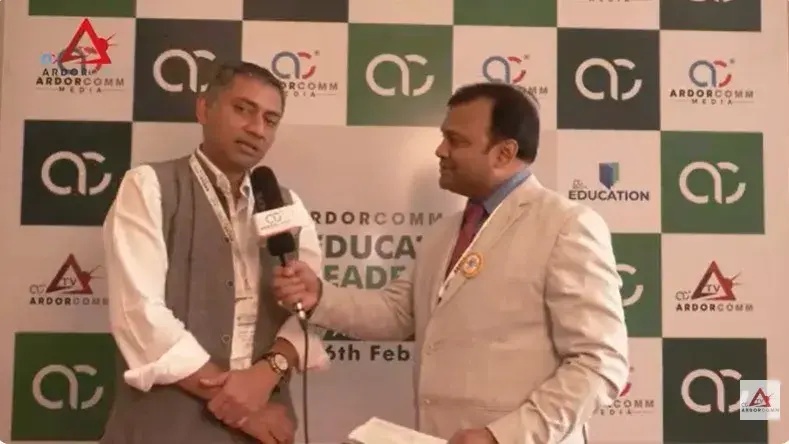
ArdorComm Media Bureau
February 24, 2026
We would like to know more about your organisation — the various streams you offer, the student strength, and the USP of the university.
Dayananda Sagar University is about 10 years old in Bengaluru, and it is one of the first AI-first universities in India. The objective of the university leadership is to introduce Artificial Intelligence right from academics to administration and in all activities concerning students and faculty.
Given the large component of technology and healthcare courses in the university, a lot of interdisciplinary research and application of AI across these streams is currently underway. As we speak, the university team is working very hard to collaborate with NVIDIA and set up a Centre of Excellence in Artificial Intelligence, perhaps the first of its kind in the country, at our main campus in Bengaluru.
Dayananda Sagar University also has several other departments, such as the School of Law, the School of Computer Applications, the School of Health Sciences, and the College of Journalism and Mass Communication, which I head.
We believe that along with technology and healthcare advancements, we also need good human beings. Arts and humanities are critical components of education. This is where interdisciplinary research and academic activities help.
As the world moves closer towards Artificial Intelligence — almost like a race — at some point we must pause and ask: what is happening to real human qualities such as critical thinking and analysis? Arts and humanities will play a very important role here. A balanced academic approach is what strengthens a university like Dayananda Sagar University.
With so many developments in new-age learning, where does teacher training stand? What developments are happening in that area?
As a conscious policy at Dayananda Sagar University, we train teachers in an interdisciplinary manner. Teachers who teach technology or healthcare-related subjects must compulsorily include components from the humanities — whether it is soft skills, dealing with patients, interacting with students, managing clients, or working in management streams. They need knowledge of sociology, psychology, and human behaviour. Understanding how to approach human beings and how to pass on thoughts and training is crucial.
On the other hand, teachers in humanities also need some technical training. Today, without technology, you cannot even run a classroom or upload notes. So we must strike a balance and bring both sides together midway.
In journalism and mass communication, do students see it as a lucrative, polished, or materialistic sector, or are they entering it with a sense of service to society? How is today’s generation approaching it?
That’s a very interesting question. I think students who choose media, mass communication, and journalism do so primarily because they are genuinely interested in it.
However, what I find lacking is awareness at the school level. Not enough is done in the curriculum to inform students that there are excellent career opportunities in media, digital media, social media, advertising, and public relations. Mass communication is not just journalism; it includes all these allied fields.
Students who are aware of these opportunities pursue it as a career option. More than service to society, I think many are excited by the idea of doing something different from their peers.
Media and entertainment today are among the largest sectors globally in terms of turnover, and technology is transforming this space significantly, creating more opportunities. So awareness must be built at the school level to encourage more students to voluntarily take it up and excel.
In forums like this, where corporates, government entities, and academicians come together, how do such platforms help the larger community?
This is a fantastic forum because it brings together policymakers, faculty, university leadership, and administrators — at both school and higher education levels.
Today, many of us are working in silos. We are not talking enough to each other or exchanging ideas. When we work in isolation, we tend to believe that our way is the best way.
Only when we meet others — even competitors — do we learn from their best practices. A platform like this brings together people from diverse backgrounds and helps in the exchange of ideas and thoughts. I believe we need more such summits and conclaves.
We are a four-year-old media startup, launched during the COVID era, working pan-India to create such forums. Any message or wishes for us?
I think you are doing a fantastic job. Starting during the COVID era and operating without a physical office — with everyone working from their own spaces — is a great business model. It reflects passion and commitment towards the education sector.
What stands out is the intent behind your events. These are not merely marketing events; they are platforms that bring thought leaders together to exchange ideas and best practices. That is phenomenal.
Unfortunately, many events today are treated more as marketing exercises rather than platforms for idea exchange. In the West, events focus strongly on sharing best practices openly, and that is how countries progress.
You are doing a phenomenal job. My best wishes to ArdorComm Media. I am very happy that Dayananda Sagar University is associated with ArdorComm. Last time we met in Bengaluru, we received the award for Best Media Institute. Going forward, we would be happy to continue as partners, depending on management decisions.