






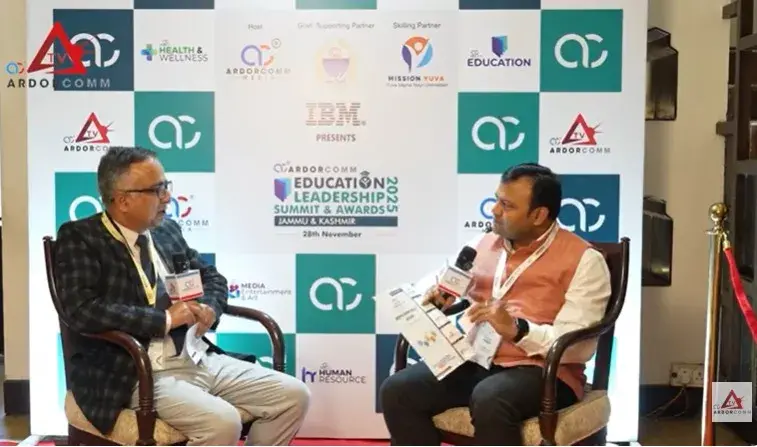
ArdorComm Media Bureau
December 20, 2025
Would you like to introduce a bit more about your association?
Actually, this association spans across the LoC of J&K and the plains of Jammu and Kashmir. It covers the entire region, with approximately 4,700 schools associated. Around 94% of these are budget schools. We also have elite schools associated, enabling collaborative learning.
I have recently taken over the association, and now it is very vibrant across all districts. We have tehsil-level units, district-level units, and division-level units—one in Jammu and another in Kashmir.
What is the mission of your association?
Our association focuses on making the government understand that private schools should be treated as knowledge partners. Another key goal is achieving the SDG objectives of quality education and promoting collaborative learning. Collaborative learning is essential to understand the best practices happening across Jammu, Kashmir, and even near the LoC. Despite being in a conflict zone for the last 40 years, schools in these areas have acted as agents of peace and pillars of stability, which need to be strengthened.
Regarding technological initiatives, I believe we should strengthen the infrastructure of private schools, making them technological hubs that serve the community. Initially, the government can be the community owner, while individual schools manage and operate them under the supervision of the association. After 10 years, ownership should transfer to the schools themselves, because ultimately this infrastructure is being given back to the community and funded by taxpayers’ money.
The key challenge is creating a robust system. If we rely solely on government agencies, no one takes full responsibility for maintenance and repairs. By giving ownership to schools after 10 years, they are responsible for managing and serving the community, and eventually, it becomes their property. We need to change the dynamics and adopt out-of-the-box solutions; without innovative thinking, these initiatives cannot succeed.
How do you see technology and digitalization being integrated into schools in your region?
I recently visited a group of progressive schools in Kashmir for voluntary pilot projects. We assessed internet connectivity, computer availability, and basic infrastructure. Clearly, there is a gap in infrastructure, though cosmopolitan schools are more advanced.
We also need to focus on improving mathematical skills, linguistics, and financial literacy. Without a solid foundation in these areas, interest in AI, data science, and other emerging fields cannot be fully realized.
How is skilling being addressed in schools, and how is teacher training managed?
Teacher training is a major bottleneck in private schools. India has the highest number of budget schools in the world, which form the backbone of our education system. Teachers in private schools have not always been selected through proper processes like SSRBs, unlike government teachers who have access to DIETs, SCRTs, and NCERTs for training.
Private schools often rely on companies to support curriculum selection and teacher development. Curriculum is a USP for us, and government intervention sometimes creates bottlenecks. We use a combination of online and offline sessions to train teachers, ensuring they are equipped to implement quality education.
How does participation in forums like the ArdorComm Education Leadership Summit & Awards help your association in terms of knowledge sharing and growth?
These forums are extremely beneficial. They allow us to socialize, network, and learn from experts. For example, I met the director of the government’s Skill Mission here, which helped me understand the new programs being launched in schools.
We also explored skill development initiatives for non-teaching staff, such as drivers and maids, integrating them into productive activities that contribute to the school and the community. I had been thinking about this for a month, as many of these staff members spent their time idle, resting, or chatting without any productive engagement. I wanted them to feel that being associated with the school gives them a tangible benefit.
The idea was to train them in skill-development sessions, enabling them to contribute to the school and even generate income by selling their work to the market. This approach empowers them economically while benefiting the school and the community.
These sessions also provide an opportunity to meet other educators, share experiences, and consult with experts. For instance, I learned during the forum about programs launched by the government on the 25th that I had previously missed. The director of the Skill Mission personally interacted with me and encouraged suggestions, allowing us to contribute to these initiatives.
Such forums are invaluable for learning, collaboration, and implementing practical solutions. I sincerely congratulate the organizers for creating this platform, which is truly progressive and impactful.
Finally, this is the fourth anniversary of ArdorComm Media Group. Do you have any message or wishes?
I wish them all the best. Knowledge is invaluable, and collaborative learning is essential. Organizations like ArdorComm play a significant role in shaping education in India. I also want to acknowledge their work in conflict zones like the Himalayas, which is truly commendable.
In this “Amrit Kaal” of education, collaborative learning cannot happen in isolation. Organizations like ArdorComm have a vital role to play in promoting knowledge and innovation across the country. I salute their efforts in working in challenging areas, and I hope to organize one or two conferences or sessions in Srinagar soon.