ArdorComm Media Group

Saturday, November 8, 2025 5:39 PM

DTH

DD Free Dish Strengthens Lead in TV Distribution, Amid Dispute Over Reach
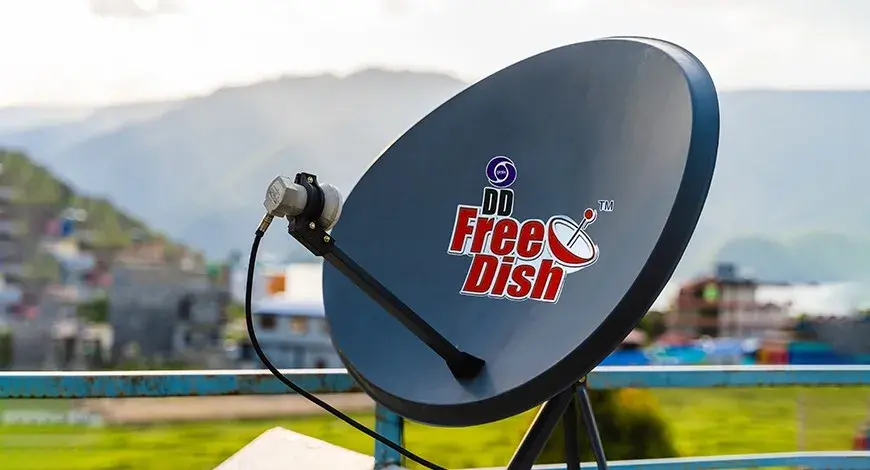
Prasar Bharati’s free direct-to-home (DTH) platform, DD Free Dish, has reinforced its position as India’s largest television distribution service. However, debates continue over the true extent of its reach. Official estimates put its user base at 49 million households in 2024, up from 33 million in 2018. Independent agencies, such as Chrome DM, believe the actual footprint is far bigger, suggesting it has already crossed 60 million homes, surpassing the combined customer base of all private pay DTH operators (around 57 million). The confusion stems from DD Free Dish’s unencrypted signal, which makes tracking households impossible. A plan to introduce encrypted MPEG-4 boxes for measurement never materialized, leaving most viewers with inexpensive MPEG-2 set-top boxes that cannot be monitored. Launched in 2004, DD Free Dish is unique as India’s only subscription-free DTH service. Viewers spend just a one-time amount of up to ₹2,000 for a dish and set-top box, making it the most affordable TV access option in the country. According to a FICCI-EY report, the platform is expected to expand from 49 million homes in 2024 to 57 million homes by 2030, although exact measurement remains elusive. Industry experts say its rapid rise has primarily been at the cost of pay-TV operators, with broadcasters fueling growth by placing free-to-air (FTA) versions of popular Hindi entertainment channels like Star Utsav, Colors Rishtey, Zee Anmol, and Sony Pal on the service. For millions who never had access to premium pay-TV channels, these reruns feel like fresh content. Broadcasters find DD Free Dish lucrative since reruns involve low additional costs, yet give access to the ₹2,000 crore free TV ad market. With carriage fees of ₹15–20 crore per channel, networks have often used the platform strategically, exiting under pay-TV pressure and rejoining later. For instance, Hindi GECs reappeared on the platform in April after a three-year hiatus. Independent channels like Dangal TV thrived in their absence, building businesses worth hundreds of crores. Executives like Kevin Vaz (CEO, Entertainment, JioStar) and Gaurav Banerjee (CEO, Sony Pictures Networks India) argue that free TV plays a vital role in attracting rural and small-town audiences, serving as a bridge to upgrade viewers to pay-TV as incomes grow. Meanwhile, pay DTH players are innovating. Dish TV India has introduced the Zing Super Device, bundling free entertainment channels with pay-TV options for affordability. Yet, competition is growing. With affordable data, YouTube has become the biggest rival, expected to surpass 800 million users in India by 2029. DD Free Dish continues to dominate in the Hindi heartland—Uttar Pradesh, Bihar, Jharkhand, Madhya Pradesh, Rajasthan, and Uttarakhand—but is now expanding into southern states with reserved slots for regional channels. For Prasar Bharati, it has become a major revenue generator, earning nearly ₹800 crore annually through slot auctions, while avoiding expenses like license fees and transponder rentals (as these are provided free by ISRO). Industry bodies argue that being outside TRAI’s pricing framework gives DD Free Dish an unfair advantage. TRAI has recommended encryption and regulatory oversight to ensure parity with private operators. For now, the platform remains India’s most powerful frequency in the TV landscape, balancing its public service role with growing commercial importance. Its future will hinge on whether households see it as a permanent solution or a stepping stone before transitioning to pay-TV or digital streaming. Source: Economic Times  

DD Free Dish Strengthens Lead in TV Distribution, Amid Dispute Over Reach Read More »
DTH Revenues Dip in FY25 While FM Radio Sees Growth: MIB Report

Media news

The Ministry of Information and Broadcasting (MIB) reported a decline in revenue from the Direct-to-Home (DTH) television sector in FY25, signaling a waning user base for pay TV services. In contrast, earnings from the FM radio sector witnessed an uptick, according to the ministry’s latest financial disclosures. In FY25, revenue from private DTH operators stood at ₹648.73 crore, down from ₹692 crore in FY24 and ₹859.96 crore in FY23—a 25% decline over two years. Meanwhile, private FM radio revenues rose to ₹196.28 crore, up from ₹186.80 crore in FY24 and ₹178.99 crore in FY23. Overall, the ministry earned ₹1,012.39 crore in non-tax revenue in FY25 through the Bharatkosh platform on the NTR e-portal, primarily from TV and radio licensing fees. India’s DTH sector, comprising Tata Play, Airtel Digital TV, Dish TV, and Sun Direct, has seen a continuous drop in active pay-TV subscribers—from 70.26 million in 2020 to 56.92 million in 2025, as per TRAI data. This trend is driven by a growing shift toward OTT platforms and the free-to-air DD Free Dish service, which now reaches an estimated 50–60 million households. Adding to the sector’s challenges, the MIB issued demand notices exceeding ₹16,000 crore to private DTH operators for unpaid licence fees. Meanwhile, DD Free Dish, operated by Prasar Bharati, does not pay licence fees and falls outside the private DTH revenue structure. On the other hand, FM radio continues to maintain its relevance, especially in regional and semi-urban markets. Revenue is generated through entry and migration fees, licence fees, tower rentals, and processing charges. The ministry noted FM’s growing popularity among youth and advertisers, with 388 private FM channels operating across 113 cities in 26 states and 5 Union territories as of March 2024. New FM stations have also been launched in border areas such as Leh, Kargil, Bhaderwah, Kathua, and Poonch to bolster outreach efforts. TRAI data shows total advertising revenue for FM radio reached ₹466.63 crore in Q4 FY24, a slight drop from ₹500.11 crore in Q3, but still reflecting the medium’s resilience in a rapidly evolving media environment. Source: Economic Times  

DTH Revenues Dip in FY25 While FM Radio Sees Growth: MIB Report Read More »

I&B Ministry Proposes Comprehensive Broadcasting Bill to Modernize Regulatory Framework

The Information & Broadcasting Ministry is proposing a new Broadcasting Services (Regulation) Bill to regulate broadcasting services, including DTH, OTT, and digital news platforms. The draft Bill, released for public consultation, aims to replace the outdated Cable TV Networks (Regulations) Act 1995 and other governing policies. The proposed legislation includes content evaluation committees, a more participative Broadcast Advisory Council for self-regulation, differentiated codes for programs and advertisements, and statutory penalties. Information & Broadcasting Minister Anurag Thakur described the draft as a “pivotal legislation” to modernize the regulatory framework for the dynamic world of broadcasting, adapting to emerging technologies. The bill introduces contemporary definitions and extends regulatory purview to cover OTT content and digital news. It mandates self-regulation through Content Evaluation Committees and proposes a Broadcast Advisory Council with independent experts. The draft allows differentiated codes for various services, requiring self-classification of content and access control for restricted content. Statutory penalties, including advisory, warning, censure, or monetary penalties, are proposed, with provisions for imprisonment and fines for serious offenses. The bill also suggests fairness by linking monetary penalties to the entity’s investment and turnover. It includes provisions for infrastructure sharing among broadcasting network operators and carriage of platform services. Overall, the proposed unified law is seen as a positive step for business ease and appropriate regulation.

I&B Ministry Proposes Comprehensive Broadcasting Bill to Modernize Regulatory Framework Read More »