

ArdorComm Media Group

Thursday, April 16, 2026 7:19 PM

FutureOfEducation

The NEP and Digitalization: Driving India’s Education Revolution

The National Education Policy (NEP) 2020 represents a significant reform in India’s educational landscape, aiming to transform the system into a more holistic, flexible, and inclusive framework. With the rapid advancement of technology and the increasing importance of digital literacy, NEP 2020 integrates digitalization as a core component of educational reform, setting the stage for an educational revolution in India. Overview of NEP 2020 Approved by the Union Cabinet on July 29, 2020, NEP 2020 replaces the National Policy on Education of 1986. It aims to create an education system that is rooted in Indian ethos while also preparing students for global challenges. The policy is built on five pillars: Access, Equity, Quality, Affordability, and Accountability. These principles are designed to ensure that every child receives a high-quality education, thereby transforming India into a global knowledge superpower. Key Features of NEP 2020 New Academic Structure: The traditional 10+2 schooling system will transition to a new 5+3+3+4 structure, which aligns with the developmental stages of children. Multilingual Education: Emphasis is placed on teaching in the mother tongue until Class 5, promoting linguistic diversity while ensuring quality education. Holistic and Multidisciplinary Learning: NEP encourages students to explore various subjects beyond rigid disciplinary boundaries, fostering critical thinking and creativity. Integration of Technology: The policy highlights the importance of digital literacy and the use of technology in classrooms to enhance learning outcomes. The Role of Digitalization in Education Digitalization is pivotal in achieving the objectives set forth by NEP 2020. The integration of technology into education can enhance accessibility and quality while preparing students for a digital economy. Here are some ways digitalization is driving this transformation: Enhanced Learning Platforms The rise of online learning platforms has made education more accessible to students across various socio-economic backgrounds. During the COVID-19 pandemic, institutions rapidly adopted online teaching methods, which demonstrated the potential for digital platforms to deliver quality education remotely. NEP 2020 advocates for expanding these digital learning resources to ensure continuity in education. Teacher Training and Professional Development NEP emphasizes continuous professional development for teachers through digital means. Online training modules can equip educators with modern teaching strategies and technological tools necessary for effective instruction. This approach not only enhances teacher capabilities but also directly impacts student learning outcomes. Data-Driven Decision Making Digitalization enables educational institutions to collect and analyze data effectively. By leveraging data analytics, schools can identify learning gaps, monitor student progress, and tailor interventions accordingly. This evidence-based approach supports personalized learning experiences and improves overall educational quality. Challenges in Implementation While NEP 2020 presents a robust framework for educational reform, its success hinges on effective implementation. Some challenges include: Infrastructure Gaps: Many rural areas still lack reliable internet access and technological infrastructure, hindering the full realization of digital education. Resistance to Change: Traditional mindsets among educators and institutions may pose barriers to adopting new teaching methodologies and technologies. Equity Concerns: Ensuring equitable access to digital resources remains a significant challenge, especially for marginalized communities. Future Prospects The successful integration of digitalization within the framework of NEP 2020 could lead to transformative changes in India’s education system. By focusing on inclusivity and accessibility, India can harness technology to create a more equitable educational landscape. Goals for 2030 NEP aims to achieve a Gross Enrollment Ratio (GER) of 100% from preschool to secondary level by 2030 and increase GER in higher education from 26.3% (2018) to 50% by 2035. Achieving these goals will require concerted efforts from government bodies, educational institutions, and communities. The National Education Policy 2020, coupled with the power of digitalization, holds immense potential to revolutionize India’s educational framework. By embracing technology and fostering an inclusive approach, India can pave the way for a brighter future where quality education is accessible to all, ultimately contributing to national development and global competitiveness.In summary, NEP 2020 is not just an educational reform; it is a comprehensive strategy aimed at transforming India’s youth into skilled professionals ready to meet the demands of a rapidly changing world. As we move forward, embracing digitalization will be crucial in realizing this vision.

The NEP and Digitalization: Driving India’s Education Revolution Read More »

Exploring the Role of AI in Education: Insights from an Engaging Forum

Ashok Varma, Managing Director, Fort City School, Vizianagram emphasised on “AI makes teaching easier and more effective. It helps students by providing real-time results in a graphical format, showing where they need improvement”  What is your overall impression of the forum? I’m very pleased to be here. It’s a very nice forum, and I appreciate the opportunity to come together and explore how AI can be used in schools and colleges. I’ve learned a lot of new things, and this experience will help me ensure that I pass on this knowledge to my subordinates and train the teachers well.  How do you think AI can be incorporated into education? The key is to focus on the basic ethics that children should learn. Some people are concerned that AI might cause the loss of human interaction, but I believe by engaging more with parents and involving them in small projects with their kids, it fosters communication. Additionally, working in groups teaches students how to interact, depend on each other, and help their peers.  How can teachers support ethical learning in students? Teachers play a crucial role by demonstrating good body language, communication skills, and treating children with respect. They can also encourage students to treat one another well. This way, ethics can be taught through the actions of the teacher and the classroom environment.  How does AI assist in teaching and assessing students? AI makes teaching easier and more effective. It helps students by providing real-time results in a graphical format, showing where they need improvement. Teachers can see which students are struggling and adjust their approach accordingly. AI helps both teachers and students track progress efficiently.  What are your thoughts on the growth and impact of ArdorComm third year? ArdorComm is doing great. I encourage more initiatives like this that inspire people to communicate and do good for society. I appreciate the hard work put into organizing this forum, and I look forward to seeing more of these events in the future. Keep up the great work!

Exploring the Role of AI in Education: Insights from an Engaging Forum Read More »

Prof Geeta Gandhi Kingdon, Manager, City Montessori School shared the importance of diversification, and vision for the future of the school

ArdorComm Interview

“The key factors are the choice of parents to send their children to our school, honesty towards the children, and a sincere commitment to service.” Said Prof Geeta Gandhi Kingdon, Manager, City Montessori School We would like to understand more about your organization, its diversification, and your vision for the future. City Montessori School is a K-12 school in Lucknow with 21 campuses across the city, serving about 63,000 students. Each campus has its own principal, and there is a head office managing common operations. We focus on providing education in three areas: material, human, and divine. We emphasize skill development, not just theoretical learning, so children can apply their knowledge effectively and develop communication and collaboration skills. How does it feel to have your school ranked and nominated in the Guinness Book of World Records as the world’s largest school in a city? What are the key factors attracting both domestic and international students? It’s a great privilege to be in the Guinness Book of World Records. The key factors are the choice of parents to send their children to our school, honesty towards the children, and a sincere commitment to service. Our diligent teachers, discipline, focus on good values, and respect for teachers contribute significantly to our success. What key implementations have you made to modernize your education system and move towards new-age learning? We have embraced educational technology, using tools like Google Classroom, interactive whiteboards, and flat panels. However, modernizing education is not just about technology but also about moving away from rote learning towards skill development. We’ve reformed our assessments to be competency-based, encouraging teachers to focus on creating competencies rather than just preparing students for exams. This shift aims to ensure conceptual clarity and the ability to apply knowledge effectively. The event is named the New Normal Education Leadership Summit and Award. What does the term “new normal” mean to you? The new normal signifies a shift from traditional teaching methods, where the teacher is the sole source of knowledge, to a more engaging and participatory approach. It involves students being actively involved in their learning through peer work, group work, and collaborative learning. We aim to integrate subjects and use experiential learning to show connections between different topics, like how geography and chemistry intersect. We are celebrating the third anniversary of ArdorComm Media. Do you have any messages or feedback for the ArdorComm Media Group? Connecting people and bringing together stakeholders in education is valuable. By facilitating exchanges of ideas, you help improve education practices. I appreciate the platform you provide for educationists to share their insights.

Prof Geeta Gandhi Kingdon, Manager, City Montessori School shared the importance of diversification, and vision for the future of the school Read More »

Prof. (Dr.) Rajendra Sinha, Vice Chancellor, Sandip University, Emphasizes on implementation of NEP 2020

“In today’s scenario practical learning is far more important than theoretical learning,” said Prof. (Dr.) Rajendra Sinha, Vice Chancellor, Sandip University in an interview at “ArdorComm New Normal- Education Leadership Summit & Awards 2023” held in Pune, Maharashtra on 24th November 2023. How is Sandip University implementing the New Education Policy, and what progress has been made in the process? The implementation of the New Education Policy at Sandip University is marked by a commitment to innovative teaching and learning methodologies. The university has embraced research-based learning, personalized learning, and project-based learning to meet the contemporary need for practical education over theoretical knowledge. Recognizing the significance of practical learning in today’s scenario, the institution is actively engaging in collaborations with other countries. This international exchange program involves sharing teachers and students to facilitate the mutual learning of diverse teaching techniques. The emphasis on personalized learning is particularly noteworthy, ensuring that teachers understand the ‘what,’ ‘when,’ and ‘why’ of their instruction, while students can gauge their comprehension effectively. What was the overall takeaway from this event? The event organized by ArdorComm has proven to be a valuable platform for Sandip University, providing a conducive environment for in-depth discussions on the future of education. The creation of multiple panels and a structured setup facilitated the exchange of diverse views, suggestions, and ideas. This collaborative space allowed participants to delve into the possibilities and challenges of evolving educational paradigms, contributing to the collective growth of the academic community. Any testimony for the ArdorComm Media? Extending wishes and appreciation to the organizing committee of ArdorComm Media, I express gratitude for orchestrating such a wonderful event. The seamless organization and execution of the event not only provided an enriching experience but also created a platform for meaningful discussions and networking. Best wishes for the continued success of ArdorComm Media in fostering educational dialogues and advancements in the future.

Prof. (Dr.) Rajendra Sinha, Vice Chancellor, Sandip University, Emphasizes on implementation of NEP 2020 Read More »

Dr. Mahesh KM, Principal, JGI, SBM Jain Evening College, Shares his Experience of Attending New Normal ELSA Bengaluru

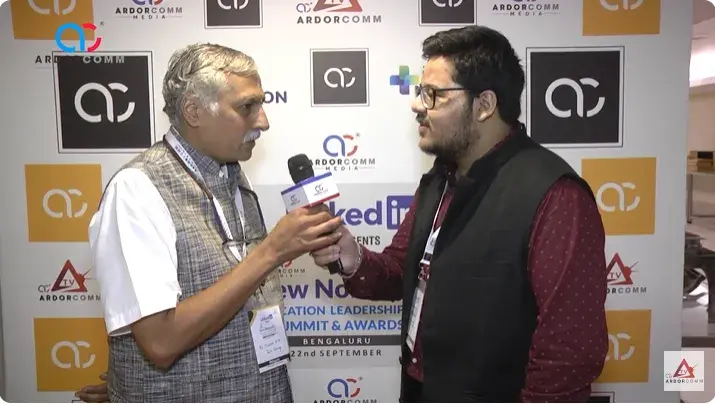
“This platform is bringing together everything that is required for our society,” says Dr. Mahesh KM, Principal, JGI, SBM Jain Evening College, in an interview with Pratik Ghosh, Content Writer, ArdorComm Media at the ‘New Normal – Education Leadership Summit & Awards 2023’ #ELSABengaluru #ELSAKarnataka How are you feeling to witness the New Normal Education Leadership Summit and Awards in Bengaluru? This is my second experience in this particular Summit. When they started after COVID-19, there were a lot of changes and real experiences. They are addressing what the society and the present generation require when it comes to educational institutions. What teachers, education institutions, and students require – they’re bringing all these aspects together on one platform to emphasize the growth of both institutions and students. When institutions grow, they require a lot of changes. For example, LinkedIn and the Jain Group of institutions have partnered up. Our chairman has tied up with LinkedIn to offer courses as internal assessments for our students. This platform is bringing together everything that is required for our society. As you know, in forums like this, we bring in educational leaders, EdTech players, and government representatives. How does this kind of forum benefit the education sector? The education sector is going through a lot of changes. For example, in the admission process, we require automation. This platform provides insights into the software needed for the admission process. It also covers aspects related to the assessment process, such as digital courses, or any other platform that relates to admissions. This platform is vital for addressing the evolving needs of the education sector. ArdorComm Media Group has recently completed 2 years of its existence, any messages or wishes for them? I want to congratulate the entire team at ArdorComm. I’ve experienced their growth from the first anniversary to now. They are doing great work both at an international and state level. My best wishes are always with ArdorComm. Congratulations and God bless the entire team and the founder behind it.

Dr. Mahesh KM, Principal, JGI, SBM Jain Evening College, Shares his Experience of Attending New Normal ELSA Bengaluru Read More »

Dr. Bhavna Chibber, Principal, Laburnum Public School, Gurugram, Emphasizes on Skill Based Learning

 “Skills are unique, indigenous, and the educators, who are the curators in the classroom, must know what kind of skill to develop in each learner,” says Dr. Bhavna Chibber, Principal, Laburnum Public School, Gurugram, in an Interview with Pratik Ghosh, Content Writer, ArdorComm Media Group at the ‘New Normal – Education Leadership Summit & Awards 2023’ #ELSANewDelhi #ELSAGurugram How are you feeling to witness the New Normal Education Leadership Summit and Award? It was an awesome experience to listen to all the dignified personalities. We have learned so many things here, and the discussions were so interesting that we thought this kind of conference should be held for our leaders. These kinds of forums are essential. I’m thankful to ArdorComm Media for providing the opportunity to educators to spread their wings, learn, and take the lead. In this new normal, adaptability and flexibility are crucial skills, and now is the time when we’re preparing our learners to thrive in this world. So, thanks to ArdorComm Media for providing this platform for leaders to share, learn, collaborate, and grow. What’s your take on skill-based learning and the multi-disciplinary approach in education? There are two different things: skill-based learning and the multi-disciplinary approach. When we talk about Saksham, we follow a 5S philosophy: Saksha, Saksham, Samarth, Shodak, and Sanskar. There’s a thin line difference between Saksham and Samarth. For example, consider car driving. I drive a car, so it’s easy for me to understand how the clutch works, how to change gears, etc. But how competent am I? That’s called Saksham. Skill development is about preparing learners for the future, not just for the near future, but for the years ahead. Skills are unique, indigenous, and the educators, who are the curators in the classroom, must know what kind of skill to develop in each learner. Regarding the interdisciplinary approach, terms like interdisciplinary, multidisciplinary, and transdisciplinary have been integrated. Collaborative projects are a key strategy to enhance the interdisciplinary approach on the school campus. Any message for the ArdorComm Median on its 2nd anniversary? Keep soaring high, the sky is the limit.

Dr. Bhavna Chibber, Principal, Laburnum Public School, Gurugram, Emphasizes on Skill Based Learning Read More »