


ArdorComm Media Group

Tuesday, May 12, 2026 8:41 PM

HAL

DRDO successfully conducts high-speed rocket-sledge test for fighter jet escape system
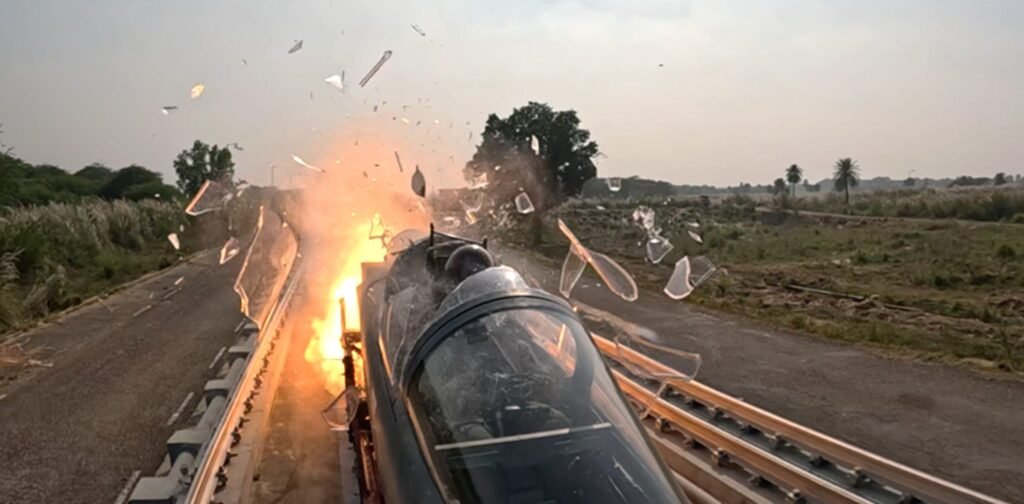
The Defence Research and Development Organisation (DRDO) has successfully carried out a high-speed rocket-sledge test of an indigenous fighter aircraft escape system, marking a major leap in India’s in-house dynamic testing capabilities. With this achievement, India has entered the select group of nations capable of performing advanced escape-system trials at controlled high velocities. The test was jointly executed with the Aeronautical Development Agency (ADA) and Hindustan Aeronautics Limited (HAL) at the Rail Track Rocket Sledge (RTRS) facility of the Terminal Ballistics Research Laboratory in Chandigarh. Officials from the Indian Air Force (IAF) and the Institute of Aerospace Medicine were present during the evaluation. Defence Minister Rajnath Singh congratulated DRDO, IAF, ADA, HAL and industry partners, calling the milestone a “significant boost to India’s defence self-reliance.” Dynamic ejection trials such as this are far more challenging than standard tests like Net or Zero-Zero trials. They offer a realistic assessment of ejection seat reliability and the canopy severance mechanism’s efficiency. For this test, a dual-sledge system carrying the forebody of an LCA aircraft was accelerated to an exact velocity through sequential firing of multiple solid-fuel rocket motors. Key performance indicators — including canopy break pattern, ejection timing, and full aircrew recovery — were assessed using a fully instrumented Anthropomorphic Test Dummy, designed to replicate the physiological responses of a human pilot. The test captured detailed data on forces, acceleration, and motion loads that an ejected aircrew member would endure. The entire sequence was recorded through onboard sensors and ground-based imaging systems. Source: newsonair

DRDO successfully conducts high-speed rocket-sledge test for fighter jet escape system Read More »
Rajnath Singh Inaugurates DPSU Bhawan, Launches R&D and Green Manufacturing Initiatives to Boost Defence Self-Reliance

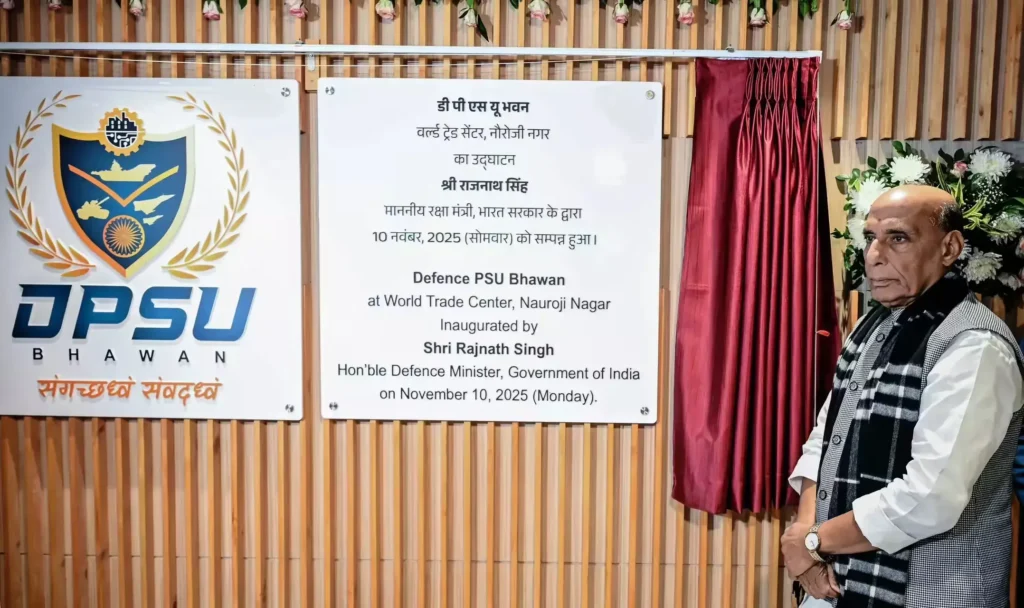
In a significant move to strengthen India’s defence manufacturing ecosystem, Defence Minister Rajnath Singh inaugurated the state-of-the-art DPSU Bhawan at Naoroji Nagar, New Delhi, on November 10, 2025. The new facility aims to serve as a central hub for collaboration and innovation among the country’s 16 Defence Public Sector Undertakings (DPSUs), promoting synergy under the national vision of Atmanirbhar Bharat. The event also featured the launch of a comprehensive R&D roadmap for DPSUs and the unveiling of HAL’s R&D Manual, designed to enhance indigenous design, intellectual property creation, and collaboration with Indian academia. Singh said the roadmap represents India’s shift “from manufacturing under licence to manufacturing through innovation,” reinforcing the goal of technological self-sufficiency. Highlighting the sector’s growth, Singh revealed that India’s defence production in FY25 touched a record ₹1.51 lakh crore, with DPSUs contributing over 71%. Defence exports also surged to ₹6,695 crore, showcasing global confidence in Indian-made platforms. He urged DPSUs to continue their momentum by focusing on rapid indigenisation, quality enhancement, and timely deliveries. Four DPSUs — Munitions India Limited (MIL), Armoured Vehicles Nigam Limited (AVNL), India Optel Limited (IOL), and Hindustan Shipyard Limited (HSL) — were awarded Miniratna (Category-I) status, granting them greater operational autonomy and financial independence. To promote industry collaboration, three key MoUs were exchanged between HAL, BDL, Yantra India Limited (YIL), and MIDHANI. These agreements include the setup of a 10,000-ton forging press to reduce dependence on imported aluminium alloys and the establishment of a Metal Bank to secure critical raw materials for defence projects. HAL also announced an interest-free advance of ₹435 crore to YIL, while BDL committed to a sustained workload of 3,000 metric tonnes over the next decade. Rajnath Singh also launched SWAYAM (Sustainable and Green Defence Manufacturing) — a compendium highlighting eco-friendly practices adopted across DPSUs. Backed by the Comprehensive Energy Efficiency Action Plan (CEEAP) 2023, it promotes renewable energy, energy efficiency, and carbon reduction. He commended India Optel Limited (IOL) and Bharat Electronics Limited (BEL) for achieving 100% renewable energy usage, contributing significantly to India’s Net Zero goals. The newly inaugurated DPSU Bhawan brings all DPSUs under one roof, symbolizing unity and collective progress under the Sanskrit motto “Sangachhadhwam Samvadadhwam” — “Move together, dialogue together.” Equipped with modern simulation facilities, conference rooms, and exhibition spaces, it is set to become a showcase of India’s growing defence manufacturing capabilities. Concluding the event, Singh called on DPSUs to strengthen R&D, sustainability, and innovation to position India as a global hub for defence manufacturing. “Our goal is not just self-reliance but leadership on the world stage,” he said. Source: Economic Times

Rajnath Singh Inaugurates DPSU Bhawan, Launches R&D and Green Manufacturing Initiatives to Boost Defence Self-Reliance Read More »