


ArdorComm Media Group

Wednesday, March 18, 2026 6:17 PM

R&D

Rajnath Singh Inaugurates DPSU Bhawan, Launches R&D and Green Manufacturing Initiatives to Boost Defence Self-Reliance
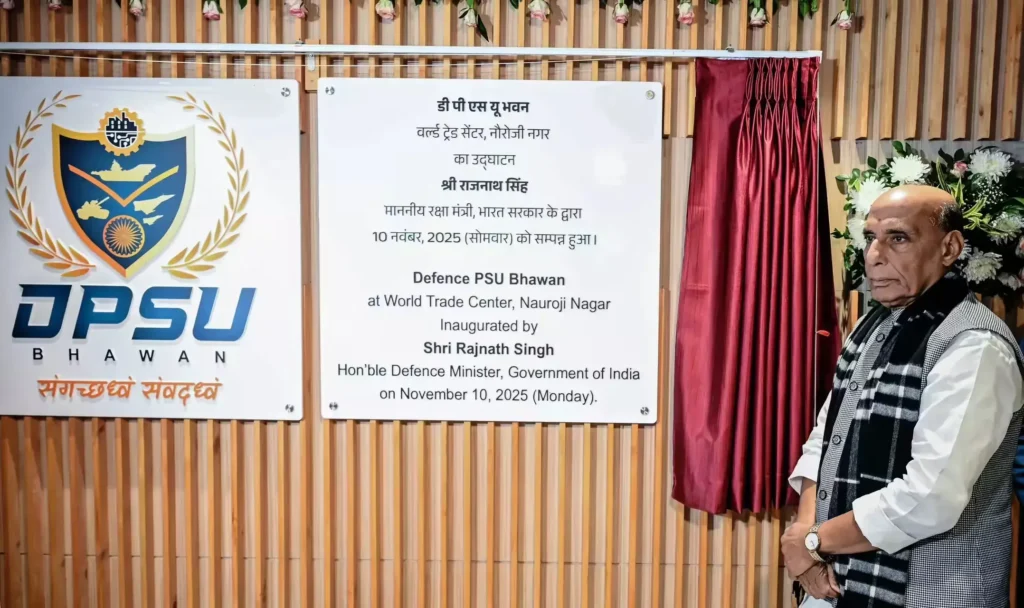
In a significant move to strengthen India’s defence manufacturing ecosystem, Defence Minister Rajnath Singh inaugurated the state-of-the-art DPSU Bhawan at Naoroji Nagar, New Delhi, on November 10, 2025. The new facility aims to serve as a central hub for collaboration and innovation among the country’s 16 Defence Public Sector Undertakings (DPSUs), promoting synergy under the national vision of Atmanirbhar Bharat. The event also featured the launch of a comprehensive R&D roadmap for DPSUs and the unveiling of HAL’s R&D Manual, designed to enhance indigenous design, intellectual property creation, and collaboration with Indian academia. Singh said the roadmap represents India’s shift “from manufacturing under licence to manufacturing through innovation,” reinforcing the goal of technological self-sufficiency. Highlighting the sector’s growth, Singh revealed that India’s defence production in FY25 touched a record ₹1.51 lakh crore, with DPSUs contributing over 71%. Defence exports also surged to ₹6,695 crore, showcasing global confidence in Indian-made platforms. He urged DPSUs to continue their momentum by focusing on rapid indigenisation, quality enhancement, and timely deliveries. Four DPSUs — Munitions India Limited (MIL), Armoured Vehicles Nigam Limited (AVNL), India Optel Limited (IOL), and Hindustan Shipyard Limited (HSL) — were awarded Miniratna (Category-I) status, granting them greater operational autonomy and financial independence. To promote industry collaboration, three key MoUs were exchanged between HAL, BDL, Yantra India Limited (YIL), and MIDHANI. These agreements include the setup of a 10,000-ton forging press to reduce dependence on imported aluminium alloys and the establishment of a Metal Bank to secure critical raw materials for defence projects. HAL also announced an interest-free advance of ₹435 crore to YIL, while BDL committed to a sustained workload of 3,000 metric tonnes over the next decade. Rajnath Singh also launched SWAYAM (Sustainable and Green Defence Manufacturing) — a compendium highlighting eco-friendly practices adopted across DPSUs. Backed by the Comprehensive Energy Efficiency Action Plan (CEEAP) 2023, it promotes renewable energy, energy efficiency, and carbon reduction. He commended India Optel Limited (IOL) and Bharat Electronics Limited (BEL) for achieving 100% renewable energy usage, contributing significantly to India’s Net Zero goals. The newly inaugurated DPSU Bhawan brings all DPSUs under one roof, symbolizing unity and collective progress under the Sanskrit motto “Sangachhadhwam Samvadadhwam” — “Move together, dialogue together.” Equipped with modern simulation facilities, conference rooms, and exhibition spaces, it is set to become a showcase of India’s growing defence manufacturing capabilities. Concluding the event, Singh called on DPSUs to strengthen R&D, sustainability, and innovation to position India as a global hub for defence manufacturing. “Our goal is not just self-reliance but leadership on the world stage,” he said. Source: Economic Times

Rajnath Singh Inaugurates DPSU Bhawan, Launches R&D and Green Manufacturing Initiatives to Boost Defence Self-Reliance Read More »

TRAI Launches Consultation Paper on 5G Ecosystem’s Role in India’s Digital Transformation

The Telecom Regulatory Authority of India (TRAI) has released a consultation paper titled “Digital Transformation through 5G Ecosystem.” The primary aim of this paper is to address policy challenges and propose an appropriate policy framework to expedite the adoption and effective use of new technologies within the 5G ecosystem, contributing to the comprehensive and sustainable development of India’s economy. The Ministry of Communications has emphasized that India is currently undergoing a rapid digital transformation, significantly impacting its economy and society. Reliable mobile communication technologies play a pivotal role in achieving the objectives set forth by the Digital India program. These technologies are bolstering the economy and empowering citizens by enabling services like the unified payment interface (UPI) and various innovative government-to-business (G2B) and government-to-citizen (G2C) applications. With the emergence of technologies like 5G, Internet of Things (IoT), Artificial Intelligence (AI), Augmented/Virtual Reality (AR/VR), and the Metaverse, India stands on the cusp of unlocking new opportunities for growth and innovation. India initiated its 5G services on October 1, 2022, with telecom service providers actively expanding the 5G network across the entire nation. The government has launched multiple initiatives to develop 5G infrastructure and promote research and development in this domain. TRAI has also issued recommendations to accelerate the deployment of 5G networks and services in the country. Collaborative efforts spanning various sectors have been undertaken to expedite the rollout of 5G. Beyond just infrastructure deployment, it is crucial to develop and deploy new use cases for both consumers and enterprises to realize the full potential of 5G technology. When 5G is combined with AI, extended reality (XR), and IoT, it will enable businesses and society to fully harness the benefits of these technological advancements. However, achieving this vision necessitates effective collaboration across the ecosystem, involving Telecom Service Providers (TSPs), Original Equipment Manufacturers (OEMs), infrastructure providers, and the government. Adequate infrastructure upgrades, fiberization for 5G deployment, and network densification are essential elements to fully reap the benefits of this technology across various industries. The adoption of 5G will depend on factors like dedicated research and development investments to create India-specific use cases, increased enterprise involvement, affordable devices, and consumer adoption. To accomplish these goals, TRAI has proactively released this consultation paper to identify policy challenges and propose a suitable policy framework. The objective is to expedite the adoption and effective utilization of new technologies, ultimately contributing to the holistic and sustainable development of India’s economy through the 5G ecosystem. The consultation paper is available on TRAI’s website, www.trai.gov.in, for input from stakeholders. Interested parties are invited to submit written comments on the issues under consideration by October 30, 2023, and counter-comments, if any, by November 13, 2023. Comments and counter-comments should preferably be submitted electronically via email to advadmn@trai.gov.in, with a copy to vibhatomar@trai.gov.in. For further clarification or information, stakeholders may reach out to Vandana Sethi, Advisor (Admin & IR), at 11-23221509.

TRAI Launches Consultation Paper on 5G Ecosystem’s Role in India’s Digital Transformation Read More »