





From Scrolling to Storytelling: Why India Is Falling for Microdramas and the Rise of the One-Minute Episode
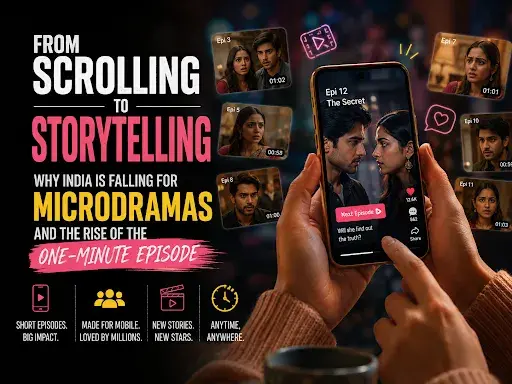
For years, the Indian entertainment industry operated on a familiar rhythm: television serials filled the evening, films dominated weekends and OTT platforms competed for hours of uninterrupted viewing. Then came the reel. What started as a quick way to consume comedy, music, fashion and creator content has gradually changed something deeper — the way Indians expect stories to be told. Today, audiences are increasingly moving from watching isolated short videos to following short, episodic stories designed specifically for the smartphone screen. Microdramas — usually vertical, fast-paced episodes that can run for just a few minutes — are emerging as one of the most interesting developments in India’s digital entertainment economy. And the appeal is surprisingly simple: viewers no longer need to find an hour for entertainment. Entertainment can now find them in the few minutes between meetings, during a commute, while waiting for food or before going to bed. The smartphone has become India’s television screen India’s enormous smartphone and internet ecosystem has created the perfect environment for short-form entertainment. By September 2025, India had nearly 1.02 billion internet users and around 750 million smartphones, while average monthly mobile-data consumption had climbed to about 24 GB per user. That infrastructure has changed the economics of attention. A viewer does not necessarily sit down and decide, “I am going to watch a show now.” Instead, entertainment increasingly appears inside the same feeds used for messaging, shopping, news and social interaction. Meta and Ormax’s 2026 research on India’s microdrama audience found that 89% of viewers discover microdramas through social feeds, while viewers spend a median of 3.5 hours a week watching them, often across multiple short sessions. The study surveyed 2,000 viewers aged 18-44 across 14 states. This is perhaps the biggest difference between microdramas and traditional television or OTT. The viewer doesn’t have to go looking for the programme. The programme finds the viewer. From “scroll” to “what happens next?” The evolution is particularly interesting because microdramas combine two seemingly different entertainment habits. The first is the infinite scroll. The second is the serialised story. Reels trained audiences to expect immediate gratification. Traditional television trained them to return tomorrow for the next episode. Microdramas bring those two behaviours together. An episode might establish a conflict in the first few seconds, introduce a dramatic twist and end precisely when the viewer wants an answer. Then comes the next episode. And the next. Instead of asking viewers to commit to a 45-minute episode, microdramas repeatedly ask for a much smaller commitment: just another two minutes. That seemingly insignificant decision can become a surprisingly powerful retention mechanism. The cliffhanger is the new hook Traditional television often used the commercial break to create suspense. OTT platforms use episode endings and season arcs to encourage binge-watching. Microdramas take the idea to an extreme. Almost every episode has to work as a miniature marketing device for the next one. A confrontation may begin in Episode 12 and be resolved only in Episode 13. A secret is revealed halfway through an episode and explained later. A character receives a message — and the episode ends before the audience sees the reply. The objective is not simply to tell a story. It is to create a reason to tap again. This makes microdrama storytelling fundamentally different from conventional short-form creator content. A reel can succeed because it is funny, informative or visually striking. A microdrama needs another ingredient: narrative momentum. Why younger audiences are responding The strongest concentration of microdrama viewers in India is among younger audiences, particularly those aged 18-34, although the format is also attracting students, working professionals, homemakers and viewers outside major metropolitan centres. That demographic profile makes sense. Younger viewers have grown up in an environment where entertainment is available continuously and where the smartphone is often the first screen of the day. But the appeal isn’t necessarily limited to Gen Z. A working professional may not have the time or patience to begin a full-length series after a long day. A student may want entertainment during a short break. Someone travelling on public transport can watch several episodes without needing to dedicate an entire evening. Microdramas effectively turn dead time into entertainment time. India is particularly suited to the format There is another reason microdramas could become much bigger in India: linguistic diversity. A traditional OTT series requires significant investment in production, marketing and distribution. Microdramas can potentially be produced and adapted for different languages and audience segments at a much faster pace. That opens the door to stories built specifically for Hindi, Tamil, Telugu, Bengali, Marathi and other regional audiences rather than treating India as one homogeneous market. The rise of Tamil microdramas, for example, illustrates how quickly the format can develop within a regional entertainment ecosystem. Short dramas lasting roughly one to five minutes are increasingly attracting younger audiences and creating opportunities for new actors, writers and creators. This could eventually produce an entertainment landscape where the next major digital star doesn’t necessarily emerge from television or cinema. They could emerge from a 90-second episode watched on a phone. Bollywood’s biggest competition may not be another film The rise of microdramas also raises an important question for the broader entertainment industry. What exactly are OTT platforms competing against? For years, the answer was Netflix versus Amazon Prime Video versus Disney+ Hotstar and other streaming services. But the competition is increasingly about attention rather than platforms. A viewer deciding whether to watch a 50-minute drama, scroll through Instagram, watch YouTube Shorts or follow a 20-episode microdrama is making an attention decision. That is why major streaming and entertainment companies are increasingly interested in the category. Industry reporting in 2026 has highlighted growing investment in microdramas from major players, as platforms look at short episodic content as both a discovery mechanism and a potential new entertainment business. In other words, the microdrama isn’t necessarily trying to replace the blockbuster series. It is fighting for the moments when the blockbuster series is simply too
