






ArdorComm Media News Network
August 14, 2026
For years, the Indian entertainment industry operated on a familiar rhythm: television serials filled the evening, films dominated weekends and OTT platforms competed for hours of uninterrupted viewing. Then came the reel.
What started as a quick way to consume comedy, music, fashion and creator content has gradually changed something deeper — the way Indians expect stories to be told.
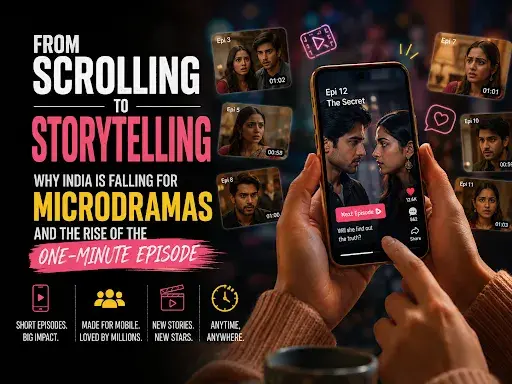
Today, audiences are increasingly moving from watching isolated short videos to following short, episodic stories designed specifically for the smartphone screen. Microdramas — usually vertical, fast-paced episodes that can run for just a few minutes — are emerging as one of the most interesting developments in India’s digital entertainment economy.
And the appeal is surprisingly simple: viewers no longer need to find an hour for entertainment. Entertainment can now find them in the few minutes between meetings, during a commute, while waiting for food or before going to bed.
The smartphone has become India’s television screen
India’s enormous smartphone and internet ecosystem has created the perfect environment for short-form entertainment. By September 2025, India had nearly 1.02 billion internet users and around 750 million smartphones, while average monthly mobile-data consumption had climbed to about 24 GB per user.
That infrastructure has changed the economics of attention.
A viewer does not necessarily sit down and decide, “I am going to watch a show now.” Instead, entertainment increasingly appears inside the same feeds used for messaging, shopping, news and social interaction.
Meta and Ormax’s 2026 research on India’s microdrama audience found that 89% of viewers discover microdramas through social feeds, while viewers spend a median of 3.5 hours a week watching them, often across multiple short sessions. The study surveyed 2,000 viewers aged 18-44 across 14 states.
This is perhaps the biggest difference between microdramas and traditional television or OTT.
The viewer doesn’t have to go looking for the programme.
The programme finds the viewer.
From “scroll” to “what happens next?”
The evolution is particularly interesting because microdramas combine two seemingly different entertainment habits.
The first is the infinite scroll.
The second is the serialised story.
Reels trained audiences to expect immediate gratification. Traditional television trained them to return tomorrow for the next episode. Microdramas bring those two behaviours together.
An episode might establish a conflict in the first few seconds, introduce a dramatic twist and end precisely when the viewer wants an answer.
Then comes the next episode.
And the next.
Instead of asking viewers to commit to a 45-minute episode, microdramas repeatedly ask for a much smaller commitment: just another two minutes.
That seemingly insignificant decision can become a surprisingly powerful retention mechanism.
The cliffhanger is the new hook
Traditional television often used the commercial break to create suspense. OTT platforms use episode endings and season arcs to encourage binge-watching.
Microdramas take the idea to an extreme.
Almost every episode has to work as a miniature marketing device for the next one.
A confrontation may begin in Episode 12 and be resolved only in Episode 13. A secret is revealed halfway through an episode and explained later. A character receives a message — and the episode ends before the audience sees the reply.
The objective is not simply to tell a story.
It is to create a reason to tap again.
This makes microdrama storytelling fundamentally different from conventional short-form creator content. A reel can succeed because it is funny, informative or visually striking. A microdrama needs another ingredient: narrative momentum.
Why younger audiences are responding
The strongest concentration of microdrama viewers in India is among younger audiences, particularly those aged 18-34, although the format is also attracting students, working professionals, homemakers and viewers outside major metropolitan centres.
That demographic profile makes sense.
Younger viewers have grown up in an environment where entertainment is available continuously and where the smartphone is often the first screen of the day.
But the appeal isn’t necessarily limited to Gen Z.
A working professional may not have the time or patience to begin a full-length series after a long day. A student may want entertainment during a short break. Someone travelling on public transport can watch several episodes without needing to dedicate an entire evening.
Microdramas effectively turn dead time into entertainment time.
India is particularly suited to the format
There is another reason microdramas could become much bigger in India: linguistic diversity.
A traditional OTT series requires significant investment in production, marketing and distribution. Microdramas can potentially be produced and adapted for different languages and audience segments at a much faster pace.
That opens the door to stories built specifically for Hindi, Tamil, Telugu, Bengali, Marathi and other regional audiences rather than treating India as one homogeneous market.
The rise of Tamil microdramas, for example, illustrates how quickly the format can develop within a regional entertainment ecosystem. Short dramas lasting roughly one to five minutes are increasingly attracting younger audiences and creating opportunities for new actors, writers and creators.
This could eventually produce an entertainment landscape where the next major digital star doesn’t necessarily emerge from television or cinema.
They could emerge from a 90-second episode watched on a phone.
Bollywood’s biggest competition may not be another film
The rise of microdramas also raises an important question for the broader entertainment industry.
What exactly are OTT platforms competing against?
For years, the answer was Netflix versus Amazon Prime Video versus Disney+ Hotstar and other streaming services.
But the competition is increasingly about attention rather than platforms.
A viewer deciding whether to watch a 50-minute drama, scroll through Instagram, watch YouTube Shorts or follow a 20-episode microdrama is making an attention decision.
That is why major streaming and entertainment companies are increasingly interested in the category. Industry reporting in 2026 has highlighted growing investment in microdramas from major players, as platforms look at short episodic content as both a discovery mechanism and a potential new entertainment business.
In other words, the microdrama isn’t necessarily trying to replace the blockbuster series.
It is fighting for the moments when the blockbuster series is simply too long.
The economics are different too
Traditional OTT economics are built around relatively large production budgets, subscriptions, advertising and long-term audience retention.
Microdramas can operate on a very different model.
Because episodes are short, production can be structured around a high volume of content. Stories can be tested quickly. Successful concepts can be extended, while underperforming ones can potentially be discontinued without the same level of investment associated with a full-length series.
And monetisation doesn’t have to depend entirely on conventional subscriptions.
The wider Indian digital entertainment market is already moving towards subscriptions, virtual gifting and micro-transactions. A 2025 Lumikai-Ipsos study found that more than half of video consumers surveyed were willing to pay for content, while microdramas were increasingly positioned as a format suited to small pockets of viewing time.
This creates an intriguing possibility: instead of paying one large monthly subscription for unlimited entertainment, some users may be willing to make a series of small payments for specific stories, episodes or premium access.
It is entertainment following the logic of the micro-payment economy.
But there is a danger: quantity can destroy quality
The microdrama boom comes with an obvious challenge.
When the cost and production cycle of content fall, the volume of content can rise dramatically.
That is good for experimentation.
It can also produce an ocean of repetitive stories.
Many microdramas rely on familiar ingredients — revenge, forbidden romance, family conflict, secret identities, betrayal, wealth differences and sudden twists. These themes work because they are instantly recognisable and emotionally accessible.
But if every series uses the same narrative formula, audiences could eventually experience fatigue.
The next stage of the industry will therefore depend on whether creators can move beyond simply making stories shorter.
The real opportunity is to make storytelling structurally different.
AI could accelerate the microdrama revolution
Artificial intelligence could make that process even faster.
AI-assisted scripting, translation, dubbing, subtitling, localisation, thumbnail creation and audience analytics could reduce the time required to develop and distribute short episodic content.
That could make it easier for a successful story concept to be adapted into multiple languages or for creators to experiment with different endings and narrative structures.
But this also creates a fundamental question for the entertainment industry: if technology makes content dramatically cheaper to produce, will audiences reward volume or originality?
The answer could determine which microdrama platforms survive.
The next big entertainment battle is over fragmented attention
India’s video consumption is already deeply mobile-first. Meta’s 2026 research found that daily video engagement is high across both urban and rural audiences, while Reels has become a major discovery mechanism for younger users, creators and brands.
Microdramas take that behaviour one step further.
The reel says: watch this.
The microdrama says: watch what happens next.
That distinction matters.
One is based primarily on discovery.
The other is based on retention.
And if platforms can successfully combine the discovery power of social feeds with the emotional pull of serialised storytelling, microdramas could become much more than another short-video trend.
They could become a new layer of India’s entertainment ecosystem.
From television episodes to smartphone moments
The Indian audience has not necessarily stopped liking long-form entertainment.
It has simply gained more choices.
A viewer can still spend three hours watching a film. They can binge an entire OTT season over a weekend. They can watch television with their family.
But between those experiences lies a growing space — the two-minute break, the five-minute commute, the ten-minute wait.
Microdramas are moving into that space.
And perhaps that is why their rise is more significant than simply another social-media trend.
The entertainment industry has spent decades trying to answer one question: How do we get people to sit down and watch?
The microdrama era is asking a different question:
What if people never have to sit down at all?
That may ultimately be the biggest change brought by the format — not that stories are becoming shorter, but that the boundary between everyday life and entertainment is becoming almost invisible.