





ArdorComm Media Bureau
September 22, 2026
Healthcare has always evolved alongside science. But the transformation taking place today is different in scale and speed. Artificial intelligence, precision medicine and digital health are no longer ideas confined to research laboratories or futuristic films. They are increasingly becoming part of how diseases are detected, treatments are planned and patients interact with healthcare systems.
By 2030, the biggest change may not be that hospitals have become more technologically advanced. It may be that healthcare has become more personalised, predictive and connected.
The question is no longer whether technology will enter healthcare. It is how responsibly it will be used—and whether patients, doctors and healthcare institutions will be ready for that change.
From Treating Illness to Predicting Risk
For generations, healthcare has largely operated on a reactive model: a person develops symptoms, visits a doctor, undergoes tests and receives treatment.
Digital health could gradually shift this model towards prevention.
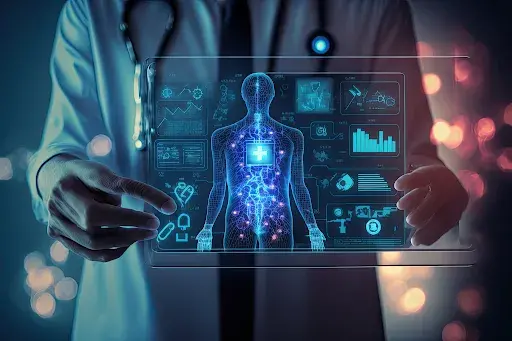
Wearable devices can continuously collect information such as heart rate, sleep patterns, physical activity and, increasingly, other health indicators. Combined with electronic health records and AI systems, such data could help identify unusual patterns before they become obvious symptoms.
Imagine a patient whose digital health profile gradually shows changes in sleep, heart rate and activity. Instead of waiting until that person arrives at a hospital with a serious complaint, an intelligent system could flag the pattern for medical review.
The technology would not replace the doctor. It could give the doctor an earlier signal.
That distinction is important. The future of healthcare is unlikely to be “AI versus doctors”. It is more likely to be doctors supported by better information.
AI: The New Layer of Healthcare
Artificial intelligence could become one of the most influential technologies in healthcare by 2030.
AI systems are already being explored for medical imaging, clinical decision support, drug discovery, administrative work and patient engagement. Their potential lies partly in their ability to process enormous volumes of information much faster than humans can.
For a radiologist, for example, AI could help identify patterns in medical images that deserve closer examination. For researchers, AI could help analyse biological data and accelerate the search for potential drug candidates. For hospitals, intelligent systems could help manage appointments, records and workflows.
But healthcare is not simply another data-processing industry.
A wrong recommendation can have consequences for a person’s life. That makes accuracy, transparency, privacy and accountability essential.
By 2030, one of the most important questions may therefore not be “How powerful is the AI?” but “How safely is the AI being used?”
Human oversight will remain critical, particularly in diagnosis and treatment decisions.
The Rise of Precision Medicine
Two patients can have the same disease and still respond very differently to the same treatment.
This is where precision medicine could change the traditional approach to healthcare.
Instead of relying primarily on broad categories such as age, symptoms or disease type, precision medicine seeks to understand a patient’s individual characteristics—including genetics, lifestyle, environment and other biological factors.
Consider cancer treatment. A tumour that appears similar under conventional examination may have different molecular characteristics in different patients. Understanding those differences can help clinicians identify treatments that are more appropriate for a particular patient.
By 2030, advances in genomics and data analytics could make this approach increasingly relevant across several areas of medicine.
The long-term ambition is simple: move from a “one treatment fits many” approach towards treatment decisions that are increasingly tailored to the individual.
However, access will be a major question. Precision medicine can be expensive and data-intensive. If advanced personalised healthcare remains concentrated in major cities and high-income settings, technological progress could widen existing healthcare inequalities rather than reduce them.
Your Smartphone Could Become Part of Your Healthcare Journey
The hospital of 2030 may not begin at the hospital.
It could begin with a smartphone.
Digital health is creating new ways for patients to communicate with healthcare providers, access medical records, monitor health conditions and receive reminders or follow-up care.
Telemedicine has already demonstrated how geographical barriers can be reduced. Remote consultations, digital prescriptions and connected medical devices can potentially bring elements of healthcare closer to people’s homes.
For countries such as India, this could be particularly significant.
A patient living far from a specialist centre may not need to travel hundreds of kilometres for every follow-up consultation. A local healthcare worker could potentially collect relevant information digitally and connect with specialists elsewhere.
Technology cannot eliminate the shortage of doctors or infrastructure overnight. But it can help healthcare systems use limited resources more efficiently.
The Data Dilemma
There is, however, another side to this digital transformation.
Healthcare’s future will depend heavily on data—and health data is among the most sensitive information a person can share.
Who owns the data generated by a wearable device? Who can access an electronic health record? How long should medical data be stored? Can an individual’s health information be used to train an AI system? What happens if sensitive information is leaked?
These are not merely technology questions. They are questions of trust.
A healthcare system cannot become truly digital if patients are afraid to use it.
By 2030, strong data governance, cybersecurity, informed consent and transparent policies will need to develop alongside technological innovation. The more connected healthcare becomes, the more important trust will become.
Doctors Will Still Matter—Perhaps More Than Ever
One common fear surrounding healthcare AI is that machines could replace doctors.
The more realistic scenario is different.
AI may automate some repetitive tasks, identify patterns and assist with decision-making. But medicine involves more than analysing information. Doctors listen to patients, understand context, explain difficult choices and make decisions when evidence is incomplete.
A machine may recognise a pattern in a scan. A doctor must still explain what that finding means for a particular person.
Technology can process data. Healthcare professionals provide context, judgement and human connection.
The healthcare professional of 2030 may therefore need a different skill set: not simply knowing medicine, but knowing how to work effectively with AI and digital systems.
Healthcare Could Become More Connected—but Not Automatically More Equal
Perhaps the biggest promise of digital healthcare is accessibility.
A connected healthcare ecosystem could bring specialists, laboratories, pharmacies, hospitals, primary-care centres and patients onto a common digital network.
But connectivity alone does not guarantee equality.
Millions of people still face barriers involving affordability, internet access, digital literacy, language and geographical availability. A sophisticated healthcare app is of limited value to someone who cannot reliably access the internet or navigate a digital platform.
This means the healthcare transformation of the next decade must be designed around people, not just technology.
Digital inclusion will need to become part of healthcare policy.
The 2030 Healthcare System: Preventive, Personalised and Participatory
The healthcare system of 2030 may look fundamentally different from today’s model.
AI could help healthcare professionals analyse complex information. Precision medicine could make treatment more individualised. Digital health could connect patients with care beyond the walls of hospitals. Wearables could provide continuous health information. Genomics could reveal risks and treatment possibilities that were previously invisible.
But technology alone will not define the future.
The real transformation will occur when technology, medical expertise, public policy and patient participation work together.
Healthcare could move from episodic treatment towards continuous care; from reacting to disease towards identifying risk earlier; and from standardised treatment towards increasingly personalised interventions.
Yet the central principle should remain unchanged.
Behind every dataset is a person. Behind every medical record is a life. And behind every technological breakthrough is a responsibility to ensure that progress actually improves people’s health.
By 2030, the smartest healthcare system may not necessarily be the one with the most advanced technology. It may be the one that uses technology intelligently while keeping the patient—not the machine—at the centre of care.