






ArdorComm Media Bureau
August 17, 2026
For years, India’s biggest health challenges were closely associated with infectious diseases, malnutrition and limited access to healthcare. But the country is now facing another major public-health challenge: a rapidly growing burden of metabolic and non-communicable diseases.
Obesity, diabetes, hypertension and abnormal cholesterol levels are increasingly affecting Indians across age groups and income categories. What makes the situation particularly concerning is that these conditions are closely connected. A person with excess weight may develop insulin resistance, which can increase the risk of type 2 diabetes. High blood pressure and abnormal cholesterol can further increase the risk of heart disease and stroke.
The problem is no longer confined to older adults. Younger Indians are increasingly exposed to sedentary lifestyles, calorie-dense diets, poor sleep and chronic stress, creating the conditions for metabolic problems much earlier in life.
The World Health Organization identifies unhealthy diets, physical inactivity, tobacco use and harmful alcohol consumption as major behavioural risk factors for non-communicable diseases. These behaviours contribute to metabolic changes such as raised blood pressure, high blood glucose, overweight and obesity.
The scale of India’s metabolic health problem
One of the clearest pictures of India’s metabolic health comes from the ICMR-INDIAB study, a large population-based study covering adults across 31 states and Union Territories.
Published in The Lancet Diabetes & Endocrinology in 2023, the study assessed more than 113,000 participants and examined the prevalence of diabetes, prediabetes, hypertension, obesity and other metabolic conditions.
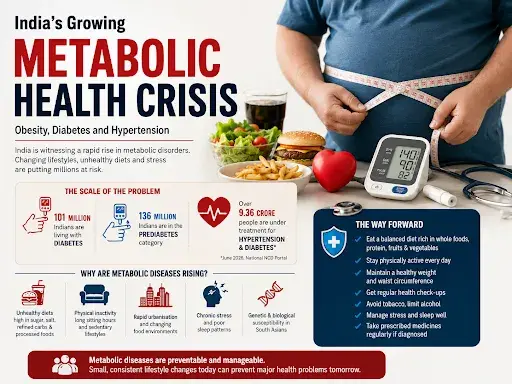
The findings estimated that India had around 101 million people living with diabetes, while another 136 million were in the prediabetes category.
The study also highlighted substantial levels of hypertension and obesity, with considerable variation between states and between urban and rural populations.
This variation is important. India does not have a single metabolic-health profile. Dietary habits, economic conditions, urbanisation, physical activity, genetics and access to healthcare differ significantly from one region to another.
Yet the broader direction is clear: metabolic disorders have become a major component of India’s disease burden.
Obesity is becoming a public-health issue
Obesity is often discussed as an issue of appearance or weight management. Medically, however, excess body fat can have much broader consequences.
India’s Ministry of Health and Family Welfare notes that overweight and obesity are important risk factors for conditions including coronary heart disease, hypertension, stroke, type 2 diabetes, fatty liver disease, certain cancers and osteoarthritis.
The concern is also spreading to younger generations.
In July 2026, reporting based on the World Obesity Atlas 2026 estimated that approximately 41 million children in India were overweight or obese. Around the same time, ICMR-NIN unveiled policy recommendations focused on improving children’s food environments, including measures involving food advertising, labelling, school canteens and the pricing of unhealthy foods.
Childhood obesity is particularly concerning because metabolic risk can accumulate over decades. A child who develops unhealthy eating patterns and low physical activity early in life may carry those behaviours into adolescence and adulthood.
That does not mean every overweight child will develop diabetes or hypertension. But it does mean that prevention has to begin much earlier than the traditional idea of starting health checks only in middle age.
Diabetes: India’s expanding metabolic challenge
Diabetes is perhaps the most visible part of India’s metabolic-health crisis.
Type 2 diabetes develops when the body becomes resistant to insulin or does not produce enough insulin to maintain healthy blood glucose levels. Genetics can play a role, but lifestyle and environmental factors also influence risk.
India’s dietary transition has become an important part of the discussion.
A 2025 study based on ICMR-INDIAB data and published in Nature Medicine examined dietary patterns among more than 18,000 adults. It reported associations between higher consumption of low-quality carbohydrates, including refined grains and added sugars, and increased odds of type 2 diabetes, prediabetes and obesity. The study also found that replacing a portion of dietary carbohydrates with protein, particularly from sources such as pulses, legumes and dairy, was associated with lower diabetes risk.
This does not mean that carbohydrates are inherently unhealthy or that Indians should eliminate rice or wheat from their diets.
Rather, it highlights the importance of diet quality, portion sizes and dietary balance.
For many Indians, the issue is not simply the presence of carbohydrates but a dietary pattern dominated by refined grains and added sugars, combined with insufficient protein, fibre, vegetables and other nutrient-dense foods.
Hypertension: The silent component of the crisis
If diabetes is often associated with blood-sugar testing, hypertension presents a different challenge.
High blood pressure can remain undetected for years because many people experience no obvious symptoms.
Persistently elevated blood pressure places additional strain on blood vessels and the heart and increases the risk of cardiovascular disease, stroke and kidney problems.
India’s National Programme for Prevention and Control of Non-Communicable Diseases includes population-based screening for hypertension and diabetes among people aged 30 years and above. The screening process includes assessment of risk factors, BMI and blood pressure, among other measures.
Government data also indicate the scale of the response required. The National NCD portal reported more than 9.36 crore people under treatment for hypertension and diabetes as of June 2026.
Importantly, the number of people receiving treatment should not be interpreted as the total number of Indians living with these diseases. It represents people captured within the government’s treatment system.
Why are metabolic diseases increasing?
There is no single cause.
1. Changing food habits
India’s food environment has changed rapidly. Traditional diets have increasingly been supplemented or replaced by packaged foods, sugary drinks, refined carbohydrates, fried foods and highly processed snacks.
Convenience has become an important factor, particularly in urban areas where long working hours and commuting leave less time for preparing meals.
2. Physical inactivity
Modern work increasingly involves sitting for prolonged periods.
Office jobs, commuting, screen-based entertainment and reduced everyday physical activity can result in people expending far fewer calories than previous generations.
Regular exercise cannot completely compensate for an unhealthy diet, but physical activity remains an important component of metabolic health.
3. Urbanisation
Urbanisation has brought economic opportunity and better access to services, but it has also changed how people eat, travel and work.
WHO identifies rapid and unplanned urbanisation as one factor contributing to the growing burden of non-communicable diseases.
4. Poor sleep and chronic stress
Sleep is often overlooked in discussions about metabolic health.
Irregular working hours, excessive screen exposure, long commutes and workplace stress can affect sleep patterns. Chronic stress and insufficient sleep can, in turn, make healthy eating and regular physical activity more difficult.
5. Genetic and biological susceptibility
South Asians can develop metabolic abnormalities at relatively lower levels of body weight compared with some other populations.
This is one reason why simply looking at body weight does not provide the complete picture of metabolic health.
Someone may not appear visibly obese while still carrying significant abdominal fat or having elevated blood glucose, blood pressure or cholesterol.
The “thin but unhealthy” problem
One of the most important misconceptions surrounding metabolic health is that a person has to be visibly overweight to be at risk.
A relatively slim individual can still have high blood pressure, abnormal cholesterol, insulin resistance or elevated blood glucose.
This is particularly relevant in India because body composition and fat distribution matter alongside overall body weight.
For this reason, waist circumference, blood pressure, blood glucose and lipid measurements can provide useful information that a weighing scale alone cannot.
The message is simple: looking healthy does not necessarily mean being metabolically healthy.
The connection between obesity, diabetes and hypertension
These conditions should not be viewed as isolated diseases.
They frequently overlap because they share several underlying risk factors.
Excess body fat can contribute to insulin resistance. Insulin resistance can increase the risk of type 2 diabetes. Excess weight, high sodium intake, inactivity and other factors can contribute to high blood pressure. Diabetes and hypertension together can substantially increase cardiovascular and kidney risks.
The WHO describes raised blood pressure, overweight/obesity, high blood glucose and high cholesterol as key metabolic risk factors that contribute to major non-communicable diseases.
This interconnected nature of metabolic disease means treating one condition while ignoring the others may not be enough.
The hidden economic cost
The metabolic-health crisis is not only a medical problem.
Chronic diseases require long-term monitoring, medicines, diagnostic tests and regular medical consultations. Complications such as heart attacks, strokes, kidney disease and vision problems can result in significantly greater healthcare costs.
There is also an indirect economic burden.
A person with poorly controlled diabetes or hypertension may face reduced productivity, frequent medical appointments or long-term disability. Families can face additional costs when a member develops complications requiring prolonged care.
For a country with a large working-age population, preventing metabolic disease can therefore have economic benefits beyond reducing hospital admissions.
India’s response is shifting towards screening and prevention
The government’s National Programme for Prevention and Control of Non-Communicable Diseases has expanded screening and treatment infrastructure for conditions including hypertension and diabetes.
The National NCD portal has enrolled tens of crores of beneficiaries and is being used across states and Union Territories to track screening, diagnosis and treatment.
This represents an important shift from treating advanced disease to identifying risks earlier.
However, screening alone cannot solve the problem.
A person can be diagnosed with high blood pressure, but if medicines are not taken consistently or lifestyle risks remain unchanged, long-term control may remain difficult.
Similarly, identifying prediabetes creates an opportunity for intervention—but only if individuals have access to practical dietary guidance, physical activity opportunities and appropriate follow-up.
Prevention has to start before disease appears
The most effective response to India’s metabolic crisis cannot be limited to hospitals.
Schools, workplaces, communities and families all have a role to play.
For children, this means creating healthier food environments and encouraging physical activity rather than relying solely on individual willpower. The recent ICMR-NIN policy framework on childhood obesity has specifically called for measures addressing food advertising, school canteens, labelling and the affordability of unhealthy foods.
For adults, prevention can include:
- Eating a more balanced diet with adequate protein, vegetables, fruits, pulses and whole foods.
- Reducing excessive intake of added sugars, refined foods and highly processed snacks.
- Maintaining regular physical activity.
- Breaking up prolonged periods of sitting.
- Maintaining a healthy body weight and waist circumference.
- Getting adequate and consistent sleep.
- Avoiding tobacco.
- Limiting harmful alcohol consumption.
- Checking blood pressure, blood glucose and cholesterol when medically appropriate.
- Taking prescribed medicines consistently when diagnosed with a chronic condition.
These are broad preventive principles, not substitutes for individual medical advice.
What should young Indians be concerned about?
Perhaps the biggest change in India’s metabolic-health landscape is that these conditions can no longer be considered problems exclusively associated with old age.
A young adult who spends most of the day sitting, sleeps poorly, consumes a highly processed diet and has a family history of diabetes may have meaningful metabolic risk even if they feel completely healthy.
That does not mean every young person needs extensive medical testing.
But it does mean that age should not create a false sense of immunity.
People with risk factors such as a family history of diabetes, excess abdominal weight, high blood pressure, abnormal cholesterol, sedentary lifestyles or previous abnormal blood-sugar readings should discuss appropriate screening with a healthcare professional.
The way forward
India’s metabolic-health challenge is ultimately bigger than obesity, diabetes or hypertension individually.
It is a challenge created by the interaction of food, physical activity, urbanisation, stress, sleep, genetics, healthcare access and the wider environment.
The country has made progress in expanding screening and chronic-disease treatment, but the scale of the problem demands a stronger emphasis on prevention.
The growing burden of childhood obesity makes that need even more urgent. At the same time, the country’s large population of adults with diabetes, prediabetes and hypertension shows why prevention cannot wait for the next generation.
India’s healthcare system will need to increasingly focus not only on treating disease but also on preventing people from developing it in the first place.
The objective should not simply be to help Indians live longer. It should be to help them spend more of those years healthy, active and free from preventable metabolic complications.