






ArdorComm Media Bureau
December 5, 2025
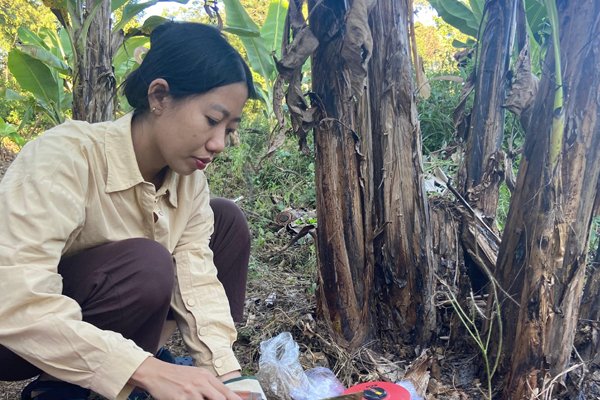
LUMAMI, NAGALAND, 24th November 2025: Nagaland University scientists were part of a multi-institute research team that conducted an extensive study on how diverse land use practices are transforming soil health in Dhansiripar region of the State. Their study sheds new light on the urgent need for sustainable land management to protect agricultural productivity and environmental stability.
The research team assessed soil across six villages – Amaluma, Dhansirpar, Doyapur, Kiyeto, Melongmen and Razhaphe, capturing the complex interactions between local farming systems and soil characteristics.
The study not only contributes to scientific understanding but also has wide societal implications, from informing local farming practices and supporting policy development to enhancing environmental conservation and boosting long-term food security.
The researchers aim to generate data-driven insights that help farmers improve crop yields, support sustainable agriculture, enhance local livelihoods and contribute to national goals of environmental resilience.
The team examined how rapid agricultural expansion, urbanisation and forest conversion are impacting essential soil properties, including soil acidity (pH), bulk density, porosity, water-holding capacity, organic carbon and nutrient availability. The team found that prevailing practices in the region are contributing to soil degradation, declining fertility and heightened erosion risks-issues that farmers themselves raised during initial field surveys.
The research was undertaken by Nagaland University jointly with researchers from ICAR-Indian Agricultural Statistics Research Institute, University of California San Francisco, Dibrugarh University, Tocklai Tea Research Institute and Diphu Medical College and Hospital.
The findings were published in Environmental Monitoring and Assessment (https://doi.org/10.1007/s10661-025-14699-8), an international peer-reviewed journal brought out by the global academic publisher Springer that focuses on scientific methods, tools and data used to track environmental quality.
Highlighting the need for such studies, Prof. Jagadish K Patnaik, Vice Chancellor, Nagaland University, said, “Nagaland University today announced findings from a multi-institute, university-led study revealing rapid soil degradation in the Dhansiripar region of the State. The research team reports strongly acidic soils, declining structural stability and sharp variations in nutrient availability across six surveyed villages. The University urges immediate adoption of sustainable land-management practices to prevent further deterioration and safeguard the region’s agricultural productivity and environmental health”
A major focus of the study was understanding how soil properties differ among lowland paddy fields, cultivated agricultural plots, orchards and forest areas. Researchers employed advanced tools such as multivariate analysis of variance, principal component analysis and cluster analysis to quantify variations and pinpoint the underlying causes.
Strongly to moderately acidic soil conditions, ranging from pH 4.9 to 5.9, were documented across sites. Organic carbon content ranged between 0.45 and 3.69 percent, indicating substantial variation in organic matter turnover. The team also reported notable differences in macronutrient availability and cation exchange capacity, underscoring the need for tailored nutrient management approaches.
Highlighting the important findings of this research, Co-author Prof. Manoj Dutta, Department of Soil and Water Conservation, School of Agricultural Sciences, Nagaland University, said, “This study meticulously examines a diverse array of land use systems, encompassing lowland paddy fields, cultivated agricultural plots, flourishing orchards, and verdant forest areas. By adopting this comprehensive approach, the research facilitates a nuanced exploration of how various land management practices impact soil properties. This methodology allows for specific and insightful comparisons that are often absent in contemporary peer-reviewed studies.”
Further, Prof. Tanmoy Karak, Department of Soil Science, School of Agricultural Sciences, Nagaland University, said, “We found that soil in Dhansiripar is particularly vulnerable to erosion and fertility loss, with the Soil Structural Stability Index showing signs of degradation in low-land paddy zones. These findings reinforce the need for land-use-specific conservation strategies and sustainable farming interventions. Our research also integrates the perspectives of local farmers, whose concerns and observations have helped shape the study’s long-term objectives.”
Emphasising the critical findings of the research, Ms. Reshinaro Tzudir, PhD Scholar, Department of Soil and Water Conservation, School of Agricultural Sciences, Nagaland University, said, “Our study highlights the significant variability in soil properties across different regions and the alarming susceptibility of these soils to erosion and fertility loss under prevailing agricultural practices. This raises urgent concerns regarding the long-term sustainability of our ecosystems. By focusing on the extensive degradation observed across many areas, we underscore the pressing need for innovative, sustainable management strategies. This emphasis is particularly timely and resonates with the growing global efforts to combat soil degradation, ensuring the preservation of our natural resources for future generations.”
Dr. Ranjit Kumar Paul from the ICAR–Indian Agricultural Statistics Research Institute in New Delhi, added, “The study employs advanced multivariate statistical methods to deliver a comprehensive quantitative analysis of soil characteristics. This rigorous methodological approach not only enhances the reliability of the results but also facilitates stronger conclusions regarding the interactions between land use and soil properties.”
According to the team, the research stands out due to its focus on a region that has been largely absent from detailed soil health assessments. Its comparative approach across multiple land-use systems, combined with rigorous statistical modelling, offers a holistic picture of soil dynamics that is rarely available in the North East.
FUTURE RESEARCH OBJECTIVES
Looking ahead, the researchers plan to undertake longitudinal studies to monitor how soil properties evolve, and implement them, such as agroforestry and improved crop rotations. They also plan to collaborate with local communities to integrate traditional knowledge.
The researchers also aim to engage policymakers to promote evidence-based land-use planning and to explore soil biological properties for a fuller understanding of soil health. Comparative studies with similar regions and community awareness programs are also proposed as part of the future roadmap.
MULTI-INSTITUTE STUDY
The study was carried out by Miss Reshinaro Tzudir, Prof. Manoj Dutta, Dr. Alongba Jamir, Mr. Sorenthung Patton, Dr. Rizongba Kichu, Mr. Haiguipeung Hieme, Miss Angela Pidenro, Dr. Sewak Ram, Mr. Debobratha Mondal, Prof. C. S. Maiti, Dr. Animesh Sarkar, Dr. Pankaj Neog and Prof. Tanmoy Karak from the School of Agricultural Sciences, Nagaland University, Medziphema.
Collaborators include Dr. Ranjit Kumar Paul and Dr. Md. Yeasin from ICAR–Indian Agricultural Statistics Research Institute, New Delhi; Dr. Saumik Panja from the University of California San Francisco; Dr. Jiban Saikia from Dibrugarh University; Dr. Harisadhan Malakar from the Tocklai Tea Research Institute, Jorhat; and Dr. Sagarika Das from Diphu Medical College and Hospital, Assam.
(Disclaimer: This report is generated from PRO services. ‘ArdorComm Media’ holds no responsibility for its content.)