






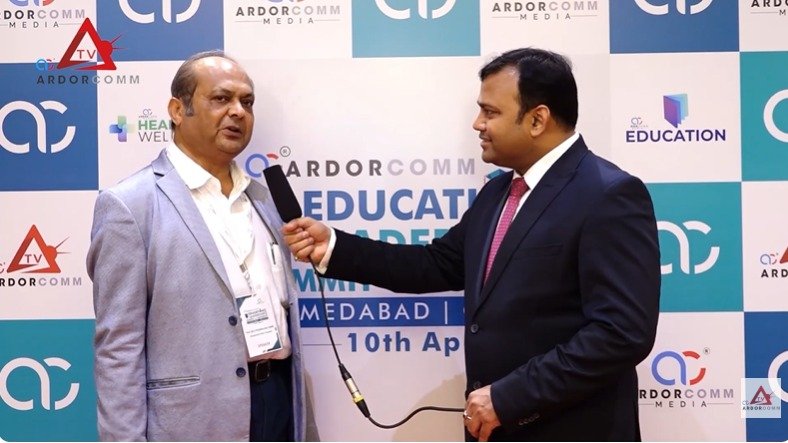
ArdorComm Media Bureau
April 24, 2026
You have been associated with this event for quite some time. How do you view the evolution of such platforms?
It is my pleasure. I have been associated with your event for the last three to four years. Previously, I worked with ISRO, and this is my third term as a Vice Chancellor.
I was going through the tracks you have planned—from education policy reforms to the role of AI and ICT. The kind of industry presentations you have arranged, such as Microsoft and ERP solutions, are very relevant. These technologies are already being used in teaching-learning processes and governance practices.
In terms of innovation and skilling, what initiatives are being taken at your university?
I follow three different philosophies for technology adoption in a university.
Technology adoption in classrooms is the easiest. Adoption in governance practices is the next level. The most difficult is adoption in laboratories, as it requires significant investment.
In our university, we have multiple faculties such as health, medical, dental, Ayurveda, and nursing. We have invested in advanced equipment even beyond regulatory requirements. For example, fetal medicine, CT scan, MRI, and advanced pathology labs are not mandatory as per council norms, but we have established them.
Such infrastructure benefits both students and faculty.
On the engineering side, we have installed DGX H200 systems, which are considered a standard today. We have identified five verticals where this technology can be applied: health, agriculture, education and governance, manufacturing industry, and geospatial (GOI-related applications). In AI, our focus is on these five key sectors, aligning with the needs of digital transformation.
How do forums like this, which bring together academia, government, and corporates, help society?
Everything cannot be done in-house. Our main task is teaching, learning, research, and innovation. Technology development is the strength of industry.
Universities cannot build ERP systems or large-scale equipment on their own. Collaboration is essential.
Such events provide a single platform where universities and industry partners can interact and understand emerging technologies.
For example, developing large language models is extremely challenging—even at a national level. So instead, we are working on small language models. We have downloaded models and are applying them across our five verticals.
We have dedicated teams working on prompt engineering and model distillation. Similar to how DeepSeek was developed using open-edge approaches, we are following similar methodologies.
Within a short time, we expect to develop our own AI solutions, which will be integrated into university governance. However, adopting AI is not just about technology—it also requires restructuring workflows.
Humans will not be replaced; instead, AI combined with human effort will enhance efficiency.
Any message or good wishes for ArdorComm as it completes four years?
You are doing wonderfully well. Your presence is across India, and your events cover multiple sectors and geographies.
I still remember when I suggested organizing an event in Ahmedabad while I was in Rajasthan. Now, it is good to see your expansion in Gujarat.
Gujarat has over 100 universities, and the government is very proactive in technology development. A significant budget has been allocated for long-term programs in education and technology.
Now it depends on university leadership to present the right proposals and take advantage of these opportunities.
You are doing a great job—keep it up. Looking forward to your future events.