

ArdorComm Media Group

Sunday, November 8, 2026 10:41 AM

AI training

Maharashtra Partners with Google to Train 4 Lakh Teachers in AI and Digital Skills
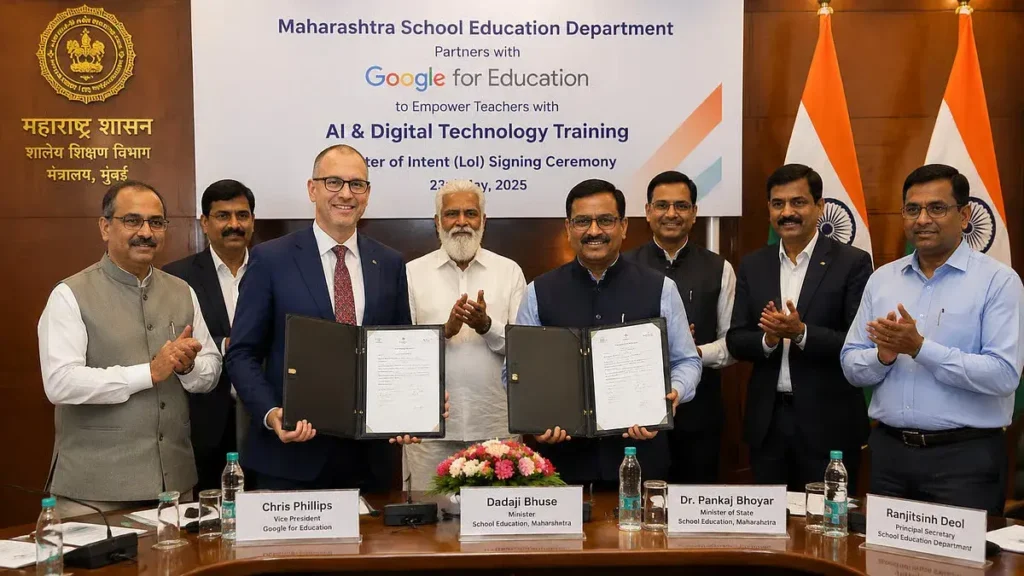
The Maharashtra School Education Department has entered into a strategic partnership with Google for Education to provide artificial intelligence and digital technology training to more than four lakh teachers across the state. The memorandum of understanding (MoU) was signed at Mantralaya in the presence of School Education Minister Dadaji Bhuse. As part of the initiative, selected master trainers will first receive specialised training and will then mentor teachers across schools statewide. The programme will be offered completely free of cost by Google, ensuring no financial burden on the state government. Officials stated that while Google will facilitate training, the Maharashtra government will maintain full oversight of implementation and digital safety protocols for teachers. Minister of State for School Education Pankaj Bhoyar highlighted that the goal is to equip teachers in government and aided schools with globally recognised digital skills. The initiative will focus on improving AI literacy, enhancing digital competencies, and delivering training content in Marathi, Hindi, and English while encouraging the use of AI-powered educational tools for professional development. Source: PTI

Maharashtra Partners with Google to Train 4 Lakh Teachers in AI and Digital Skills Read More »

Gujarat Rolls Out AI Action Plan to Revolutionize Governance by 2030

Ardorcomm news

The Gujarat government has approved a comprehensive Artificial Intelligence (AI) Implementation Action Plan for 2025–2030, signaling a major step toward embedding AI technologies into its governance and public service mechanisms. Endorsed by Chief Minister Bhupendra Patel, the initiative is geared toward enhancing service delivery, optimizing administrative efficiency, and leveraging AI across key sectors including healthcare, education, agriculture, and finance. This strategic blueprint, developed by the Department of Science and Technology and shaped by insights from a 10-member AI Taskforce, aligns with national development visions such as Viksit Gujarat@2047 and Viksit Bharat@2047. It also supports the Centre’s push under Prime Minister Narendra Modi’s leadership to integrate AI into governance, public policy, and digital infrastructure. The five-year roadmap highlights six core areas: Data Security and Compliance: Establishing a trusted, regulation-friendly data environment. Infrastructure Development: Expanding GPU- and cloud-powered digital frameworks, with plans to launch AI factories in smaller cities. Skilling Initiatives: Training 2.5 lakh individuals—including students, MSMEs, and government personnel—in AI, machine learning, and emerging technologies. Research & Industry Collaboration: Fostering academic-industry partnerships to develop real-world AI models tailored for governance. Startup Support: Boosting DeepTech innovation with funding, mentorship, and incubation for startups. Responsible AI: Instituting auditing systems, safety protocols, and ethical guidelines to ensure transparent and secure AI deployment. Implementation will be phased, beginning with the creation of a state-level AI data repository and the establishment of AI development hubs. Pilot programs will be rolled out in select government departments to test and refine AI use cases. To guide the initiative, a dedicated AI and Deep Tech Mission will be established—tasked with overseeing project design, monitoring, and cross-sectoral collaboration. Gujarat has already laid strong groundwork in the AI space, launching an AI Centre of Excellence at GIFT City, organizing capacity-building workshops for civil servants, and initiating efforts to develop Indian language-based AI solutions. The state also conducted an AI Innovation Challenge to source practical AI applications from innovators and entrepreneurs. With this action plan, Gujarat positions itself at the forefront of AI-enabled governance, aiming to create a smarter, more responsive, and future-ready administrative ecosystem. Source: The Hindu Photo Credit: PTI  

Gujarat Rolls Out AI Action Plan to Revolutionize Governance by 2030 Read More »

Canadian Lawsuit Challenges OpenAI’s Data Scraping Practices Under Copyright Law

OpenAI is facing a legal challenge in Canada over allegations of breaching copyright laws through unauthorized data scraping from news websites. Several Canadian news organizations have filed a lawsuit claiming OpenAI violated their terms of service by bypassing protective measures, such as the Robot Exclusion Protocol, and using their content for commercial purposes. The plaintiffs argue that by scraping their material, OpenAI copied their work without authorization and infringed upon terms limiting use to “personal, non-commercial” purposes. This dispute centers on whether data scraping constitutes reproduction protected by copyright or falls under the fair dealing exception. Under Canadian and U.S. copyright law, fair dealing or fair use allows limited unauthorized copying for purposes like education or research. OpenAI contends its practices qualify as transformative use, similar to Google’s digitization of books for searchable databases. Legal scholars and groups like Creative Commons support this view, noting that AI models abstract metadata rather than reproducing original works, creating outputs that do not compete with the original content. In response to earlier lawsuits, OpenAI has taken steps to allow news organizations to opt out of its training processes and has pursued licensing agreements. However, the Canadian case raises broader questions about the balance between innovation in AI and the financial interests of media companies. The outcome of this legal battle could have far-reaching implications for the AI industry. If OpenAI’s actions are deemed fair dealing, it may weaken the licensing market for news content. On the other hand, a settlement or licensing arrangement could set a precedent for future AI training practices. As Canadian and U.S. courts prepare to hear these cases, the decisions will likely shape the future interplay between AI development and intellectual property rights.

Canadian Lawsuit Challenges OpenAI’s Data Scraping Practices Under Copyright Law Read More »