ArdorComm Media Group

Friday, May 1, 2026 3:39 AM

higher education reforms

Over 1,800 Industry Veterans Appointed as Professors of Practice Across 349 Institutions

In a significant push to align higher education with industry needs, more than 1,800 professionals from diverse sectors have joined universities and colleges across India as Professors of Practice (PoP). The Ministry of Education revealed that 1,841 experts have been appointed across 349 higher education institutions as part of reforms envisioned under the National Education Policy (NEP) 2020. Responding in writing to the Rajya Sabha, Union Minister of State for Education Sukanta Majumdar said the initiative is intended to deepen industry-academia engagement and promote hands-on, skill-oriented learning. He highlighted that the position of Professor of Practice is largely temporary and honorary in nature, enabling accomplished professionals to contribute to academic development and nation-building by sharing real-world expertise. Private universities accounted for the largest share of appointments with 715 PoP positions, followed by deemed-to-be universities with 699. State universities appointed 212 professionals, while central universities added 15. Colleges across the country contributed another 200 appointments. State-wise, Tamil Nadu leads with 395 Professors of Practice, followed by Maharashtra (193), Gujarat (179), Karnataka (170), and Uttar Pradesh (157). Several other states and Union Territories have also implemented the model, albeit on a smaller scale. What is a Professor of Practice? The Professor of Practice designation allows experienced industry and professional leaders to take up academic roles even if they do not hold conventional academic qualifications such as a PhD, which is otherwise mandatory for regular professor or associate professor positions. Appointments are typically for a term of up to three years, with a possible one-year extension in exceptional circumstances, capping the maximum tenure at four years. Institutions may allocate up to 10% of their sanctioned faculty positions to Professors of Practice. Eligible candidates must be distinguished professionals with at least 15 years of experience and notable contributions in fields such as science and technology, social sciences, media, armed forces, and other domains. To facilitate diverse participation, three categories of appointments have been introduced: industry-funded Professors of Practice, institution-funded positions supported by the higher education institution’s own resources, and honorary Professors of Practice. Source: Indian Express  

Over 1,800 Industry Veterans Appointed as Professors of Practice Across 349 Institutions Read More »

Budget 2026 puts spotlight on medical education, skilling and the Orange Economy

The Union Budget 2026–27 signals a strong policy push towards medical education, workforce skilling and creative industries, positioning education-led employment as a key engine of India’s services-driven growth. Presenting the budget on Sunday, the Union Finance Minister outlined wide-ranging measures spanning healthcare training, allied professions, design, content creation and short-term professional skilling, with a clear emphasis on employability and regional inclusion. A major pillar of the announcements is healthcare education. The budget proposes a ₹10,000-crore bio-pharma sectoral development package to strengthen pharmaceutical education, clinical training and research. As part of this, three new National Institutes of Pharmaceutical Education and Research (NIPERs) will be established, taking the total to 10, while seven existing NIPERs will be upgraded to enhance advanced research, industry collaboration and training quality. A nationwide network of accredited clinical facilities is also planned to improve hands-on learning and translational research in medical and pharmaceutical education. The government has also outlined a significant expansion of allied health education. Training capacity will be scaled up across 10 priority disciplines such as optometry, anaesthesia technology, applied psychology and behavioural health, with a target of training one lakh Allied Health Professionals over the next five years to address workforce shortages in hospitals and community health systems. In parallel, the budget lays the groundwork for a stronger geriatric and long-term care ecosystem. Around 1.5 lakh multi-skilled caregivers, including wellness and yoga practitioners, will be trained to meet the growing demand for elder care services. Five integrated hubs for medical value tourism were also announced, combining healthcare delivery, diagnostics, rehabilitation, education and post-care services, and creating new employment opportunities across the health sector. Traditional medicine and mental healthcare education have received renewed attention. Three new All India Institutes of Ayurveda will be set up to expand capacity in AYUSH education. In mental health, a second NIMHANS-like national institute will come up in north India, alongside the upgradation of the existing mental health institute in Ranchi. Beyond healthcare, the budget underscores short-cycle, practical skilling aimed at smaller cities. Professional bodies such as ICAI, ICSI and ICMAI will design modular, short-term courses to create “corporate mitras” who can support MSMEs with accounting, compliance and governance, particularly in tier-2 and tier-3 regions. To strengthen the education-to-employment pipeline, the government will constitute a high-powered standing committee focused on employment generation, services exports and enterprise development. The services sector has been identified as the main driver of the next growth phase, with a specific focus on aligning higher education with AI-linked skills and evolving job roles. The Finance Minister also referenced the Anusandhan Research Fund and reiterated that government interventions have helped nearly 25 crore people move out of poverty. Boost to the Orange Economy Creative and design industries feature prominently in the budget. The Indian Institute of Creative Technology in Mumbai will be upgraded, and the institute will anchor the rollout of content-creation labs focused on animation, visual effects, gaming and comics (AVGC) across 15,000 schools and 500 colleges. Recognising the growing demand for trained designers, the government has also announced a new National Institute of Design (NID) in eastern India. Higher education infrastructure will see a new spatial approach through a challenge-based model. The Centre will support states in setting up five university townships in industrial and logistics hubs, envisioned as integrated clusters with multiple institutions, shared research facilities and residential infrastructure to improve access to quality higher education. Equity, science and sectoral skilling To address gender gaps in education, the budget proposes one girls’ hostel in every district, with a focus on regions with low female participation in STEM fields. Science education and outreach will receive a boost through the development of four major astronomy and astrophysics facilities, including a large solar telescope, the Himalayan Chandra Telescope and the COSMOS-2 planetarium. Tourism, hospitality and sports have been woven into the broader skilling agenda. A National Institute of Hospitality will be set up, and the National Council for Hotel Management (NCHM) will be upgraded to strengthen industry linkages. As a pilot, 10,000 tourist guides across 20 iconic destinations will undergo 12-week training programmes designed in collaboration with IIMs. In sports, the Khelo India Mission will be extended with a 10-year integrated talent development pathway covering beginner to elite levels. The budget also links education and technology with agriculture. Under an ICAR-led initiative, AI-based decision-support systems will be deployed to enhance farm productivity, supported by technology-enabled training and advisory services for farmers.

Budget 2026 puts spotlight on medical education, skilling and the Orange Economy Read More »

Parliament to Introduce Bill Creating a Single Higher Education Regulator to Replace UGC, AICTE, NCTE

Parliament is set to take up a landmark reform bill aimed at overhauling India’s higher education regulatory framework. The Higher Education Commission of India (HECI) Bill, scheduled for introduction in the winter session beginning December 1, proposes replacing key regulatory bodies—the University Grants Commission (UGC), the All India Council for Technical Education (AICTE), and the National Council for Teacher Education (NCTE)—with one unified authority. According to the Lok Sabha bulletin, HECI will act as the central regulator for higher education across the country, except for medical and legal education. The new body will focus on regulation, accreditation, and setting professional standards. Funding responsibilities, however, will continue to remain with the administrative ministry and not under HECI’s purview. The concept has been in discussion for years, with a draft bill first released in 2018 for public feedback, proposing the repeal of the UGC Act. Efforts to revive the plan gained momentum after Dharmendra Pradhan became the Union Education Minister in 2021. The National Education Policy (NEP) 2020 strongly advocates for such a unified regulator, noting that India’s higher education system requires a complete structural overhaul. The policy stresses that regulation, accreditation, funding, and academic standard-setting should function independently yet cohesively under empowered bodies to strengthen the sector. Source: Indian Express

Parliament to Introduce Bill Creating a Single Higher Education Regulator to Replace UGC, AICTE, NCTE Read More »

AICTE Launches Major Employability Push for Engineering Students, Targets 20 Lakh Learners

ardorcomm news

Marking Engineers’ Day on September 15, the All India Council for Technical Education (AICTE) unveiled a series of initiatives to enhance the employability of engineering graduates, a persistent challenge in India’s higher education sector. The reforms were launched by Dr. Vineet Joshi, Secretary of Higher Education, Government of India, and include Project PRACTICE (Project for Advancing Critical Thinking, Industry Connect and Employability), the AICTE Research Internship (ARI) Portal, and the mandatory setup of R&D Cells and Climate Cells across all approved institutions. At the heart of the reforms, Project PRACTICE will focus on 1,000 tier-2 and tier-3 engineering colleges where academic outcomes are often weaker. Over three years, it aims to benefit 20 lakh students and 10,000 faculty members through project-based learning, industry-linked assignments, and skill enhancement modules. Supported by the Maker Bhavan Foundation, LEAP, and CRISP, the programme carries a joint investment of ₹23.31 crore, co-funded by AICTE and its partners. In a move to integrate technology into learning, AICTE will also provide free access to AI tools like ChatGPT and Perplexity Go, helping students streamline routine work and focus on critical thinking, research, and innovation. Speaking at the launch, AICTE Chairman Prof. T.G. Sitharam said the initiatives are aimed at bridging the employability gap while fostering innovation, sustainability, and stronger industry-academia collaboration. The ARI Portal will open up structured research internship opportunities, while the mandated R&D and Climate Cells are expected to build a culture of innovation and environmental responsibility in campuses. Leaders from partner organisations, including CRISP’s R. Subrahmanyam, highlighted that these reforms will particularly uplift underserved institutions, enabling them to perform closer to the standards of premier colleges. With over 30 lakh students enrolled across 5,868 AICTE-approved engineering and diploma institutes, officials noted that these measures could play a pivotal role in preparing a new generation of graduates equipped to meet evolving industry demands. Source: Indian Express  

AICTE Launches Major Employability Push for Engineering Students, Targets 20 Lakh Learners Read More »

Education Minister Urges IITs to Lead India’s ‘Atmanirbhar Bharat’ Mission

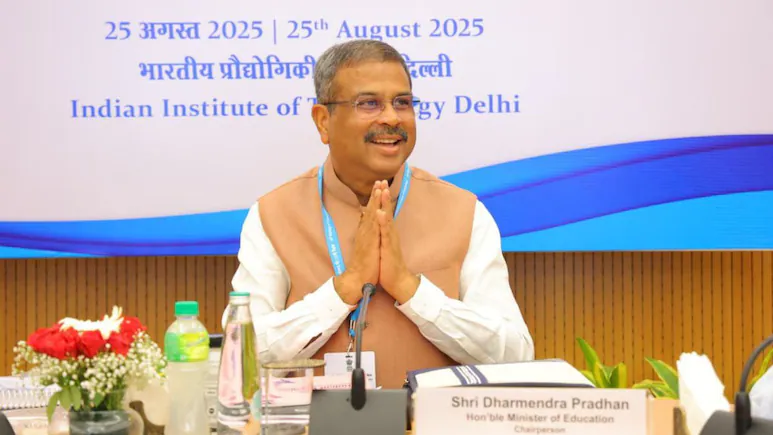
Union Education Minister Dharmendra Pradhan chaired the 56th meeting of the IIT Council at IIT Delhi, where key decisions were taken to strengthen IITs as drivers of self-reliance, innovation, and inclusive growth in line with the Prime Minister’s vision of “Atmanirbharta se Samriddha Bharat.” Mr. Pradhan called upon IITs to act as catalysts for transformative change rather than incremental progress. He urged the premier institutes to embrace regional languages alongside English to make education more inclusive, and to focus on producing job creators by solving real-world challenges through translational research in critical technologies. Highlighting their contribution to India’s innovation ecosystem, he noted that IITs have nurtured over 6,000 start-ups, 56 unicorns, and nearly 5,000 patents. He expressed confidence that IITs would not only boost employment and economic opportunities but also play a pivotal role in building a Samriddh and Viksit Bharat by 2047. Supported by initiatives such as the PM Research Fellowship, Centres of Excellence in AI, and research parks, IITs are emerging as engines of economic growth in tune with the Prime Minister’s call to “Reform, Perform, Transform.” Minister of State for Education & DoNER Dr. Sukanta Majumdar said IITs were not just centres of learning but engines of Innovation, Inclusion, and Transformation. With 23 IITs, growing international campuses, and a thriving startup culture, he emphasized that IITs are producing global leaders and innovators while ensuring India continues to RISE through Research, Innovation, Skills, and Entrepreneurship. The meeting, attended by senior policymakers, industry leaders, and academicians including Dr. K. Radhakrishnan (former ISRO Chairman), Sridhar Vembu (Zoho CEO), Prof. M. Jagadesh Kumar (former UGC Chairman), Prof. T.G. Sitharam (AICTE Chairman), and several IIT chairpersons, focused on: Reforming PhD education and improving global rankings  Strengthening research commercialisation and industry-academia linkages  Adapting curriculum to emerging technologies like AI  Promoting mental well-being of students and faculty  Enhancing alumni networks for mentorship and collaboration  Attracting international students and faculty  The Council also resolved to elevate the IIT R&D Fair into a global innovation platform and draft a policy within a month to accelerate translational research and product development for self-reliance under the IITs@2047 roadmap. Source: NDTV  

Education Minister Urges IITs to Lead India’s ‘Atmanirbhar Bharat’ Mission Read More »