


ArdorComm Media Group

Thursday, June 11, 2026 12:34 PM

IndiaAI Impact Summit

Eros Innovation Launches Cultural AI Platform Across 34 Languages
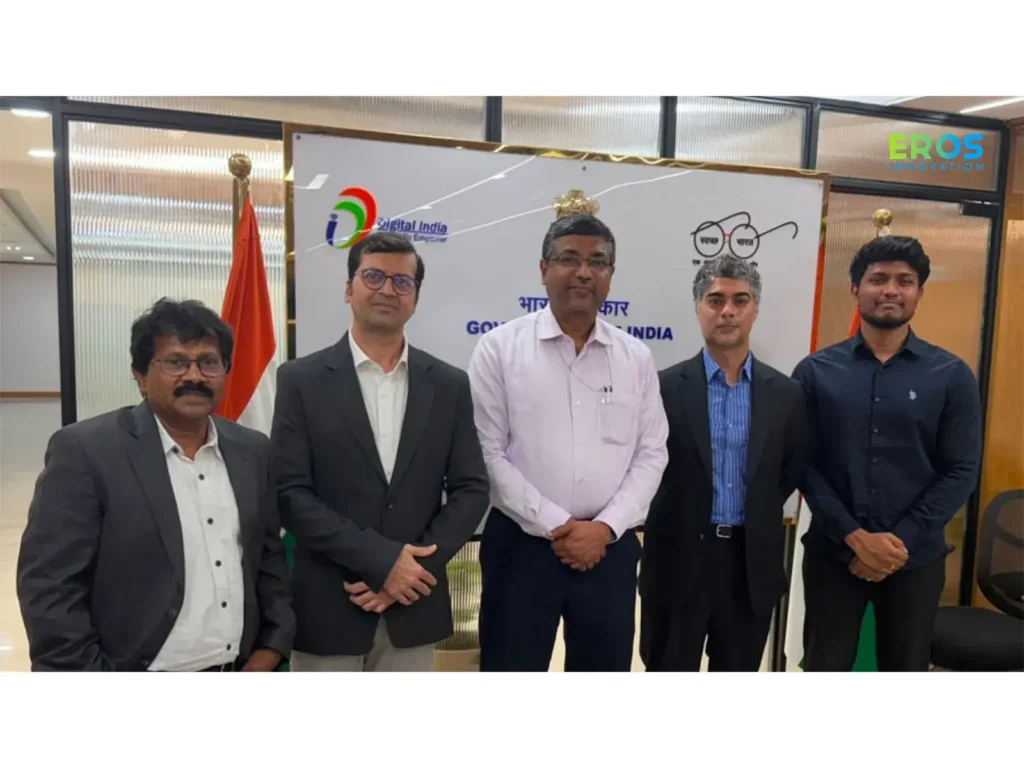
Eros Innovation has officially unveiled its Cultural AI Platform, introducing what it describes as the world’s first artificial intelligence ecosystem built to understand, preserve, and express culture across languages and digital experiences. Initially showcased at the IndiaAI Impact Summit in February 2026, the platform is now live in 34 global languages. At its core are two proprietary technologies—Eros LCVM (Large Cultural Voice Model) and Eros Persona AI—which together form the foundation of a new category the company calls “Cultural AI.” Unlike traditional AI models that primarily focus on language processing and content generation, the Cultural AI Platform is designed to capture cultural context, emotional expression, identity, and performance nuances. Eros says its LCVM technology can generate performances lasting up to five minutes while maintaining voice consistency, accurate lip-syncing, emotional depth, and cultural authenticity across multiple languages. The platform is powered by a rights-cleared dataset comprising more than 11,000 films and over 100,000 characters. It integrates multilingual voice generation, music creation, storytelling, character performance, and persistent digital identities within a unified AI architecture. Accessible through the Eros Universe Super App, the ecosystem enables creators to build, animate, and engage with culturally intelligent digital personas. The platform consists of five interconnected layers: Eros LCM for cultural intelligence and storytelling, Eros LCVM for voice, music, and performance generation, Eros Persona AI for persistent digital identities, Eros Creator for enterprise and creator tools, and Eros Universe as the consumer-facing distribution platform. The company emphasized that all AI-generated Personas are fictional identities and are not intended to replicate or represent real-world actors, performers, or public figures. Commenting on the launch, Ridhima Lulla, Co-Founder and Co-President of Eros Innovation, said the platform is the result of years of research focused on building AI systems capable of understanding culture rather than merely processing language. Founder and Chairman Kishore Lulla described LCVM as a significant step toward advancing India’s sovereign AI vision, calling it the voice layer that enables cultural intelligence to be experienced across 34 languages. The platform was formally launched by S. Krishnan, Secretary, Ministry of Electronics and Information Technology (MeitY), who highlighted the importance of developing AI technologies that preserve linguistic diversity, cultural heritage, and creative traditions as India strengthens its sovereign AI capabilities. Source: ANI

Eros Innovation Launches Cultural AI Platform Across 34 Languages Read More »
India Introduces AI Governance Guidelines to Ensure Safe and Responsible Adoption

The Indian government has unveiled its first set of Artificial Intelligence (AI) governance guidelines, outlining a framework for the safe, transparent, and ethical use of AI technologies. The non-binding rules, released on Wednesday, are expected to shape India’s long-term vision for AI regulation ahead of the IndiaAI Impact Summit scheduled for February next year. Developed under the Ministry of Electronics and Information Technology (MeitY), the guidelines recommend potential amendments to the Information Technology (IT) Act to better classify AI systems and define liability across the AI value chain. The document highlights that the current definition of “intermediary” under the IT Act — covering telecom operators, search engines, and even cyber cafés — is outdated in the context of autonomous AI systems capable of generating data independently. Principal Scientific Adviser Ajay Sood noted that the new framework aims to provide clarity on responsibilities of AI developers and deployers, while also ensuring accountability. He added that the framework could serve as a model for AI governance in the Global South, especially for countries with limited regulatory resources. The guidelines also propose an India-specific AI risk assessment framework based on real-world harm evidence, along with a national database of AI incidents to track misuse, bias, and potential threats. This centralised repository will collect data from smaller regional databases managed by sectoral regulators, helping policymakers better understand the societal and security implications of AI technologies. The framework further recommends establishing new institutions to oversee AI policy, including an AI Governance Group—a permanent inter-ministerial body responsible for coordination and policy development—and leveraging the newly formed AI Safety Institute as the lead authority for ensuring safe and trusted AI use in India. Other key proposals include adopting regulatory sandboxes to allow innovation in controlled environments with limited legal exposure, and mandating accessible grievance redressal mechanisms through the existing Grievance Appellate Committee process. The guidelines also stress the need to update copyright laws to support large-scale AI model training and clarify digital platform classifications. MeitY Secretary S. Krishnan said the government is committed to acting when necessary to ensure AI is developed responsibly and ethically. The document, shaped after studying AI policies in the US, European Union, and China, and informed by over 2,500 submissions from stakeholders including academia, industry, and government bodies, marks a significant step in India’s effort to build a robust governance ecosystem for emerging technologies. Source: Economic Times

India Introduces AI Governance Guidelines to Ensure Safe and Responsible Adoption Read More »