


ArdorComm Media Group

Monday, November 23, 2026 1:32 AM

Indian Government

Centre Urges Four States to Implement RTE, Reserve 25% Seats in Private Unaided Schools

The Centre has urged state governments to enforce the Right to Education (RTE) Act, which mandates reserving 25% of seats in private unaided schools for children from economically weaker sections. Minister of State for Education Jayant Chaudhary informed the Rajya Sabha that states like Punjab, Kerala, Telangana, and West Bengal have not yet implemented this provision. During the Question Hour, Education Minister Dharmendra Pradhan emphasized that education, being a concurrent subject, requires joint efforts from both the Centre and states to ensure school education up to class 12 for all children. He noted that while there is nearly 100% enrollment in class 1 due to collective efforts, the number of students decreases in higher classes, which depends on the proactive measures taken by state governments. Pradhan highlighted that the RTE Act, along with the National Education Policy (NEP), aims to ensure inclusive education for all children until class 12. He acknowledged the previous government for framing the RTE, which includes a significant provision for reserving 25% of seats for underprivileged kids. He appealed to the non-compliant states to implement this provision to achieve universal education. AAP’s Vikramjit Singh Sahney inquired about the number of children covered under RTE and the government’s actions to regulate higher education fees. Chaudhary responded that the RTE, passed in 2009, prioritizes inclusive education for children from poor families and has provisions for reintegrating those who missed formal education. He noted that the Punjab government, under AAP, cited a sufficient number of government schools as a reason for not implementing the 25% quota. Sahney also raised concerns about the high cost of education from kindergarten to postgraduate levels. Chaudhary pointed out that while education is a concurrent subject, states have a significant role in fee regulation. He mentioned that several states have formulated policies to regulate fees and that investments in education have increased, with the Centre’s budget for education doubling over the last decade. AAP’s Swati Maliwal highlighted the exploitation by private schools forcing parents to buy expensive uniforms and books. Pradhan reiterated that education is primarily a state subject, and state governments should take stringent actions against such profiteering, with the Centre’s support.

Centre Urges Four States to Implement RTE, Reserve 25% Seats in Private Unaided Schools Read More »

No Relief for Infosys: Indian Government Maintains ₹32,000-Crore Tax Demand Amidst Canadian Fine

Infosys is facing a substantial tax challenge from the Indian government, which has refused to reduce a ₹32,000-crore ($4 billion) tax demand related to GST regulations. The demand, issued last month, pertains to services received from Infosys’s overseas branches between July 2017 and the fiscal year 2021-22. This amount represents about 85% of Infosys’s revenue for the quarter ending June 30. Infosys has requested a ten-day extension to respond after recent discussions with Indian Income Tax department officials. Despite this, the Indian authorities have indicated they will not ease the demand. In a recent update, Infosys confirmed that the tax demand for the 2017-18 financial year, totaling ₹38.98 billion, has been resolved. The company maintains it has met all tax obligations and adheres to both central and state regulations. In addition to this domestic issue, Infosys has also faced scrutiny from Canada. In May 2024, the Canadian government imposed a fine of CAD 134,822.38 (₹82 lakh) on Infosys for underpaying the employee health tax for the fiscal year ending December 31, 2020. Infosys disclosed this penalty in a regulatory filing received from Canada’s Finance Ministry on May 9. The broader IT sector has also been impacted, with significant declines in stock prices for other major players like Tata Consultancy Services and Satyam Computer Services. This downturn follows Infosys’s stock performance, which saw profit-taking after meeting market expectations and experiencing a prior price surge. Reference by Mint

No Relief for Infosys: Indian Government Maintains ₹32,000-Crore Tax Demand Amidst Canadian Fine Read More »

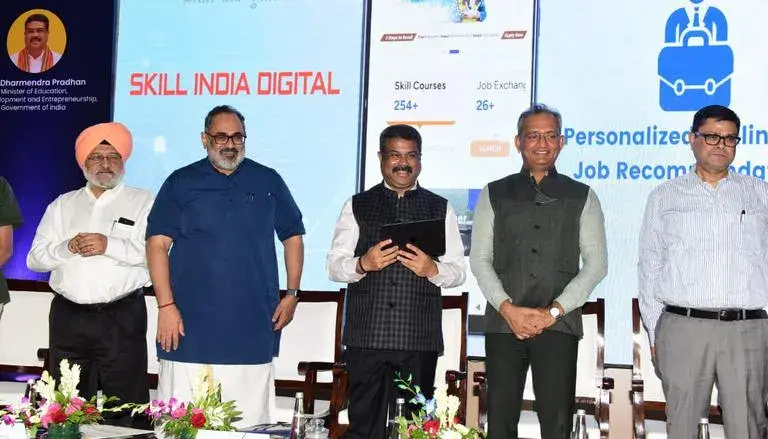
Indian Government Launches Skill India Digital: Transforming Skill Development, Education, and Employment Landscape

The Indian government, under the leadership of Union Minister for Skill Development and Entrepreneurship, Dharmendra Pradhan, unveiled Skill India Digital (SID), a digital platform with the goal of revolutionizing the education, skill development, employment, and entrepreneurship landscape in India. SID serves as the digital public infrastructure (DPI) for India’s skill development, education, employment, and entrepreneurship ecosystem, aiming to make skill enhancement more innovative, accessible, and personalized, particularly focusing on digital technology and industry 4.0 skills. Its primary objectives are to facilitate the hiring of skilled talent, support lifelong learning, and promote career advancement. Furthermore, SID will serve as a comprehensive information hub for all government initiatives related to skill development and entrepreneurship. Minister Pradhan expressed that the Ministry of Skill Development and Entrepreneurship (MSDE) has established an open-source platform to cater to the diverse skilling needs of India’s population. Skill India Digital represents a significant step towards leveraging India’s demographic advantage and positioning the country as a global skills hub. This digital initiative is set to revolutionize the learning and skill development landscape, making skilling accessible to everyone, anytime and anywhere. SID offers support in multiple Indian languages and ensures secure access through Aadhaar-based eKYC verification to ensure genuine participation. The platform adopts a mobile-first approach, enabling uninterrupted learning on handheld devices. One of its standout features is the use of Digitally Verified Credentials, which allows users to present their qualifications, experiences, and certifications in a digital format with built-in authenticity. Through personalized QR codes, potential employers and partners can easily access a candidate’s portfolio, showcasing their skills, qualifications, experiences, and accomplishments. The platform is designed to encompass all training programs initiated by both central and state governments, as well as various departments. This centralized hub for skill development initiatives aims to provide learners with improved accessibility, personalized learning experiences, streamlined verification processes, and enhanced career guidance. Ultimately, Skill India Digital seeks to empower individuals to acquire relevant skills, stay updated with industry trends, and contribute effectively to the country’s workforce development.

Indian Government Launches Skill India Digital: Transforming Skill Development, Education, and Employment Landscape Read More »