


ArdorComm Media Group

Thursday, June 11, 2026 12:49 PM

Indian Knowledge Systems

NCERT Launches ‘Kaveri’ as New Class 9 English Textbook with Focus on Indian Writers
The National Council of Educational Research and Training (NCERT) has introduced a new Class 9 English textbook titled Kaveri, bringing a stronger focus on Indian authors and the integration of Indian Knowledge Systems (IKS). The textbook has been developed in line with the National Curriculum Framework for School Education 2023 (NCF-SE 2023) and will replace the earlier English textbooks Beehive and Moments. Unlike the previous curriculum used between 2006–07 and 2025–26 — which featured 29 texts with a larger share of international authors — the new book contains 16 carefully selected pieces that give equal space to Indian and global writers. Of the 16 texts included, eight are written by Indian authors. The Indian contributors featured in the anthology include renowned figures such as poet Subramania Bharati, author Sudha Murty, Naga writer Temsula Ao, Assamese novelist Mitra Phukan, and Nobel laureate Rabindranath Tagore. The book begins with a story from Murty’s 2004 collection How I Taught My Grandmother to Read and Other Stories. The international section features works by American poet David Roth, English poet Charles Swain, children’s author Bryanna T. Perkins, poet Robert Langley, writer Maya Anthony, and Singapore-based author Irene Chua. The compilation also includes an anonymous poem titled Gifts of Grace: Honouring Our Vocations and a feature based on an interview with Paralympic champion Deepa Malik, highlighting her journey and achievements. According to officials, the revision also reduces the number of textbooks for the subject from two to one, while streamlining the syllabus by cutting the total number of texts from 29 to 16. The move aims to make the curriculum more balanced and manageable while ensuring equal representation of Indian and international literary voices. Source: PTI

NCERT Launches ‘Kaveri’ as New Class 9 English Textbook with Focus on Indian Writers Read More »
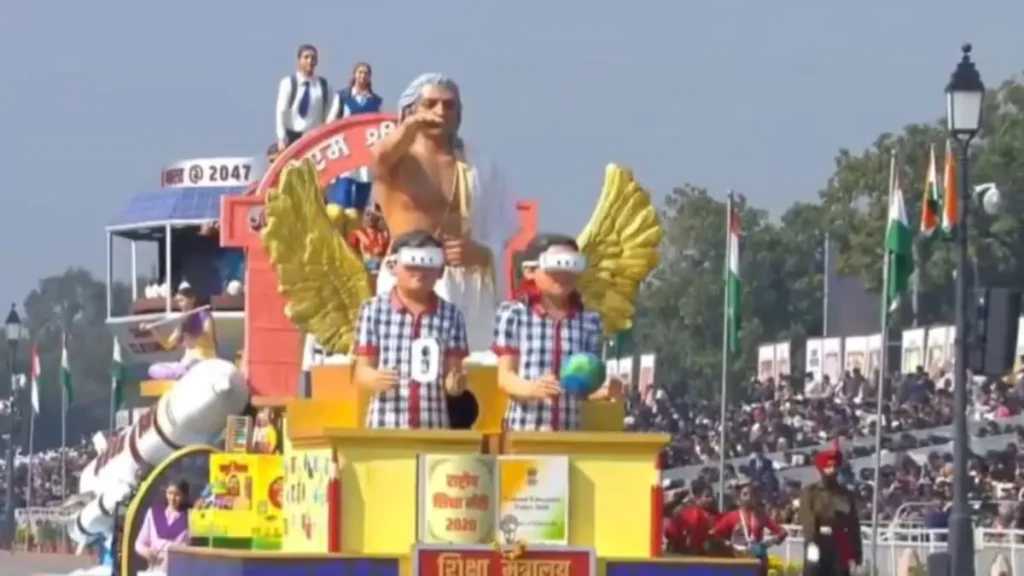
Republic Day Parade 2026: School Education Ministry highlights NEP 2020 and India’s knowledge heritage

At the Republic Day Parade 2026, the Department of School Education and Literacy presented a visually rich tableau that traced India’s civilisational wisdom and its transformation through the National Education Policy (NEP) 2020. The display positioned school education as a cornerstone in the journey towards Viksit Bharat 2047, seamlessly connecting the past, present, and future of learning. Anchored by the gateway of a PM SHRI School, the tableau narrated a story that moved from ancient intellectual traditions to future-ready education. At the forefront stood Aryabhata, overlooking cheerful children holding Shunya (zero) and a globe — a powerful symbol of India’s historic contributions to global knowledge and the responsibility of passing this legacy to the next generation. Flowing behind them, expansive wings represented NEP 2020, signifying confidence, opportunity, and global preparedness, all firmly rooted in the spirit of Aatmanirbharta. The theme of “ancient roots, digital wings” came alive through children wearing VR headsets, while the Jaadui Pitara showcased joyful, play-based foundational learning using indigenous toys and multilingual, mother-tongue materials. The PM SHRI School entrance depicted students planting saplings, reinforcing values of inclusion, sustainability, and environmental stewardship aligned with Mission LiFE. Another student working with tools highlighted the early integration of skill-based education. At the heart of the tableau, the holistic vision of education was portrayed through martial arts, performing arts, and sports, underscoring balanced development. A robotic hand symbolised the harmony between tradition and technology — the journey from takhti to tablet — guided by strong cultural values. The narrative culminated at the Viksit Bharat 2047 tower, showcasing smart classrooms, tinkering labs, and innovation hubs. Visual elements such as books, gears, and electronic circuits reflected PM SHRI Schools as living embodiments of NEP 2020, committed to nurturing skilled, ethical, and empowered citizens across regions, genders, and abilities. The tableau ultimately presented NEP 2020 as a powerful catalyst — a rocket driving transformative reforms in school education — propelling India steadily towards the goal of becoming a developed nation. Source: PTI

Republic Day Parade 2026: School Education Ministry highlights NEP 2020 and India’s knowledge heritage Read More »