

ArdorComm Media Group

Friday, August 14, 2026 6:23 AM

Ministry of Education

Indian Institutions in QS Rankings Rise from 11 to 52 Since NIRF Launch: Centre

India’s presence in global higher education rankings has expanded significantly over the past decade, with the number of Indian institutions featured in the QS World University Rankings rising from 11 in 2015 to 52 in the 2027 edition, the Centre informed the Lok Sabha on Monday. The government linked the growth to efforts to strengthen the quality, competitiveness and global visibility of Indian higher education institutions following the launch of the National Institutional Ranking Framework (NIRF) in 2015. NIRF was introduced to assess and rank higher education institutions across the country. Its evaluation framework covers teaching, learning and resources; research and professional practices; graduation outcomes; outreach and inclusivity; and peer perception. NIRF participation more than doubles The government response also highlighted a substantial rise in participation in the national ranking exercise. The number of applications submitted to NIRF increased from 6,272 in 2021 to 14,163 in 2025. Over the same period, the number of unique institutions participating in NIRF grew from 4,030 to 7,692, reflecting wider participation across India’s higher education sector. More Indian institutions make gains in QS rankings The QS World University Rankings 2027 indicate that India’s progress is increasingly extending beyond the country’s traditional IIT-led group of institutions. Of the 52 Indian institutions included in the latest rankings, 26 improved their positions, while nine retained their previous ranks. Another 15 institutions saw their rankings decline, while two institutions made their debut in the global rankings. Eighteen Indian institutions recorded their highest-ever QS positions, with 13 of them coming from outside the IIT system. Among the leading Indian institutions, IIT Delhi moved up five places to rank 118th globally, equalling the highest position ever attained by an Indian institution. IIT Bombay, which had reached the same position in the 2026 edition, slipped five places to 134th. IIT Madras improved to 170th, while IIT Kharagpur climbed to 205th. IISc Bengaluru was placed at 221st. Several non-IIT institutions recorded particularly notable gains. Shoolini University moved up 51 places to 452nd, while BITS Pilani jumped 93 places to 575th. VIT made one of the biggest advances, rising 94 places to 597th. IIT Hyderabad improved by 76 places, while Jamia Millia Islamia climbed more than 75 positions to rank 686th. NEP 2020 among key government initiatives The Centre attributed the improvement in the global standing of Indian institutions to a range of policy measures, including initiatives introduced under the National Education Policy (NEP) 2020. The policy places emphasis on multidisciplinary education, critical thinking, research and innovation, improved infrastructure and faculty development. The government also cited the Institutions of Eminence scheme, funding and institutional support provided through RUSA and PM-USHA, and the expansion of premier higher education institutions as contributing factors. Since 2014, the government said, 43 new premier institutions have been established, including seven IITs, eight Central universities and nine IIMs. The rising number of Indian institutions in the QS rankings, alongside broader participation in NIRF, points to a widening global footprint for India’s higher education sector and growing competition among institutions to improve academic and research performance. Source: Indian Express

Indian Institutions in QS Rankings Rise from 11 to 52 Since NIRF Launch: Centre Read More »

India’s Single-Teacher Schools Decline by 3,282, But Five States Record Sharp Rise

India recorded a net decline of 3,282 single-teacher schools in 2025-26, with their total number falling from 1,04,125 in 2024-25 to 1,00,843, according to data from the Unified District Information System for Education Plus (UDISE+). The figures were also presented in the Rajya Sabha in late July in response to a question concerning teacher vacancies. A single-teacher school is one where one teacher handles multiple classes and subjects, making it an important indicator of staffing shortages and resource constraints in school education. However, the national decline masks significant differences between states. Five states alone reported a combined reduction of more than 11,000 single-teacher schools, more than three times the overall national decline. This was offset by substantial increases in several other states, resulting in a net reduction of 3,282 schools nationally. Madhya Pradesh records biggest decline Madhya Pradesh reported the largest reduction, with its number of single-teacher schools dropping from 7,217 in 2024-25 to 2,269 in 2025-26 — a fall of 4,948 schools. Chhattisgarh recorded the second-largest decline, reducing its count by 3,512, from 5,973 to 2,461. Uttar Pradesh, which continues to have one of the highest numbers of such schools among major states, saw the figure fall from 9,508 to 7,874, a reduction of 1,634. Punjab and Gujarat also registered notable declines, with their single-teacher school numbers falling by 682 and 601 respectively. Andhra Pradesh sees largest increase In contrast, Andhra Pradesh recorded the biggest increase in the country. The state’s single-teacher schools rose from 12,912 in 2024-25 to 16,357 in 2025-26, an increase of 3,445. Maharashtra reported an addition of 1,117 such schools, while Rajasthan saw an increase of 1,083. Karnataka and Jharkhand recorded increases of 693 and 655 respectively. The contrasting trends indicate that the national improvement has not been evenly distributed across the country. Government response does not explain state-wise variation The Centre’s response in the Rajya Sabha did not provide a state-specific explanation for the sharp variations. It cited factors such as teacher retirements, resignations, creation of new posts, rationalisation of teacher deployment and changes in student enrolment as general reasons for teacher vacancies. The government also did not provide the state-wise sanctioned, working and vacant teacher positions sought in the original question. It said such information is maintained by individual state governments and Union Territory administrations. Instead, the response provided the number of teachers currently in position and the number of single-teacher schools based on UDISE+ 2025-26 data. This means the available figures alone cannot establish whether reductions in single-teacher schools were primarily due to new teacher appointments. Other factors, including school mergers, closures or changes in classification, could also have contributed. Pupil-teacher ratio indicates improvement The latest data also point towards relatively favourable pupil-teacher ratios, although the two years cannot be compared directly because the figures were presented differently. UDISE+ 2024-25 reported an overall national pupil-teacher ratio of 24 students per teacher. For 2025-26, the government provided level-wise ratios of 19 at the primary level, 17 at upper primary, 15 at secondary and 23 at higher secondary. All four ratios are below the 2024-25 composite figure. The government said these figures remain within the benchmarks outlined under the National Education Policy (NEP) 2020, which recommends a pupil-teacher ratio below 30 nationally and below 25 in areas with a high proportion of socio-economically disadvantaged students. While the figures suggest an improvement in teacher availability, the different methods of reporting mean they should not be treated as a direct year-on-year comparison. Source: Indian Express

India’s Single-Teacher Schools Decline by 3,282, But Five States Record Sharp Rise Read More »

UGC flags 32 fake universities, warns students against EdTech franchise-based online degree programmes

The University Grants Commission (UGC) has identified 32 institutions as fake universities in its latest list released in February 2026, the Ministry of Education informed the Rajya Sabha on Wednesday. The disclosure came in response to questions concerning misleading advertisements by EdTech platforms promoting 100% placement guarantees, lucrative job prospects, unauthorised institutional affiliations, fake universities, invalid degrees and unrecognised foreign collaborations. Minister of State for Education Dr. Sukanta Majumdar said the UGC has observed that several EdTech companies are advertising online and Open and Distance Learning (ODL) degree and diploma programmes in collaboration with universities and institutions recognised by the commission. He clarified that the UGC has issued a public notice stating that franchise arrangements for offering online or ODL programmes are not permitted. Degrees awarded through such unauthorised partnerships are not recognised by the UGC, and appropriate action will be taken against both defaulting EdTech firms and higher education institutions under existing laws and regulations. The commission has advised students and other stakeholders to verify the recognition or entitlement status of any online or distance education programme through the UGC Distance Education Bureau (DEB) portal before taking admission. According to the ministry, whenever the UGC receives complaints about unauthorised institutions awarding degrees, it issues notices seeking explanations. If the response is found unsatisfactory, the institution is subsequently included in the commission’s list of fake universities. To tackle such malpractice, the UGC established its Anti-Malpractice Cell (AMPC) on May 30, 1996, to address cases involving fake or unrecognised universities operating in violation of the UGC Act, 1956. The regulator also issues warning and show-cause notices, regularly publishes state-wise lists of fake universities, and conducts awareness campaigns through its website and social media channels. It has further urged state governments and Union Territories to initiate action, including filing FIRs where necessary, against fake institutions operating within their jurisdictions. The latest list includes fake institutions across Delhi, Haryana, Rajasthan, Uttar Pradesh, Jharkhand, Andhra Pradesh, Arunachal Pradesh, West Bengal, Maharashtra and Puducherry. Students have been urged to verify the authenticity and recognition status of higher education institutions through the official UGC website before seeking admission. Source: Indian Express

UGC flags 32 fake universities, warns students against EdTech franchise-based online degree programmes Read More »

Pralhad Joshi Assumes Charge as Education Minister After Dharmendra Pradhan’s Resignation

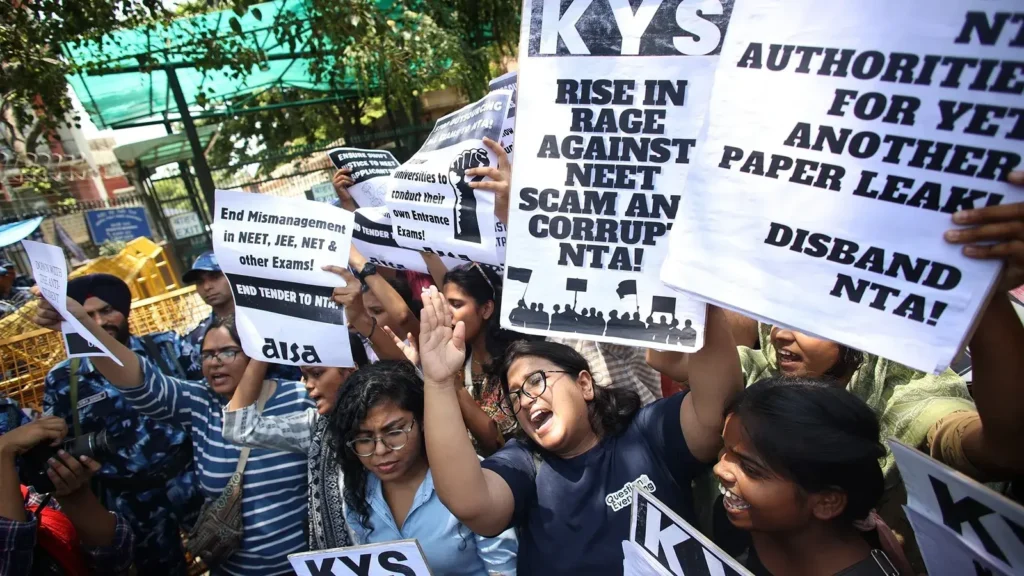
Union Minister Pralhad Joshi has been entrusted with the additional charge of the Ministry of Education after Dharmendra Pradhan stepped down from the post amid mounting protests over alleged examination paper leaks. Speaking to reporters after taking charge, Joshi expressed gratitude to Prime Minister Narendra Modi for the responsibility. He said he accepted the role with humility and highlighted the achievements of the Modi government over the past 12 years, adding that he would work with a strong sense of duty in his new assignment. Pradhan’s resignation came after weeks of nationwide demonstrations led by the Cockroach Janta Party (CJP), which had demanded his resignation over the government’s handling of the examination paper leak controversy. Following the resignation, the CJP announced the immediate withdrawal of its protest movement. Supporters gathered at Delhi’s Jantar Mantar were asked to disperse after the government agreed to the group’s key demands. The decision was announced during a joint press conference addressed by CJP spokespersons Saurav Das and Ashutosh Ranka, along with Union Ministers JP Nadda and Jitendra Singh. According to the CJP, the government has assured that all police cases registered against protesting students will be withdrawn and that no future action will be taken against them. The government has also agreed to provide the maximum compensation permissible under existing rules to the families of students who died by suicide in connection with the NEET paper leak controversy. Dharmendra Pradhan’s resignation was the principal demand of the protesters, and its acceptance paved the way for the suspension of the agitation. Source: NDTV  

Pralhad Joshi Assumes Charge as Education Minister After Dharmendra Pradhan’s Resignation Read More »

Private Universities Drive India’s Higher Education Expansion, Growing Three Times Faster Than Public Institutions Over a Decade

India’s higher education landscape has witnessed a major transformation over the past decade, with private universities emerging as the primary drivers of institutional growth. According to the Ministry of Education’s All India Survey on Higher Education (AISHE) 2023-24, the number of private universities increased from 219 in 2013-14 to 546 in 2023-24, registering a remarkable 149.3% growth. In comparison, government universities rose from 504 to 733 during the same period, reflecting a comparatively modest 45.4% increase. Overall, the total number of universities in the country climbed from 723 to 1,279, marking a 76.9% rise over the decade. The data indicates that private universities expanded at more than three times the pace of their government counterparts. At the state level, Gujarat recorded the highest increase in private universities, adding 51 institutions to reach 67 private universities in 2023-24, overtaking Rajasthan, which now has 57. Madhya Pradesh followed with 52 private universities, while Uttar Pradesh and Maharashtra reported 45 and 42, respectively. Government universities, however, continued to maintain a strong presence across the country. Uttar Pradesh remained the leading state in terms of public universities, increasing its count from 35 to 58, followed by Karnataka, which expanded from 32 to 51 government institutions. Despite the rapid rise in private universities, public institutions continue to educate the majority of university students. Government university enrolment increased from 51.9 lakh students in 2013-14 to 73.9 lakh in 2023-24, although their share of total enrolment declined from 81.3% to 68.1% over the decade. Private universities, on the other hand, recorded a much sharper increase in student numbers. Enrolment nearly tripled from 11.9 lakh to 34.6 lakh students, representing a 191.8% growth. Their share of total university enrolment rose from 18.6% in 2013-14 to 31.9% in 2023-24, highlighting their growing role in India’s higher education ecosystem. The AISHE findings also point to broader progress in higher education participation. India’s Gross Enrolment Ratio (GER) for the 18–23 age group improved from 23.0 in 2013-14 to 30.0 in 2023-24. Female participation continued to outpace that of males, with the female GER reaching 31.2, compared to the male GER of 28.9, marking the seventh consecutive year in which women recorded a higher enrolment ratio. Source: Indian Express  

Private Universities Drive India’s Higher Education Expansion, Growing Three Times Faster Than Public Institutions Over a Decade Read More »

NEET & JEE Admissions May Soon Factor in 50% Board Exam Weightage Under Major Education Reform Push

India’s higher education admission system could soon witness a significant overhaul, with board examination marks potentially carrying up to 50 percent weightage in admissions currently determined primarily through competitive entrance exams such as National Eligibility cum Entrance Test (NEET) and Joint Entrance Examination (JEE). According to sources, the proposed reform is aimed at reducing the immense pressure associated with single high-stakes examinations and creating a more balanced evaluation framework for students seeking admission to medical and engineering institutions. The discussions come amid growing concerns over recurring irregularities in the examination ecosystem, including paper leaks and evaluation discrepancies, which have intensified debates around the credibility and fairness of the current system. Among the key changes under consideration is the introduction of 50 percent weightage for board examination scores in final admission merit lists. In addition, authorities are reportedly looking at bringing entrance examinations closer to school curriculum frameworks to reduce students’ heavy reliance on coaching institutes. Other proposals include allowing multiple exam attempts and gradually transitioning towards adaptive, on-demand computer-based testing systems. At present, admissions to engineering and medical courses are largely dependent on entrance examination scores, with students only required to secure minimum qualifying marks in board examinations to become eligible for these competitive tests. The proposed reforms are currently being examined by a nine-member committee constituted by the Ministry of Education last year. The panel was tasked with studying issues such as the growing dependency on coaching centres, the rise of so-called dummy schools, and concerns regarding fairness and transparency in highly competitive entrance examinations. Sources indicate that the committee’s final report is expected to be submitted to the government in the coming weeks, with recommendations also focusing on better alignment between school education and national-level entrance assessments. Source: PTI

NEET & JEE Admissions May Soon Factor in 50% Board Exam Weightage Under Major Education Reform Push Read More »

India Introduces AI & Computational Thinking for Classes 3–8, Expanding Early Tech Education in Schools

In a major step toward embedding future skills in school education, the Ministry of Education has unveiled a new Artificial Intelligence (AI) and Computational Thinking (CT) curriculum for students from Classes 3 to 8 under the Central Board of Secondary Education. Announced on April 1, the initiative marks the first structured integration of AI concepts at the foundational and middle school levels. Union Education Minister Dharmendra Pradhan described the move as a “transformative step” aimed at preparing students for a technology-driven future. According to the Minister, the curriculum is supported by well-designed modules, detailed teacher handbooks, and a strong assessment framework. These components are intended to provide students with early exposure to emerging technologies while ensuring a systematic learning approach. This development aligns with the vision of the National Education Policy 2020, which emphasizes digital literacy, coding, and the development of 21st-century competencies from an early stage. While AI was previously offered as an elective subject for Classes 9 to 12, this initiative expands its reach to younger learners. The curriculum has been developed by an expert panel led by a professor from Indian Institute of Technology Madras, with participation from key institutions such as CBSE, NCERT, Navodaya Vidyalaya Samiti, and Kendriya Vidyalaya Sangathan. The rollout will begin in the academic session 2026–27 in a phased manner. Schools affiliated with CBSE will receive necessary guidelines, resources, and teacher training support to ensure consistent implementation across both urban and rural regions. The curriculum is designed to be age-appropriate, introducing younger students to core computational thinking skills like pattern recognition, logical reasoning, and problem-solving. As students progress, they will gradually explore foundational AI concepts. Rather than being taught as a separate subject in early grades, AI and CT will be integrated into existing subjects and classroom activities. The approach prioritizes experiential learning through projects, digital tools, and hands-on exercises. To address challenges in implementation, teachers will undergo dedicated training programs supported by structured handbooks. Additionally, assessments will focus on conceptual clarity and practical application instead of rote memorization. Overall, the initiative aims to build a strong technological foundation among students, equipping them with critical thinking and problem-solving skills necessary for the evolving digital landscape. Source: Deccan Herald

India Introduces AI & Computational Thinking for Classes 3–8, Expanding Early Tech Education in Schools Read More »

UGC Flags 32 Fake Universities Across India; Delhi Tops List With 12

The University Grants Commission (UGC) has identified 32 institutions across India as fake universities, warning students that degrees issued by these entities are invalid for employment and higher education. In a public notice released in February 2026, the UGC — a statutory body under the Department of Higher Education, Ministry of Education — clarified that these institutions are not recognised under Sections 2(f) and 3 of the UGC Act. The Commission emphasised that only universities established by a Central or State Act, or those declared as deemed universities under the Act, are authorised to award valid degrees. Delhi Records The Highest Number Delhi has the highest number of such institutions, with 12 entities operating without recognition. Uttar Pradesh follows with four, while several other states and Union Territories have reported one or two such cases. State-Wise Count Of Fake Universities (As of February 2026) Delhi – 12 Uttar Pradesh – 4 Andhra Pradesh – 2 Karnataka – 2 Kerala – 2 Maharashtra – 2 Puducherry – 2 West Bengal – 2 Arunachal Pradesh – 1 Haryana – 1 Jharkhand – 1 Rajasthan – 1 The UGC has advised students and parents to verify the recognition status of institutions through its official website before taking admission. It reiterated that degrees awarded by unrecognised institutions hold no legal validity and will not be accepted for jobs or further studies. The Commission’s move aims to protect students from fraudulent institutions and maintain the integrity of India’s higher education system. Source: NDTV

UGC Flags 32 Fake Universities Across India; Delhi Tops List With 12 Read More »

PM Modi Virtually Inaugurates IIM Guwahati; Rs 555 Crore Approved for Permanent Campus

Prime Minister Narendra Modi on Saturday virtually inaugurated the first academic session of the Indian Institute of Management Guwahati, marking a significant step in expanding management education in Assam and the Northeast. The institute has begun functioning from a temporary transit campus at Tech City in Bongora, spread across 6,410 square metres. It will later move to its permanent campus at Marabhita in Kamrup district near Palasbari, which will be developed over 76.83 hectares. The Union Cabinet has sanctioned Rs 555 crore for the establishment of the institute. The allocation will fund the temporary campus setup, construction of the permanent campus, and operational expenses for the first five years. With this, IIM Guwahati becomes the second IIM in the Northeast after Indian Institute of Management Shillong, and the 22nd across India. The Centre had approved the new IIM as part of efforts to broaden access to quality management education in underserved regions. Academic activities have commenced with the launch of an executive education programme curated by mentor institute Indian Institute of Management Ahmedabad. The inaugural batch includes Assam government officials, and the programme is aimed at strengthening leadership and administrative capabilities. IIM Ahmedabad will also oversee academic arrangements at the temporary campus. The regular MBA programme at IIM Guwahati is scheduled to begin from the 2026–27 academic session. In his address, the Prime Minister described the inauguration as a milestone for the Northeast, stating that the institute would enhance access to high-quality management education and help build academic and professional capacity in the region. The Ministry of Education said IIM Guwahati is envisioned as a future knowledge hub focused on holistic human resource development and is expected to attract students from across the country. Source: Indian Express

PM Modi Virtually Inaugurates IIM Guwahati; Rs 555 Crore Approved for Permanent Campus Read More »

Over 1,800 Industry Veterans Appointed as Professors of Practice Across 349 Institutions

In a significant push to align higher education with industry needs, more than 1,800 professionals from diverse sectors have joined universities and colleges across India as Professors of Practice (PoP). The Ministry of Education revealed that 1,841 experts have been appointed across 349 higher education institutions as part of reforms envisioned under the National Education Policy (NEP) 2020. Responding in writing to the Rajya Sabha, Union Minister of State for Education Sukanta Majumdar said the initiative is intended to deepen industry-academia engagement and promote hands-on, skill-oriented learning. He highlighted that the position of Professor of Practice is largely temporary and honorary in nature, enabling accomplished professionals to contribute to academic development and nation-building by sharing real-world expertise. Private universities accounted for the largest share of appointments with 715 PoP positions, followed by deemed-to-be universities with 699. State universities appointed 212 professionals, while central universities added 15. Colleges across the country contributed another 200 appointments. State-wise, Tamil Nadu leads with 395 Professors of Practice, followed by Maharashtra (193), Gujarat (179), Karnataka (170), and Uttar Pradesh (157). Several other states and Union Territories have also implemented the model, albeit on a smaller scale. What is a Professor of Practice? The Professor of Practice designation allows experienced industry and professional leaders to take up academic roles even if they do not hold conventional academic qualifications such as a PhD, which is otherwise mandatory for regular professor or associate professor positions. Appointments are typically for a term of up to three years, with a possible one-year extension in exceptional circumstances, capping the maximum tenure at four years. Institutions may allocate up to 10% of their sanctioned faculty positions to Professors of Practice. Eligible candidates must be distinguished professionals with at least 15 years of experience and notable contributions in fields such as science and technology, social sciences, media, armed forces, and other domains. To facilitate diverse participation, three categories of appointments have been introduced: industry-funded Professors of Practice, institution-funded positions supported by the higher education institution’s own resources, and honorary Professors of Practice. Source: Indian Express  

Over 1,800 Industry Veterans Appointed as Professors of Practice Across 349 Institutions Read More »