Ambani rolls out draft Reliance AI Manifesto, eyes 10x productivity leap and nationwide impact
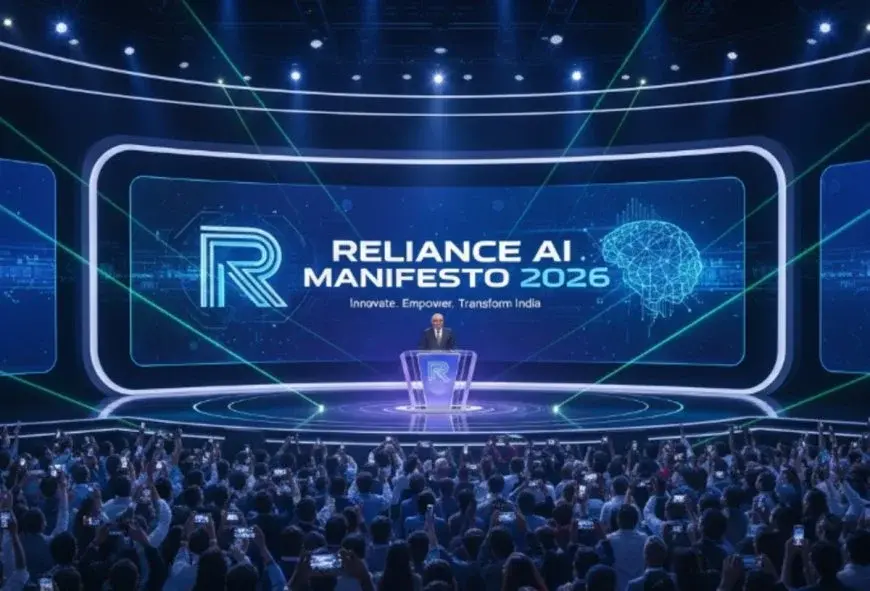
Reliance Industries Chairman Mukesh Ambani has unveiled a draft Reliance AI Manifesto, laying out a sweeping plan to reposition the conglomerate as an AI-native deep-tech enterprise while aiming for a tenfold boost in productivity across its workforce of over six lakh employees. The initiative also targets a 10x impact on India’s economy and society. Describing artificial intelligence as “the most consequential technological development in human history,” Ambani said Reliance intends to spearhead India’s AI journey, much as it played a central role in the country’s digital transformation. The group’s stated mission is to deliver “Affordable AI for every Indian”, embedding AI across businesses while ensuring safety, trust and accountability. According to Ambani, the manifesto is not a slogan but a practical action guide. “At Reliance, we are transforming ourselves into an AI-native deep-tech company with advanced manufacturing capabilities,” he said, adding that the draft manifesto will steer this transformation. Internal transformation through AI Part I of the manifesto focuses on reshaping Reliance’s internal operations. AI is positioned not as a standalone technology initiative but as a fundamentally new way of working. The group plans to reorganise around outcomes and end-to-end workflows, supported by shared digital platforms and robust governance frameworks. AI and agentic automation will be deployed to reduce repetitive tasks, enhance decision-making, and improve speed and quality, while maintaining clear human accountability. Execution will be driven by small, cross-functional teams or “pods” with defined ownership and measurable goals, supported by continuous data, learning, operations and automation systems. Core workflows such as procure-to-pay, order-to-cash, hire-to-retire and plant-to-port will be redesigned to eliminate manual handoffs, close digital gaps and enable real-time visibility. Ambani stressed that AI will augment human capability rather than replace jobs, saying the focus is on raising standards and unlocking collective potential. A common 12-layer Digital Functional Core (DFC) will standardise data, integration, security and controls across Reliance businesses, while allowing individual units autonomy over their platforms. Governance, audit trails and human-in-the-loop mechanisms will be embedded to balance speed with safety, compliance and trust. Driving India’s AI-led growth Part II extends the vision beyond Reliance, positioning the group as a catalyst for India’s broader AI transformation. Ambani said that just as AI can deliver a 10x improvement in efficiency and outcomes within Reliance, it can also generate a similar multiplier effect for the country through the group’s businesses and philanthropic efforts. Employees have been invited to submit ideas on AI applications across Reliance’s diverse portfolio—from Jio’s 500-million-plus subscribers and the country’s largest retail network to energy, materials, life sciences, financial services, media and philanthropy. Ambani also pointed to opportunities in indigenous AI hardware, robotics and cross-sector innovation to boost efficiency, sustainability and technological self-reliance. Ideas can be submitted between January 10 and 26, after which the manifesto is expected to evolve into a shared organisational commitment. “Let us begin—together,” Ambani said, calling on employees to help build “a New Reliance and a New India.” Source: PTI