ArdorComm Media Group

Saturday, November 14, 2026 3:14 PM

Remote Work

Will the Office Become Optional? The Future of Work After Hybrid Work
For a while, it looked as though the traditional office was heading towards extinction. The pandemic proved that millions of people could work from kitchen tables, spare bedrooms and home offices without bringing businesses to a halt. Video calls replaced meeting rooms, collaboration platforms replaced physical desks, and “work from home” went from an occasional benefit to a defining feature of working life. But the office did not disappear. Instead, the workplace is going through something more complicated: a negotiation between what organisations need and what employees have come to expect. In 2026, the question is no longer simply whether people should work from home or from the office. The more important question is what the office is actually for. The office is back—but the old office may not be Across India and globally, companies have increasingly established structured office-attendance policies. JLL’s 2025 research found that 66% of global office workers said their organisations had clear expectations around the number of days they should work on-site. In Asia-Pacific, about seven in 10 employees were subject to some form of return-to-office requirement. India has been particularly notable in this shift. JLL reported in 2025 that 90% of organisations in India required employees to spend at least three days a week in the office, while more than half expected in-office days to increase by 2030. Yet this does not necessarily mean employees have rejected flexibility. A 2025 Pew Research Center study in the US found that 72% of hybrid workers would choose to remain hybrid if given the choice, rather than work entirely from home or entirely from the office. That distinction matters. Employees are not necessarily asking for the office to disappear. They are asking for a reason to be there. From attendance to purpose For years, office attendance was largely treated as a measure of commitment. Being physically present meant being available, visible and involved. Hybrid work has challenged that assumption. An employee can now spend eight hours in an office and accomplish less than someone working from home with fewer interruptions. Conversely, there are conversations, creative exchanges and informal interactions that are difficult to reproduce completely through a screen. The challenge for HR is therefore not to determine which environment is universally more productive. It is to understand which type of work benefits from which environment. An individual preparing a report may need uninterrupted concentration. A newly joined employee may need face-to-face guidance. A creative team brainstorming a campaign may benefit from being together. A manager conducting a sensitive conversation may prefer a private physical setting. A global team may have no choice but to collaborate virtually. The future workplace will increasingly be organised around these differences. The office needs to earn the commute Perhaps the biggest change in employee expectations is that the office can no longer assume that people will come simply because they are told to. If an employee spends two hours commuting to sit through virtual meetings all day, the question naturally arises: Why did I come to the office? This is where the physical workplace has to become more intentional. Research published in the Journal of Environmental Psychology in 2025 found that employees’ office preferences are influenced by whether they have autonomy over where they work. Social and event-oriented spaces become particularly important on flexible workdays, while functional spaces matter more when office attendance is required. Another 2025 study found that commuting time and the type of people employees expect to encounter in the workplace are among the most influential factors in choosing between home and office. Social spaces, technology and functional facilities can make the office more attractive. In other words, companies need to stop thinking of the office simply as a collection of desks. The future office could be a place for collaboration, mentoring, learning, relationship-building, problem-solving and culture. The desk may become one of its least important features. The Gen Z question Younger employees are likely to make this debate even more interesting. For someone beginning a career, an office can offer experiences that are difficult to obtain remotely: observing senior colleagues, building informal networks, learning how meetings work, developing confidence and forming professional relationships. But younger workers have also entered the workforce after seeing that flexibility is possible. They may not accept the argument that “this is how work has always been done” as sufficient justification for returning to the office. For HR leaders, this creates an important balancing act. Too little physical interaction could weaken mentoring and belonging. Too much mandatory attendance could make organisations less attractive to talent that values autonomy. The answer may lie somewhere between the two. Hybrid work is becoming more sophisticated The first version of hybrid work was relatively simple: three days in the office, two days at home. That model may not be enough for the next stage. A better approach is likely to be purpose-led hybrid work. Instead of saying: “Everyone must be in the office on Monday, Tuesday and Thursday,” organisations could ask: “What work needs to happen together this week?” That might mean bringing teams together for strategy meetings, innovation sessions, training, client discussions or team-building, while allowing employees to work remotely when deep individual work is the priority. This requires better planning—and considerably better managers. The manager becomes more important than the policy One of the biggest lessons from hybrid work is that workplace flexibility cannot compensate for poor management. A flexible workplace with a controlling manager can still feel restrictive. A physical workplace with an empowering manager can feel collaborative and energising. Recent research has also highlighted the importance of alignment between company workplace strategies and employee preferences. A 2026 study found that employees had become clearer about whether they preferred office-based, remote or hybrid arrangements, while successful alignment increasingly depended on shared values such as flexibility, community and balance. This means HR cannot simply create a policy and expect the policy to solve the problem. Managers need to learn how to measure outcomes rather than visibility,

Will the Office Become Optional? The Future of Work After Hybrid Work Read More »
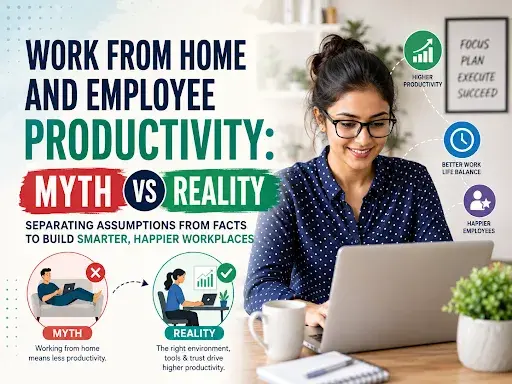
Work From Home and Employee Productivity: Myth vs Reality

The debate around work from home (WFH) has transformed from a temporary pandemic response into one of the most important workplace discussions of the modern era. For HR leaders, business owners, and employees alike, one question continues to dominate conversations: Does working from home truly improve productivity, or is it just a convenient trend? The answer is neither a simple yes nor no. Productivity in a remote environment depends on multiple factors—company culture, leadership, technology, employee mindset, and the nature of the job itself. While critics often assume that home-based employees are distracted or less committed, growing evidence suggests that remote work can significantly enhance performance when managed effectively. This blog explores the myths and realities surrounding work from home and employee productivity, helping organizations understand what truly drives success in the remote era. The Biggest Myth: Employees Work Less at Home One of the most common misconceptions is that employees spend less time working when they are at home. The image of someone answering emails from the couch while watching television has long shaped public opinion. However, reality paints a different picture. Many studies and workplace surveys have shown that remote employees often work equal or longer hours than office-based workers. Without commuting time, employees gain additional hours that can be redirected into focused work, rest, or personal wellbeing. In many cases, people start earlier, take shorter breaks, and feel more accountable for results. The shift from measuring “hours present” to measuring “output delivered” has revealed an important truth: being seen at a desk does not always equal being productive. Reality: Productivity Depends on Environment, Not Location Productivity is less about where people work and more about how they work. An employee sitting in a noisy office filled with interruptions may accomplish less than someone working quietly from home. On the other hand, an employee in a chaotic home environment may struggle more than they would in a structured office setting. This means work from home is not automatically productive—but neither is office work. The real drivers of productivity include: Clear goals and expectations Access to the right tools and technology Strong communication systems Autonomy and trust A distraction-free workspace Mental wellbeing and work-life balance When these conditions are present, remote employees often thrive. Myth: Collaboration Suffers Outside the Office Another common belief is that teamwork collapses when employees are not physically together. While spontaneous hallway conversations may reduce, modern collaboration tools have changed how teams interact. Video meetings, instant messaging, shared documents, project management platforms, and cloud-based systems now enable real-time coordination from anywhere. In fact, many teams report that remote communication becomes more intentional and efficient. Meetings are shorter, agendas are clearer, and updates are documented instead of lost in casual conversation. The key challenge is not collaboration itself—it is poor communication habits. Reality: Employees Value Flexibility, and That Boosts Performance Flexibility is one of the strongest benefits of remote work. When employees have greater control over their schedules, they often manage energy and time more effectively. Some perform best early in the morning, while others are more productive later in the day. Work from home can allow employees to align tasks with their natural productivity cycles. Additionally, flexibility helps employees manage family responsibilities, health needs, and personal commitments—reducing stress and improving engagement. A less stressed employee is usually a more focused and productive employee. Myth: Managers Lose Control in Remote Work Traditional management models often relied on visibility: seeing employees at desks, observing activity, and measuring attendance. Remote work challenges this mindset. Some leaders interpret the lack of physical presence as a loss of control. But effective leadership has never truly been about surveillance—it has always been about results, coaching, and trust. Remote work pushes managers to become better leaders by focusing on: Goal setting Performance outcomes Frequent feedback Team motivation Relationship building This shift can strengthen management quality across the organization. Reality: Burnout Can Increase If Boundaries Are Missing While remote work has many benefits, it also carries risks. Without clear boundaries, employees may find it difficult to disconnect. Workdays can extend into evenings, and constant online availability can create exhaustion. Productivity may initially rise, but long-term burnout can reduce performance dramatically. This is where HR plays a critical role. Organizations must promote healthy remote practices such as: Defined working hours Mandatory breaks Wellness support Encouraging time off Respecting non-working time Realistic workloads Sustainable productivity matters more than short bursts of overwork. What HR Leaders Should Focus On For HR professionals, the goal should not be choosing between office or home. The goal should be designing a work model that supports both business outcomes and employee wellbeing. Key HR priorities include: 1. Performance Based Evaluation Measure employees on deliverables, quality, and impact—not desk time. 2. Strong Digital Infrastructure Provide reliable tools for collaboration, communication, and cybersecurity. 3. Employee Engagement Create virtual culture through recognition, learning programs, and social connection. 4. Manager Training Teach leaders how to manage remote and hybrid teams effectively. 5. Flexible Policies Allow different teams to operate in ways that suit their roles and responsibilities. The Future Is Hybrid, Not Extreme The most successful organizations are moving beyond all-or-nothing thinking. Instead of insisting everyone return to office full-time or remain fully remote, many are adopting hybrid models. This combines the best of both worlds: Remote focus time In-person collaboration Greater flexibility Improved employee satisfaction Stronger talent attraction and retention Productivity in the future will come from choice, trust, and smart systems. Final Verdict: Myth vs Reality So, does work from home hurt productivity? Myth: Remote employees are lazy, distracted, and less productive. Reality: Remote employees can be highly productive when supported by the right culture, leadership, and tools. The real productivity challenge is not location—it is outdated management practices, unclear expectations, and lack of trust. For HR leaders, work from home is not simply a policy issue. It is an opportunity to redesign work for the modern workforce. Because in the end, productive employees do not need to be watched—they need

Work From Home and Employee Productivity: Myth vs Reality Read More »

Infosys limits WFH exemptions to five days per quarter, aligning with stricter policies at TCS and Wipro

Infosys has further tightened its work-from-home (WFH) framework, placing a cap on exemptions from working at the office (WFO) at five days per quarter, except in cases involving serious medical conditions of employees or their dependents. Any request beyond this limit will require valid medical documentation, including a doctor’s verification. Currently, employees at job level 5 and below are mandated to work from the office for at least 10 days every month. The new restriction specifically applies to requests seeking additional WFH days beyond this requirement. Managers have informed teams that there has been a sharp rise in last-minute WFH requests, prompting the company to enforce stricter planning and system-based pre-approvals rather than informal email requests. Managers have also clarified that requests not aligned with policy leave them with little flexibility. While Infosys has not officially commented, people familiar with the matter said that the company continues to allow up to 30 additional remote working days in cases of critical medical emergencies. The move is notable as Infosys leadership had recently stated that no changes were planned to its hybrid working approach. CEO Salil Parekh, during a post-earnings interaction earlier this month, had emphasised flexibility in how employees engage with the company and its clients. Infosys, which employs over 300,000 people, introduced its return-to-office policy in November 2023, requiring a minimum of 10 in-office days per month, though strict enforcement began in March last year. Employees must also spend at least three hours per day in the office. The tightening of norms mirrors similar steps by peers. Wipro has revised its policy effective January 1, requiring employees to work from the office three days a week for at least six hours daily, while cutting allowable remote days to 12 from 15 earlier. Meanwhile, TCS implemented a five-day office workweek last year and linked variable pay to office attendance, allowing limited WFH only for health-related reasons. Industry observers say these measures reflect the IT sector’s push for greater in-person collaboration amid shorter project cycles and slowing revenue growth, especially as AI-driven automation reduces dependence on large, people-intensive delivery models. Staffing experts suggest that 2026 could see more firms moving towards full-time office attendance, at least on designated workdays, to maintain agility and team coordination. Source: Economic Times

Infosys limits WFH exemptions to five days per quarter, aligning with stricter policies at TCS and Wipro Read More »

Microsoft to enforce three-day office work policy from 2026

ardorcomm news

Microsoft has announced that starting next year, employees will be required to work from office at least three days a week, marking a significant shift in its post-pandemic work policy. In a blog post on Tuesday, Amy Coleman, Microsoft’s Chief People Officer, detailed that the new hybrid work mandate will be introduced in three phases. The rollout will begin with staff based near the company’s Redmond, Washington headquarters, before extending to other U.S. locations and international offices. By February 2026, employees residing within 50 miles of the Redmond campus will need to be onsite for a minimum of three days each week. Timelines for other U.S. offices will follow, while planning for international employees is expected to commence next year. The move aligns Microsoft with other major tech companies, including Amazon, that are scaling back remote work flexibility and urging employees to return to office spaces. The pandemic had initially accelerated the widespread adoption of work-from-home policies across the industry, but firms are now reassessing their long-term workplace strategies. Source: Reuters  

Microsoft to enforce three-day office work policy from 2026 Read More »

Microsoft to Mandate Office Attendance 3 Days a Week Starting 2026

Microsoft is preparing to roll out a new return-to-office (RTO) policy that will require employees to spend at least three days a week in the office beginning January 2026. The mandate applies to staff living within 50 miles of its Redmond, Washington, headquarters, home to the bulk of its 228,000-strong global workforce. Depending on team structures and leadership decisions, some groups may face even stricter requirements—four or five days in person each week, according to Business Insider. The company is expected to formally announce the changes in September 2025, giving employees a few months to prepare. While Microsoft will allow applications for exceptions, the criteria and approval process remain unclear. This shift marks a departure from the company’s pandemic-era hybrid model, where employees could work remotely for up to half their time without managerial approval. In practice, many had been working from home far more frequently. The move aligns Microsoft with other tech majors that have rolled back remote flexibility. Amazon now demands five full days in the office, while Google and Meta enforce three. The timing, however, has sparked criticism: morale at Microsoft is reportedly at historic lows after about 15,000 layoffs this year, despite the company posting a staggering $27 billion in quarterly profits, as noted by The Verge. Some employees and analysts view the policy as a “stealth layoff strategy”—designed to push workers to resign voluntarily rather than undergo formal job cuts. Those unwilling to adjust to the new attendance rules may opt to leave, sources told Business Insider. Adding to the controversy, Microsoft continues to market its remote collaboration tools like Teams and Office 365 as productivity boosters, even as it moves away from flexible work for its own staff. Practical hurdles also loom large. Reports suggest the company’s offices face space shortages, limited power supply, and insufficient meeting rooms, despite a $5 billion campus expansion project. For now, the new mandate highlights the growing tension between employee preferences for hybrid work and tech giants’ renewed push for office-centric culture. Source: Economic Times Photo Credit: iStock  

Microsoft to Mandate Office Attendance 3 Days a Week Starting 2026 Read More »

Google Introduces Voluntary Buyouts Amid Ongoing Cost-Cutting Measures

Ardorcomm news

In its continued efforts to streamline operations, Google has initiated a new round of voluntary buyouts for employees across multiple departments, including search, advertising, research, and engineering, according to both company sources and media reports. Although the exact number of employees affected remains undisclosed, this move marks an expansion of a voluntary exit program that was previously rolled out to certain U.S.-based teams earlier this year. Google spokesperson Courtenay Mencini confirmed that additional teams have now joined the initiative, which includes severance packages aimed at supporting the company’s strategic priorities going forward. In a related development, the tech giant is also encouraging remote employees living near Google offices to transition to a hybrid work model. “This is part of our ongoing effort to foster more in-person collaboration,” Mencini noted. The latest restructuring step follows Google’s larger workforce reduction in 2023, when the company laid off approximately 12,000 employees in response to declining demand for online services post-pandemic. Source: Associated Press  

Google Introduces Voluntary Buyouts Amid Ongoing Cost-Cutting Measures Read More »

Ajman Crown Prince Orders Remote Work for Government Employees Due to Weather Fluctuations

News on Government

Sheikh Ammar bin Humaid Al Nuaimi, Crown Prince of Ajman and Chairman of the Executive Council, has instructed that Tuesday, April 16, 2024, will be designated as a remote working day for employees of the Ajman government. This decision comes in response to weather fluctuations affecting the region. The directive encompasses employees across all government departments in the Emirate of Ajman, with exceptions made for roles that necessitate on-site attendance as determined by the respective authorities within each department. The move underscores the government’s commitment to ensuring the safety and well-being of its employees amid changing weather conditions. By enabling remote work, the Ajman government aims to mitigate potential disruptions while maintaining operational continuity. This proactive measure reflects the leadership’s responsiveness to evolving circumstances and its dedication to promoting a flexible work environment that prioritizes employee welfare.

Ajman Crown Prince Orders Remote Work for Government Employees Due to Weather Fluctuations Read More »