ArdorComm Media Group

Wednesday, November 25, 2026 4:44 AM

S Krishnan

India Has Nearly 20% of Global Semiconductor Design Workforce: IT Secretary

India now accounts for nearly one-fifth of the global semiconductor design workforce, reflecting the country’s growing role in the international chip ecosystem, IT Secretary S. Krishnan said on Saturday. Speaking to IANS on the sidelines of SEMICON India 2026, Krishnan said the government is placing strong emphasis on developing semiconductor talent and is currently implementing a programme aimed at training around 85,000 design engineers. He said skill development would remain a priority across the semiconductor value chain, with particular attention being given to manufacturing. According to Krishnan, India already has a substantial pool of skilled professionals in chip design, providing an important foundation for further growth in the sector. On investments and proposals presented at SEMICON India, Krishnan said the government would assess each proposal carefully before approving incentives, given the significant use of public funds. He noted that several major Indian and multinational companies are showing interest in investing in India’s semiconductor sector. The IT Secretary attributed this growing investor interest to confidence in India’s talent pool as well as the stability and support provided by government policies. He said the government would encourage companies seeking to establish or expand their semiconductor operations in the country and work closely with them. Meanwhile, SEMI India-IESA President Ashok Chandak said SEMICON India 2026 attracted 12,000 visitors on its opening day and 16,000 on the second day, with participation continuing to grow. Chandak highlighted significant interest from students and early-career engineers, saying the participation reflected a growing desire among young people to understand the semiconductor industry and explore opportunities in the sector. The event has also witnessed participation from several Asian countries, including Japan, South Korea, Taiwan, Singapore and Malaysia, along with visitors from the Philippines, Vietnam and Thailand. Chandak said the participation demonstrated interest among companies and industry stakeholders from these countries in collaborating with their Indian counterparts. Source: IANS

India Has Nearly 20% of Global Semiconductor Design Workforce: IT Secretary Read More »
Eros Innovation Launches Cultural AI Platform Across 34 Languages

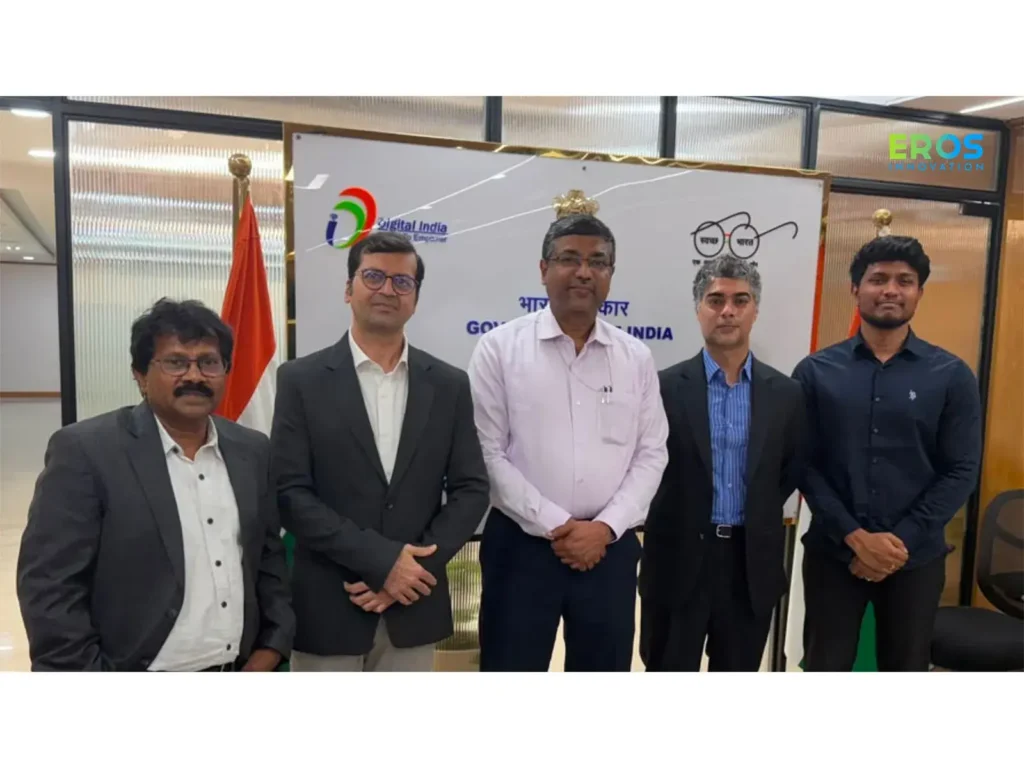
Eros Innovation has officially unveiled its Cultural AI Platform, introducing what it describes as the world’s first artificial intelligence ecosystem built to understand, preserve, and express culture across languages and digital experiences. Initially showcased at the IndiaAI Impact Summit in February 2026, the platform is now live in 34 global languages. At its core are two proprietary technologies—Eros LCVM (Large Cultural Voice Model) and Eros Persona AI—which together form the foundation of a new category the company calls “Cultural AI.” Unlike traditional AI models that primarily focus on language processing and content generation, the Cultural AI Platform is designed to capture cultural context, emotional expression, identity, and performance nuances. Eros says its LCVM technology can generate performances lasting up to five minutes while maintaining voice consistency, accurate lip-syncing, emotional depth, and cultural authenticity across multiple languages. The platform is powered by a rights-cleared dataset comprising more than 11,000 films and over 100,000 characters. It integrates multilingual voice generation, music creation, storytelling, character performance, and persistent digital identities within a unified AI architecture. Accessible through the Eros Universe Super App, the ecosystem enables creators to build, animate, and engage with culturally intelligent digital personas. The platform consists of five interconnected layers: Eros LCM for cultural intelligence and storytelling, Eros LCVM for voice, music, and performance generation, Eros Persona AI for persistent digital identities, Eros Creator for enterprise and creator tools, and Eros Universe as the consumer-facing distribution platform. The company emphasized that all AI-generated Personas are fictional identities and are not intended to replicate or represent real-world actors, performers, or public figures. Commenting on the launch, Ridhima Lulla, Co-Founder and Co-President of Eros Innovation, said the platform is the result of years of research focused on building AI systems capable of understanding culture rather than merely processing language. Founder and Chairman Kishore Lulla described LCVM as a significant step toward advancing India’s sovereign AI vision, calling it the voice layer that enables cultural intelligence to be experienced across 34 languages. The platform was formally launched by S. Krishnan, Secretary, Ministry of Electronics and Information Technology (MeitY), who highlighted the importance of developing AI technologies that preserve linguistic diversity, cultural heritage, and creative traditions as India strengthens its sovereign AI capabilities. Source: ANI

Eros Innovation Launches Cultural AI Platform Across 34 Languages Read More »

India Introduces AI Governance Guidelines to Ensure Safe and Responsible Adoption

The Indian government has unveiled its first set of Artificial Intelligence (AI) governance guidelines, outlining a framework for the safe, transparent, and ethical use of AI technologies. The non-binding rules, released on Wednesday, are expected to shape India’s long-term vision for AI regulation ahead of the IndiaAI Impact Summit scheduled for February next year. Developed under the Ministry of Electronics and Information Technology (MeitY), the guidelines recommend potential amendments to the Information Technology (IT) Act to better classify AI systems and define liability across the AI value chain. The document highlights that the current definition of “intermediary” under the IT Act — covering telecom operators, search engines, and even cyber cafés — is outdated in the context of autonomous AI systems capable of generating data independently. Principal Scientific Adviser Ajay Sood noted that the new framework aims to provide clarity on responsibilities of AI developers and deployers, while also ensuring accountability. He added that the framework could serve as a model for AI governance in the Global South, especially for countries with limited regulatory resources. The guidelines also propose an India-specific AI risk assessment framework based on real-world harm evidence, along with a national database of AI incidents to track misuse, bias, and potential threats. This centralised repository will collect data from smaller regional databases managed by sectoral regulators, helping policymakers better understand the societal and security implications of AI technologies. The framework further recommends establishing new institutions to oversee AI policy, including an AI Governance Group—a permanent inter-ministerial body responsible for coordination and policy development—and leveraging the newly formed AI Safety Institute as the lead authority for ensuring safe and trusted AI use in India. Other key proposals include adopting regulatory sandboxes to allow innovation in controlled environments with limited legal exposure, and mandating accessible grievance redressal mechanisms through the existing Grievance Appellate Committee process. The guidelines also stress the need to update copyright laws to support large-scale AI model training and clarify digital platform classifications. MeitY Secretary S. Krishnan said the government is committed to acting when necessary to ensure AI is developed responsibly and ethically. The document, shaped after studying AI policies in the US, European Union, and China, and informed by over 2,500 submissions from stakeholders including academia, industry, and government bodies, marks a significant step in India’s effort to build a robust governance ecosystem for emerging technologies. Source: Economic Times

India Introduces AI Governance Guidelines to Ensure Safe and Responsible Adoption Read More »

Online Gaming Bill 2025 introduced in Lok Sabha: Blanket ban on money games sparks debate

Union IT Minister Ashwini Vaishnaw on Wednesday introduced The Promotion and Regulation of Online Gaming Bill, 2025 in the Lok Sabha, even as opposition members voiced protests. The Bill, cleared by the Union Cabinet a day earlier, proposes a complete ban on online games involving monetary stakes, citing growing concerns of addiction, financial distress, and suicides among youth. Soon after the Bill was tabled, proceedings were adjourned until 2 PM. MeitY clarifies intent Explaining the move, IT Secretary S. Krishnan said the Bill addresses two key issues — recognising the scope of the online gaming industry while also curbing harmful real-money games. He emphasised that this is a “societal decision,” noting that the government had weighed concerns of job losses but prioritised public well-being. He added that a regulatory authority will be established to classify permissible and banned games. eSports and social games, including subscription-based formats without monetary rewards, will remain legal. What the Bill proposes Under the draft law: Offering online money games could attract up to three years in jail or fines up to ₹1 crore. Advertising such services could lead to two years in jail or fines up to ₹50 lakh. Banks and financial institutions enabling transactions for money games may also face penalties. Repeat offenders risk harsher sentences — three to five years in jail and higher fines. Importantly, the Bill does not criminalise players, treating them as victims rather than offenders. The legislation defines an “online money game” as any game where players pay fees, deposit money, or stake assets with the expectation of monetary returns — irrespective of whether it is skill-based or chance-based. It aims to curb gambling risks, financial exploitation, money laundering, and mental health crises while fostering a safe space for eSports and game development in India. Industry backlash Industry groups, including the All India Gaming Federation (AIGF), E-Gaming Federation (EGF), and the Federation of India Fantasy Sports (FIFS), have warned of severe fallout. In a letter to Home Minister Amit Shah, they claimed the blanket ban could wipe out over 2 lakh jobs, force the shutdown of more than 400 companies, and push users toward unregulated and illegal platforms. They highlighted that online skill gaming has become a ₹2 lakh crore industry, generating ₹31,000 crore in revenue and contributing ₹20,000 crore in taxes annually. The sector, growing at 20% CAGR, was projected to double by 2028, with India’s gamer base already exceeding 50 crore players by 2024. Industry voices fear that the ban could derail India’s progress as a digital innovator, discourage foreign investment, and trigger large-scale unemployment. Public health perspective Supporters of the Bill, however, argue it is a much-needed safeguard. “This is more than regulation — it is protection,” said Preetha Reddy, Vice Chairperson of Apollo Hospitals. “Online money games have exposed children and youth to exploitation and mental health risks. This step puts wellbeing first.” Source: Economic Times  

Online Gaming Bill 2025 introduced in Lok Sabha: Blanket ban on money games sparks debate Read More »