


ArdorComm Media Group

Friday, October 9, 2026 7:01 PM

Shubhanshu Shukla

From bicycles to the Moon: NCERT brings India’s space journey into classrooms
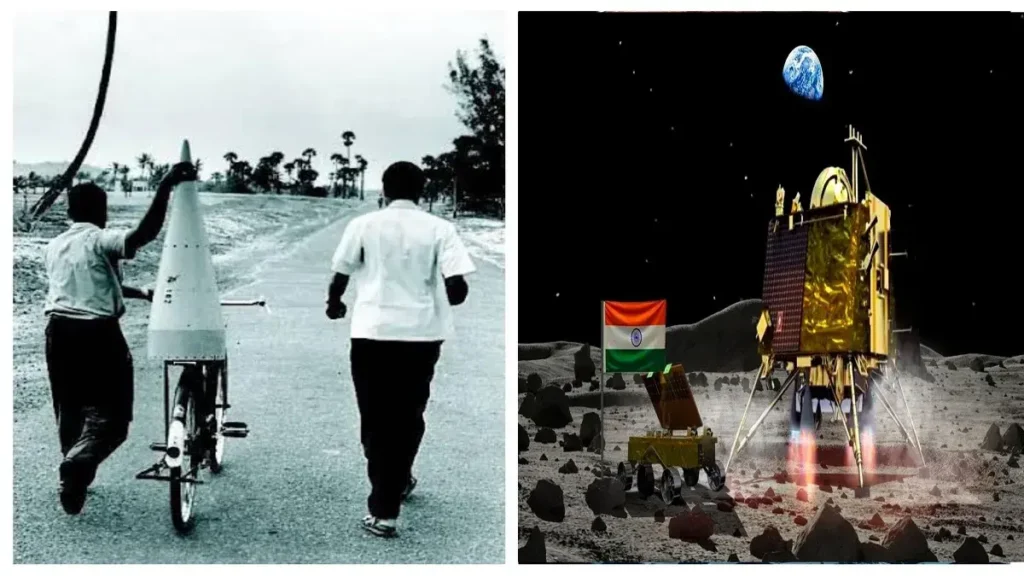
India’s space story — from humble beginnings of carrying rocket parts on bicycles and bullock carts to achieving landmark missions like Chandrayaan, Mangalyaan, and the upcoming Gaganyaan — has now been woven into NCERT’s new learning modules. The special set of two modules, titled “India: A Rising Space Power”, traces the evolution of the Indian space programme. It begins with the creation of the Indian National Committee for Space Research (INCOSPAR) in 1962 under Dr. Vikram Sarabhai, which later transformed into the Indian Space Research Organisation (ISRO), now counted among the world’s top space agencies. One of the modules highlights how India’s first rocket was so lightweight that its parts were transported using bicycles and bullock carts. Scientists avoided motorised vehicles since their electric and magnetic fields could interfere with delicate instruments, proving that simple means ensured success. The modules also honour India’s astronauts — Squadron Leader Rakesh Sharma, who became the first Indian in space in 1984, and Group Captain Shubhanshu Shukla, who in June 2025 became the first Indian to live aboard the International Space Station. They feature a quote from Prime Minister Narendra Modi: “Space may seem distant, but is an integral part of our daily life… India’s space programme is a perfect example of our vision of Scale, Speed and Skill.” Key milestones listed include: Chandrayaan-1 (2008): Discovered water molecules on the Moon. Mangalyaan (2013): Made India the first Asian nation to reach Mars, and the only country to succeed on its maiden attempt. Chandrayaan-2 (2019): Though its lander was lost, the orbiter continues to provide valuable lunar data. Aditya-L1 (2023): India’s first solar observatory at Lagrange Point-1, dedicated to studying the Sun and solar storms. Looking ahead, the modules also highlight the NASA-ISRO NISAR satellite, expected to deliver high-resolution global data every 12 days on ecosystems, glaciers, and natural disasters. Source: PTI

From bicycles to the Moon: NCERT brings India’s space journey into classrooms Read More »
Shubhanshu Shukla Becomes Second Indian in Space, 41 Years After Rakesh Sharma

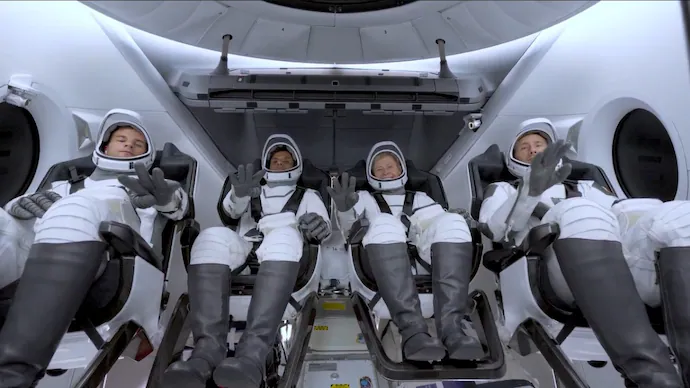
India has once again etched its name into the stars. Group Captain Shubhanshu Shukla of the Indian Air Force launched into space, becoming only the second Indian to do so — and the first to reach the International Space Station (ISS). His milestone flight comes 41 years after the legendary Rakesh Sharma’s 1984 mission aboard the Soviet Soyuz T-11. Launched from NASA’s Kennedy Space Center in Florida aboard SpaceX’s Dragon spacecraft, Shukla joins the Ax-4 mission of Axiom Space, marking a new era in India’s space journey. The crew, a mix of global astronauts, will live and work aboard the ISS for 14 days, conducting crucial scientific experiments. A Launch Worth the Wait The road to space was anything but smooth. Originally set for May 29, the launch faced seven delays due to technical issues, weather concerns, and complications aboard the ISS. SpaceX, NASA, ISRO, and Axiom Space worked tirelessly to resolve these, all while the crew remained quarantined and mission-critical biological samples were replenished. Despite the setbacks, the launch was a flawless spectacle. The Falcon-9 rocket’s engines thundered into life, lifting the Dragon capsule toward Low Earth Orbit. The first stage of the rocket returned to Earth successfully, while the second stage propelled Dragon into its planned path to the ISS. An Astronaut with a Purpose Shukla, born in 1985 — a year after Sharma’s flight — has long dreamed of reaching space. A decorated test pilot with experience flying aircraft like the MiG-21, Sukhoi-30 MKI, and Dornier, he now serves as the mission pilot. Although the Dragon is designed for autonomous docking, Shukla is responsible for monitoring flight systems and standing by for manual intervention if needed. His family watched the liftoff with pride from the viewing gallery, marking a moment not only of personal achievement but of national significance. International Crew, Shared Vision The Ax-4 crew reflects a spirit of global collaboration. Commanding the mission is Dr. Peggy Whitson — a legendary American astronaut and the most experienced spacefarer from the U.S., with over 675 days in orbit. Joining her are Poland’s Sawosz Uznanski, a CERN physicist and engineer representing the European Space Agency, and Hungary’s Tibor Kapu, a polymer technology expert involved in the HUNOR space program. Science in Orbit During the mission, Shukla will conduct seven India-designed experiments. These range from growing traditional Indian crops like moong and methi in microgravity to studying the behavior of microbes, muscle degeneration, the effects of prolonged screen exposure on mental health, and cellular ageing. One experiment will even explore algae as a sustainable space food source. The findings aim to inform future deep-space missions to the Moon and Mars. He will also connect with Indian students from orbit, inspiring the next generation of scientists and dreamers. Strategic Leap for Gaganyaan Shukla’s role in the Ax-4 mission is also a dress rehearsal for India’s upcoming Gaganyaan human spaceflight program, in which he is one of the four shortlisted astronauts. The operational knowledge — from international collaboration and pre-launch protocols to microgravity adaptation and scientific procedures — will feed directly into Gaganyaan’s readiness. This mission is not just about scientific progress; it strengthens India’s growing capabilities in human spaceflight, setting the stage for self-reliant space exploration. As Shubhanshu Shukla orbits Earth, he carries not only instruments and experiments — but the collective hopes of 1.4 billion Indians. His voyage is a testament to India’s rising stature in global space exploration and a symbol that the stars are indeed within reach. Source: India Today Photo Credit: SpaceX

Shubhanshu Shukla Becomes Second Indian in Space, 41 Years After Rakesh Sharma Read More »