





India–EU Trade Pact Opens Doors for Exports, Services and Talent Mobility
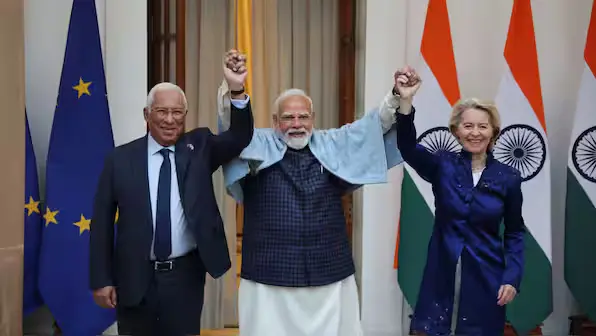
India and the European Union have formally concluded what is being described as the world’s largest trade agreement, significantly cutting tariffs and widening market access on both sides, while ring-fencing three politically and economically sensitive sectors — automobiles, steel and agriculture. Under the Free Trade Agreement (FTA), the EU will eliminate duties on 90% of Indian exports at the outset, with coverage expanding to 93% within seven years. Around 6% of goods will see partial tariff reductions or quota-based access, while nearly the entire bilateral trade basket — 99.5% — will benefit from some form of tariff concession. For India, the immediate gains are strongest in labour-intensive industries. Sectors such as marine products, chemicals, plastics and rubber, leather and footwear, textiles and apparel, base metals, gems and jewellery will enjoy zero-duty access to the European market, sharply boosting competitiveness. As a result, the EU’s average tariff on Indian goods will fall dramatically from 3.8% to just 0.1%. At the same time, both sides have taken a cautious approach to sensitive areas. In automobiles, EU cars priced below €15,000 are fully excluded from tariff concessions. Higher-end vehicles are divided into three categories, each subject to quotas and differentiated tariff reductions. Import duties on most cars will be lowered gradually from 30–35% to 10% over five years. Electric vehicle tariff reductions will begin only from the fifth year, and no concessions apply beyond quotas or to completely knocked-down (CKD) kits. Steel has been kept outside full tariff elimination, reflecting strategic and employment concerns. India, however, is pushing for better access to the EU’s duty-free steel import quotas, with discussions expected to conclude by June 30. On climate-linked trade measures, India has not secured an exemption from the EU’s carbon border duties. Instead, it will join a technical working group to verify carbon footprints and receive EU assistance to support emissions reduction efforts. Agriculture has also been carefully balanced. India has shielded key products such as dairy, cereals, poultry, soymeal, and select fruits and vegetables. At the same time, Indian exports of tea, coffee, spices, fresh produce and processed foods will gain improved access to European markets. On the import side, India will lower tariffs on EU agri-food products including wines, spirits, beer, olive oil and processed foods. Duties on premium wines, for instance, will drop from 150% to as low as 20%, while EU food safety standards will remain unchanged. Beyond goods, the agreement includes wide-ranging provisions on services, sustainability and digital trade. India will gain access to 144 EU services subsectors, while opening 102 of its own to European firms. These include IT, financial services, maritime trade, professional services and education. Binding commitments have been included on labour rights, environmental protection, women’s empowerment and climate cooperation. Digital trade rules aim to facilitate business while safeguarding privacy, security and public policy interests. The pact also lays the groundwork for enhanced business mobility, student exchanges, post-study work opportunities, social security coordination, and recognition of Indian traditional medicine practitioners in select EU countries. In exchange, India will reduce tariffs to zero on 93% of EU goods by trade value over a ten-year period. Overall, the EU will liberalise 96.8% of its tariff lines, while India will open 92.1%, making this one of India’s most comprehensive trade agreements with a developed economy. Alongside the FTA, both sides signed multiple agreements and memoranda covering security and defence cooperation, mobility, green hydrogen, disaster risk management and financial regulation. A joint roadmap titled “Towards 2030 – A Joint India–European Union Comprehensive Strategic Agenda” was also adopted, setting out collaboration priorities for the next decade. The political declaration concluding the FTA negotiations was signed by Commerce Minister Piyush Goyal and EU Trade Commissioner Maroš Šefčovič. The India–EU Security and Defence Partnership was signed by EU Vice President Kaja Kallas and External Affairs Minister S. Jaishankar, while a comprehensive mobility framework was inked by Šefčovič and Jaishankar. Source: Economic
India–EU Trade Pact Opens Doors for Exports, Services and Talent Mobility Read More »
