





ArdorComm Media News Network
October 29, 2026
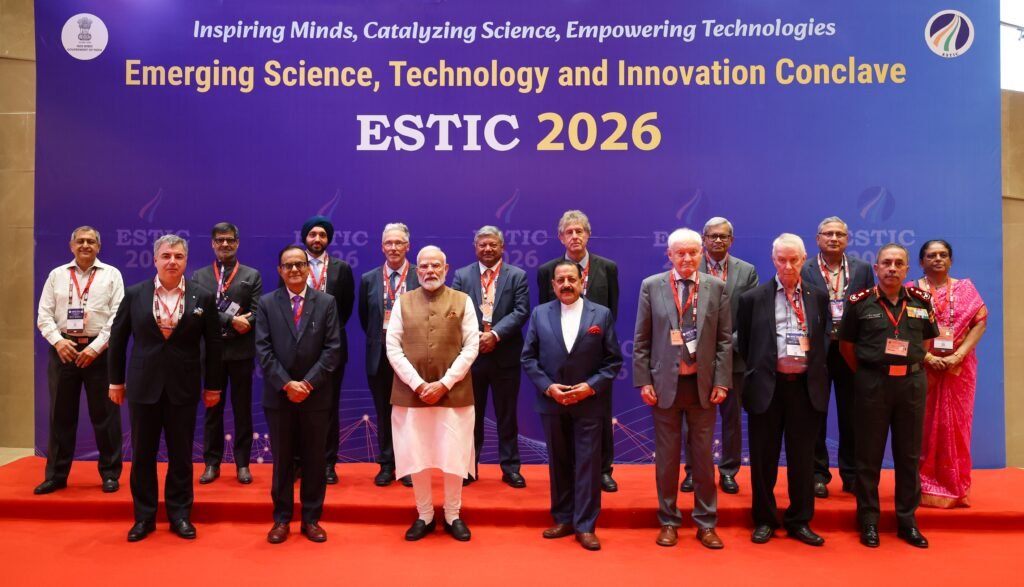
Prime Minister Narendra Modi inaugurated the Emerging Science, Technology and Innovation Conclave (ESTIC) 2026 at Bharat Mandapam in New Delhi on October 27, bringing together more than 5,000 delegates, including scientists, policymakers, industry representatives and deep-tech startups from India and abroad.
The opening day featured addresses by leading science and technology officials, plenary lectures by two Nobel laureates, parallel technical sessions, a startup exhibition, research poster presentations and a panel discussion. The discussions centred on translating scientific research into practical applications, strengthening domestic technological capabilities and using innovation to address national and global challenges.
Addressing the inaugural session, Modi urged scientists, researchers and young innovators to deliver measurable and scalable technological outcomes within a three-year timeframe. He stressed that scientific discoveries must move beyond laboratories to solve real-world problems, promote self-reliance under the Atmanirbhar Bharat vision and improve human welfare. He also highlighted India’s ambitions in emerging fields such as artificial intelligence (AI), quantum technology, advanced materials and biotechnology.
Union Minister of State for Science and Technology and Earth Sciences, Dr. Jitendra Singh, said India was moving from being a technology consumer towards becoming a global contributor to frontier scientific innovation. He highlighted the expansion of the country’s startup ecosystem from around 400 startups in 2014 to more than 2.3 lakh currently. According to the minister, approximately 50–60 per cent of these ventures are located in Tier-2 and Tier-3 cities, reflecting the geographical expansion of entrepreneurship and innovation.
Singh also emphasised the potential of India’s genetic and phenotypic diversity in advancing biotechnology. He called for stronger domestic capabilities in gene synthesis, systems biology and nuclear medicine, referring to legislative reforms, including the SHANTI Act, as part of the broader effort to accelerate scientific development.
Principal Scientific Adviser to the Government of India, Prof. Ajay K. Sood, highlighted the importance of integrating fundamental research with industrial expansion and supportive regulatory policies. He outlined ESTIC’s 12 priority thematic areas, which include quantum communication, generative and autonomous AI, semiconductor fabrication, advanced manufacturing and the Deep Ocean Mission. He said building national capabilities would require closer collaboration among research institutions, industry and policymakers.
Two Nobel laureates delivered keynote plenary lectures on developments in biological research and medical science. Prof. Joachim Frank of Columbia University, who received the 2017 Nobel Prize in Chemistry, discussed the role of cryo-electron microscopy (Cryo-EM) in identifying biological targets and supporting drug development. His presentation explored computational methods for producing high-resolution, three-dimensional images of molecular complexes and explained how these insights can contribute to rational drug design.
Sir Richard J. Roberts, the 1993 Nobel laureate in Physiology or Medicine, spoke about split genes and emerging frontiers in life sciences. His lecture examined gene splicing, microbial genomics and restriction-modification enzymes, alongside biotechnology applications in sustainable agriculture, public health and diagnostics.
The conclave also provided a platform for emerging companies and researchers to showcase innovations. Dr. Jitendra Singh inaugurated the startup exhibition and poster track, featuring deep-tech research, prototype demonstrations and interactive presentations. The initiative enabled exchanges among entrepreneurs, investors, academics, industry representatives and government stakeholders.
Three technical sessions explored applications of advanced manufacturing, artificial intelligence and synthetic biology.
The Advanced Manufacturing session, chaired by CSIR Director General Dr. (Mrs.) N. Kalaiselvi, featured a keynote address by former Defence Research and Development Organisation chairman Dr. G. Satheesh Reddy. Discussions covered digital twins, collaborative robotics, additive manufacturing and metrology, with particular attention to strengthening supply chains and expanding manufacturing capabilities among micro, small and medium enterprises (MSMEs).
The Generative and Autonomous AI session, chaired by IndiaAI CEO Shri Saurabh Vijay, featured a keynote address by Prof. Mitesh M. Khapra of IIT Madras. Participants discussed the development of indigenous large language models, access to high-performance computing through IndiaAI, agentic AI and frameworks for safe deployment. The session focused on building domestic AI capabilities while ensuring that emerging technologies are developed and deployed responsibly.
The System and Synthetic Biology session examined engineered biological systems and India’s BioE3 strategy. Using the “Understand, Design, Build, Test, Learn” framework, participants explored potential applications in precision biotherapeutics, metabolic pathway engineering, biofortified crops and waste-to-value biomanufacturing. The discussions highlighted the potential of synthetic biology to support innovation across healthcare, agriculture and industrial production.
The day concluded with a panel discussion titled “Science and Disruptive Technologies for Atmanirbhar Bharat”, chaired by Prof. Ajay K. Sood. Panellists included Dr. Tessy Thomas, Gen. N. S. Raja Subramani, Prof. Bhanu P. Jena, Dr. Samir Saran and Prof. V. K. Singh. The discussion addressed defence technology self-reliance, commercialisation of intellectual property, financing for deep-tech ventures and mechanisms for transferring technologies from research institutions to industry.
ESTIC 2026 brings together government, academia, industry and startups around 12 thematic priority areas. Discussions on the opening day also highlighted the ₹1 lakh crore Research, Development and Innovation Fund and mechanisms under the Anusandhan National Research Foundation (ANRF) as potential avenues for supporting deep-tech development across technology-readiness stages and facilitating commercialisation.
The conclave aims to strengthen the connection between scientific discovery, industrial application and public welfare, with an emphasis on developing homegrown technologies that contribute to India’s long-term development and address wider global challenges.
Source: PIB