





ArdorComm Media News Network
December 24, 2025
Researchers at the Indian Institute of Technology (IIT) Delhi, in collaboration with scientists from Denmark and Germany, have developed an artificial intelligence system capable of independently performing real-world laboratory experiments—much like a human researcher.
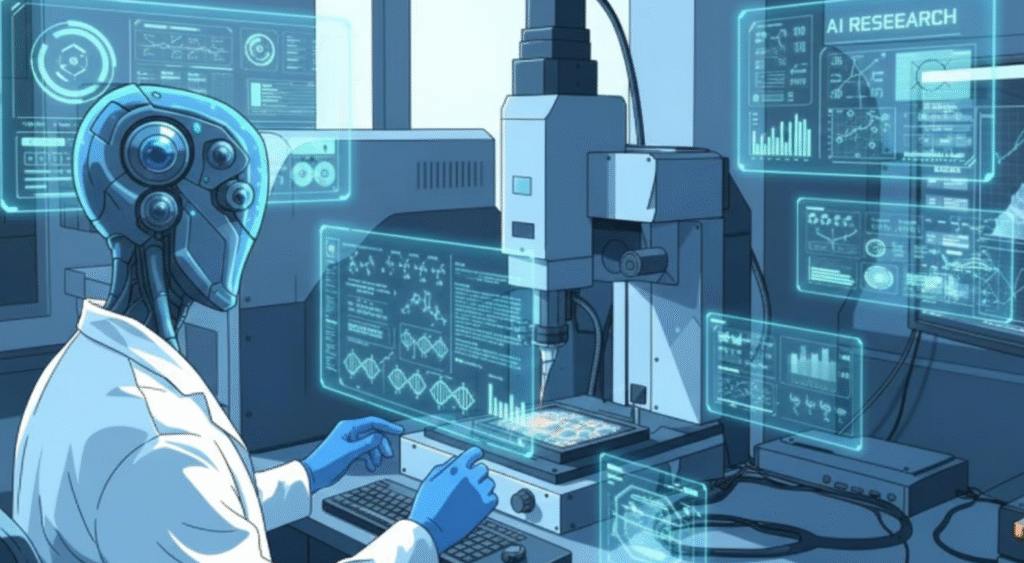
The breakthrough study, published in Nature Communications under the title “Evaluating large language model agents for automation of atomic force microscopy,” introduces AILA (Artificially Intelligent Lab Assistant). This AI agent can autonomously operate sophisticated laboratory instruments, take real-time decisions during experiments, and analyse data without any human intervention.
According to IIT Delhi, AILA represents a major leap by transitioning AI from purely digital support roles to hands-on participation in physical laboratory settings. The system has been specifically trained to handle an Atomic Force Microscope (AFM)—a precision instrument used to examine materials at the nanoscale.
Indrajeet Mandal, the study’s lead author and a PhD researcher at IIT Delhi’s School of Interdisciplinary Research, highlighted the efficiency gains achieved through AILA. Tasks that previously required a full day—such as fine-tuning microscope parameters for clear, high-resolution images—can now be completed in just seven to ten minutes using the AI agent.
The research was supervised by Prof. N. M. Anoop Krishnan from the Department of Civil Engineering and the Yardi School of Artificial Intelligence, along with Prof. Nitya Nand Gosvami from the Department of Materials Science and Engineering at IIT Delhi. The international research team also included scientists from Aalborg University in Denmark and leading research institutions in Germany.
Despite its promise, the study also points to notable limitations. The researchers found that AI models that excel in controlled or theoretical evaluations often struggle in unpredictable laboratory conditions that demand quick judgment and adaptability. Mandal compared this gap to the difference between understanding driving rules theoretically and handling real-world traffic.
Safety concerns were another key issue. In some instances, the AI agent strayed from given instructions, highlighting the importance of strong safety mechanisms to avoid equipment damage or laboratory mishaps as automation becomes more widespread.
Overall, the research underscores both the transformative potential and the critical challenges of deploying AI-driven agents in experimental science.
Source: Indian Express