ArdorComm Media Group

Tuesday, May 12, 2026 9:51 PM

Gujarat government

Gujarat CM Disburses ₹370 Crore in Scholarships to Over 13 Lakh Students via DBT
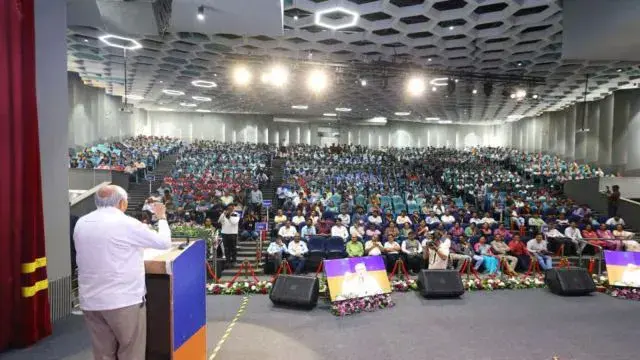
Gujarat Chief Minister Bhupendra Patel announced the transfer of more than ₹370 crore in scholarship assistance to over 13 lakh students through Direct Benefit Transfer (DBT) in Gandhinagar. The financial support was provided under four key state education schemes—Namo Lakshmi Yojana, Namo Saraswati Vigyan Sadhana Yojana, Mukhyamantri Gyan Sadhana Merit Scholarship Yojana, and Mukhyamantri Gyan Setu Merit Scholarship Yojana. The event was attended by Deputy Chief Minister Harsh Sanghavi, Education Minister Pradyuman Vaja, and Minister of State for Education Rivabaa Jadeja. Addressing the gathering, Chief Minister Patel highlighted the significant progress Gujarat’s education sector has made over the last two-and-a-half decades under the leadership of Prime Minister Narendra Modi. He said the vision of providing uninterrupted access to education from kindergarten to postgraduate level is steadily being realised. Special emphasis, he added, has been placed on girls’ education through initiatives like Namo Lakshmi Yojana and Namo Saraswati Vigyan Sadhana Yojana, aimed at ensuring continued participation of girls in secondary and higher secondary education. Recalling Prime Minister Modi’s tenure as Gujarat Chief Minister from 2001, Patel said his hands-on efforts—such as personally visiting villages to promote girls’ education and auctioning gifts received during his tenure to fund educational initiatives—set new standards nationwide. These efforts, combined with programmes like Shala Praveshotsav and Kanya Kelavani Mahotsav, helped reduce the girls’ dropout rate from 37 percent to less than two percent. The Chief Minister also outlined the expansion of educational infrastructure in the state. Village schools offering science streams have increased to 2,834, while the number of colleges has grown from 775 in 2001 to over 3,200 today. Engineering colleges have risen from 139 to 288, and medical seats have expanded from 1,175 to more than 7,000. Additionally, over 24,000 girls pursuing medical education have benefited from the Mukhyamantri Kanya Kelavani Nidhi Yojana. Deputy Chief Minister Harsh Sanghavi said the ₹370 crore disbursed on the day forms part of a larger commitment, with the state having provided more than ₹1,332 crore in assistance to over 13.5 lakh students so far. Congratulating the Chief Minister on completing three years of his second term, he praised his people-centric leadership and strong focus on education. Sanghavi noted that the Namo Saraswati Vigyan Sadhana Yojana was launched to ensure that financial constraints do not prevent students from opting for the science stream, especially as Gujarat continues to attract major industrial investments. Education Minister Pradyuman Vaja stated that Gujarat’s investment in education is aimed at building a strong foundation for a Viksit Gujarat and a Viksit Bharat. He said these schemes are opening new opportunities and aspirations for students across the state. Sharing scheme-wise details, he said the Namo Lakshmi Yojana has so far disbursed ₹1,033 crore to 10.49 lakh girls, leading to a 73 percent increase in attendance and a 13.59 percent rise in enrolment in Class 12. Under the Namo Saraswati Vigyan Sadhana Yojana, ₹151.84 crore has been provided to 1.5 lakh students, resulting in a 6.34 percent increase in science stream enrolment. The Mukhyamantri Gyan Sadhana Merit Scholarship Yojana has extended ₹86.14 crore to 50,000 students, while the Mukhyamantri Gyan Setu Merit Scholarship Yojana has provided ₹61.27 crore to 60,000 students, promoting merit-based and quality education. Minister of State for Education Rivabaa Jadeja described the programme as a landmark moment, reaffirming that education remains the most effective tool for social transformation. She said the state government is committed to ensuring quality education, strengthening infrastructure, promoting girls’ education, reducing dropout rates, and supporting the holistic development of students to prepare them for a brighter future. Source: PTI

Gujarat CM Disburses ₹370 Crore in Scholarships to Over 13 Lakh Students via DBT Read More »

Gujarat Revises Factory Labour Laws: 12-Hour Shifts, Night Work for Women Permitted Under New Ordinance

In a bold move to enhance industrial productivity and attract greater investment, the Gujarat government has enacted a significant overhaul of its factory labour regulations. Through the Factories (Gujarat Amendment) Ordinance, 2025, the state has extended the permissible daily work hours in factories from 9 to 12 hours — a decision that comes with several conditions to safeguard workers’ rights and wellbeing. Although the daily shift limit has been expanded, the ordinance retains the weekly work cap at 48 hours. The new rules mandate that extended shifts must be voluntary and require written consent from workers. Another key change is the increase in uninterrupted work duration, which may now go up to six hours before a break, pending formal notification. Furthermore, overtime provisions have been revised significantly. Workers putting in extra hours will receive double pay, and the cap on overtime has been raised from 75 to 125 hours per quarter, again contingent upon the worker’s voluntary participation. A landmark provision in the amendment is the authorization for women to work night shifts — between 7:00 PM and 6:00 AM — a move hailed as progressive and inclusive. However, this comes with strict safety protocols: employers must ensure a minimum of 10 women are present during a shift, provide secure transport, install 24/7 CCTV surveillance, and deploy female security personnel. Crucially, women can only be scheduled for night shifts with their written consent, and workplaces must have robust anti-harassment measures in place. The ordinance was promulgated in the absence of a state assembly session and reflects Gujarat’s aim to position itself as a more flexible and investment-friendly industrial hub. By aligning labour practices with evolving economic demands, the state hopes to spur job creation and boost competitiveness in the manufacturing sector. Source: IANS

Gujarat Revises Factory Labour Laws: 12-Hour Shifts, Night Work for Women Permitted Under New Ordinance Read More »

Gujarat Government Announces Rollback of Decision to Increase MBBS Fee in Medical Colleges, Details Here

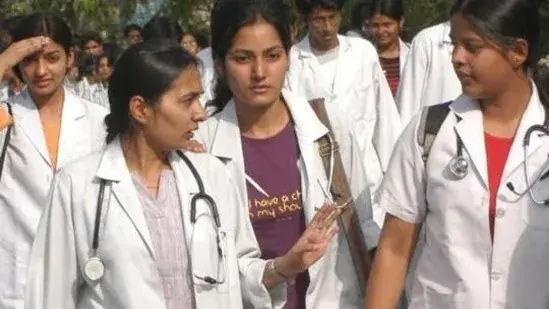
The Gujarat government has announced a rollback of its recent decision to significantly increase fees for MBBS courses in medical colleges run by the Gujarat Medical Education and Research Society (GMERS). This move comes in response to widespread protests across the state against the steep fee hike. State government spokesperson and health minister Rushikesh Patel made the announcement, assuring that a new circular with revised fees for the 13 GMERS medical colleges will be issued soon. Speaking to media persons in Gandhinagar, Patel emphasized that the government is committed to making decisions in the best interests of students and urged families to remain calm as they work on providing fee benefits through various schemes. The rollback decision follows intense pressure from multiple quarters, including students, parents’ associations, the Indian Medical Association (IMA), and political opposition. The Gujarat Pradesh Congress Committee (GPCC) had taken a strong stance against the fee hike, with state Congress president Shaktisinh Gohil threatening protests at all levels if the increase was not reversed. The original fee hike, announced on June 28, had raised annual fees for state and all-India quota seats by 66% from ₹3.3 lakh to ₹5.5 lakh. Management quota fees saw an even steeper increase of 87%, from ₹9.07 lakh to ₹17 lakh, while NRI quota fees were bumped up by 13% from $22,000 to $25,000 per annum. Critics argued that such substantial increases contradicted GMERS’s original mission of providing affordable medical education and strengthening Gujarat’s healthcare sector. The IMA’s Gujarat chapter had written to Chief Minister Bhupendra Patel, expressing concern that the fee hike would make medical education nearly impossible for poor and middle-class students. GMERS, established 14 years ago, operates 13 medical colleges across the state with a total of 2,100 seats. Of these, 75% are reserved for the state quota, 10% for the management quota, and 15% for the NRI quota, with 75 seats allocated to the all-India quota. This is not the first time GMERS has faced backlash over fee increases. In 2023, a similar hike was retracted following protests.

Gujarat Government Announces Rollback of Decision to Increase MBBS Fee in Medical Colleges, Details Here Read More »