ArdorComm Media Group

Monday, November 23, 2026 9:39 AM

Indian healthcare

India Records 38% Decline in TB Mortality Since 2015, WHO Report Shows

India has recorded a 38 per cent decline in tuberculosis (TB)-related deaths since 2015, surpassing the global reduction of 35 per cent, according to the World Health Organization’s (WHO) Global Tuberculosis Report 2026. The country has also achieved a 94 per cent treatment success rate among patients with drug-susceptible TB. The report highlights that the South-East Asia Region accounted for the largest share of new TB cases globally in 2025, at 35 per cent, followed by the Western Pacific Region at 27 per cent and the African Region at 25 per cent. Around 88 per cent of newly reported TB cases were concentrated in 30 countries. India alone contributed approximately a quarter of the global burden, followed by Indonesia (10 per cent), the Philippines (6.8 per cent), China (6.5 per cent), Pakistan (6.4 per cent), Nigeria (4.9 per cent), the Democratic Republic of the Congo (3.9 per cent) and Bangladesh (3.7 per cent). The five countries with the highest burden collectively accounted for 55 per cent of global cases. Globally, TB continues to impose a significant financial burden on affected households. Nearly half of people receiving TB treatment and their families face catastrophic expenses, exceeding 20 per cent of their total household income, when medical and non-medical costs and income losses are taken into account. The report also identifies several factors that increase the risk of developing TB, including HIV infection, undernutrition, diabetes and tobacco use. An estimated 9.6 lakh new cases were linked to undernutrition, 9.2 lakh to diabetes, 7.3 lakh to alcohol use disorders, 6.9 lakh to smoking and 5.5 lakh to HIV infection. Worldwide, approximately 10.6 million people developed TB in 2025, including 5.7 million men, 3.7 million women and 1.2 million children. The disease claimed an estimated 1.13 million lives during the year, remaining the world’s leading cause of death from a single infectious agent. Drug-resistant tuberculosis, particularly multidrug-resistant TB (MDR-TB), continues to pose a serious public health and health security challenge. Only around two in five people diagnosed with drug-resistant TB received treatment in 2025. However, global interventions against the disease have helped save an estimated 86 million lives since 2000. In India, the TB Mukt Bharat Abhiyaan has expanded screening efforts significantly. Between December 7, 2024, and November 8, 2026, the campaign brought more than 25 crore individuals within the ambit of TB screening activities. According to the Union Health Ministry, the decline in TB mortality has been driven by interventions under the National TB Elimination Programme (NTEP). These include active case detection using AI-enabled X-rays, rapid diagnostic services, timely treatment initiation, differentiated care and nutritional assistance through the Nikshay Poshan Yojana and Nikshay Mitra initiative. The ministry also highlighted the use of artificial intelligence tools to identify disease hotspots, predict high-risk patients likely to experience adverse outcomes and support patient engagement through Khushi, an AI-powered chatbot and avatar-based videobot. Tuberculosis is a bacterial infectious disease that primarily affects the lungs and spreads through the air when an infected person coughs, sneezes or spits. Despite its continued global impact, the disease is both preventable and curable. Source: The Hindu  

India Records 38% Decline in TB Mortality Since 2015, WHO Report Shows Read More »

AHPI Seeks Balanced Drug Pricing, Opposes Uniform 16% Margin on Medicines

The Association of Healthcare Providers of India (AHPI) has called for a balanced and evidence-based approach to the pricing of medicines and medical consumables, cautioning against applying a uniform 16% margin across all drugs. The healthcare providers’ body’s statement follows recent observations by the Supreme Court regarding steep markups on cancer medicines by hospitals and its suggestion of a standard 16% margin on medicines. While AHPI acknowledged that a uniform margin could improve transparency and affordability, it said a single pricing formula may not adequately account for differences in the supply chains and operational requirements of various medicines. According to the association, fast-moving chronic medicines, low-volume lifesaving drugs, cold-chain products and high-cost specialty medicines have significantly different storage, distribution and inventory requirements. Applying the same margin to all such products, it said, could make some medicines commercially difficult to stock. AHPI also highlighted the role of medicines and consumables within the broader healthcare delivery system. It said hospitals often provide treatment through bundled packages under private insurance and government health schemes, where medicines and consumables are not separately charged to patients. For patients receiving care outside such arrangements, AHPI said hospitals and retailers generally dispense medicines at the Maximum Retail Price (MRP) printed by manufacturers, subject to applicable regulations. The association noted that the MRP is determined by manufacturers rather than independently fixed by hospitals. Dr Girdhar Gyani, Director General of AHPI, said hospitals provide more than medicines, covering round-the-clock clinical services such as drug stocking, preparation, quality checks and safe administration. He said the pricing of medicines and consumables therefore needs to be considered alongside the overall responsibilities and costs involved in delivering safe and effective patient care. AHPI has consequently called for a pricing framework that considers the varied characteristics of medicines while balancing affordability, transparency, availability and the operational requirements of healthcare providers. Source: Economic Times

AHPI Seeks Balanced Drug Pricing, Opposes Uniform 16% Margin on Medicines Read More »

Govt Plans National Quality Grading System for Public and Private Hospitals

The government is working on a national framework to assess and grade public and private hospitals on healthcare quality, patient safety and clinical outcomes, with the system expected to follow international benchmarks. The initiative, being developed with the involvement of NITI Aayog, is aimed at giving patients access to clearer information when choosing healthcare providers while encouraging hospitals to improve standards of care. Officials indicated that the framework could be finalised by the end of this year, with hospital grading potentially beginning in the next financial year. NITI Aayog recently held a stakeholder consultation led by its member M Srinivas to discuss the proposed framework. The discussions focused on creating a credible and sustainable system centred on patient safety, quality of care, clinical outcomes and patient experience across different categories of hospitals. The proposed indicators could include patient-reported outcomes and experiences, hospital readmission rates and medication errors. Specialty-specific measures may also be considered, including post-transplant survival rates and postoperative mortality associated with oncology procedures. Healthcare experts said a standardised grading system could help patients make more informed decisions while allowing hospitals with stronger clinical outcomes and quality systems to distinguish themselves. It could also provide insurers and other healthcare payers with more objective data for designing outcome- and quality-linked products. At present, private hospitals can seek accreditation under the National Accreditation Board for Hospitals & Healthcare Providers (NABH), which sets standards for patient safety and clinical quality. However, detailed quality and outcome data are not routinely available to the public. The proposed framework could address this information gap by making hospital performance more transparent. Similar systems are already used in countries such as the UK, where the National Health Service publishes and audits various clinical quality and outcome indicators. The government also expects greater transparency and internationally benchmarked quality standards to strengthen India’s healthcare ecosystem and potentially support the country’s medical tourism ambitions. Source: Economic Times

Govt Plans National Quality Grading System for Public and Private Hospitals Read More »

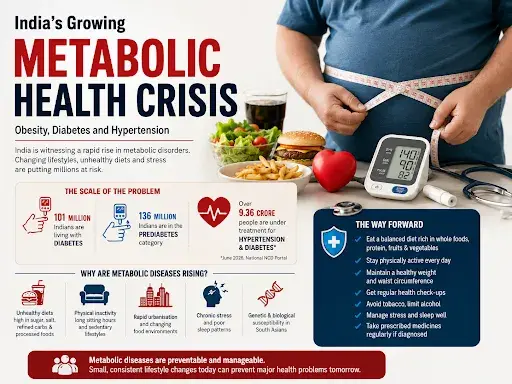
India’s Growing Metabolic Health Crisis: Obesity, Diabetes and Hypertension

For years, India’s biggest health challenges were closely associated with infectious diseases, malnutrition and limited access to healthcare. But the country is now facing another major public-health challenge: a rapidly growing burden of metabolic and non-communicable diseases. Obesity, diabetes, hypertension and abnormal cholesterol levels are increasingly affecting Indians across age groups and income categories. What makes the situation particularly concerning is that these conditions are closely connected. A person with excess weight may develop insulin resistance, which can increase the risk of type 2 diabetes. High blood pressure and abnormal cholesterol can further increase the risk of heart disease and stroke. The problem is no longer confined to older adults. Younger Indians are increasingly exposed to sedentary lifestyles, calorie-dense diets, poor sleep and chronic stress, creating the conditions for metabolic problems much earlier in life. The World Health Organization identifies unhealthy diets, physical inactivity, tobacco use and harmful alcohol consumption as major behavioural risk factors for non-communicable diseases. These behaviours contribute to metabolic changes such as raised blood pressure, high blood glucose, overweight and obesity. The scale of India’s metabolic health problem One of the clearest pictures of India’s metabolic health comes from the ICMR-INDIAB study, a large population-based study covering adults across 31 states and Union Territories. Published in The Lancet Diabetes & Endocrinology in 2023, the study assessed more than 113,000 participants and examined the prevalence of diabetes, prediabetes, hypertension, obesity and other metabolic conditions. The findings estimated that India had around 101 million people living with diabetes, while another 136 million were in the prediabetes category. The study also highlighted substantial levels of hypertension and obesity, with considerable variation between states and between urban and rural populations. This variation is important. India does not have a single metabolic-health profile. Dietary habits, economic conditions, urbanisation, physical activity, genetics and access to healthcare differ significantly from one region to another. Yet the broader direction is clear: metabolic disorders have become a major component of India’s disease burden. Obesity is becoming a public-health issue Obesity is often discussed as an issue of appearance or weight management. Medically, however, excess body fat can have much broader consequences. India’s Ministry of Health and Family Welfare notes that overweight and obesity are important risk factors for conditions including coronary heart disease, hypertension, stroke, type 2 diabetes, fatty liver disease, certain cancers and osteoarthritis. The concern is also spreading to younger generations. In July 2026, reporting based on the World Obesity Atlas 2026 estimated that approximately 41 million children in India were overweight or obese. Around the same time, ICMR-NIN unveiled policy recommendations focused on improving children’s food environments, including measures involving food advertising, labelling, school canteens and the pricing of unhealthy foods. Childhood obesity is particularly concerning because metabolic risk can accumulate over decades. A child who develops unhealthy eating patterns and low physical activity early in life may carry those behaviours into adolescence and adulthood. That does not mean every overweight child will develop diabetes or hypertension. But it does mean that prevention has to begin much earlier than the traditional idea of starting health checks only in middle age. Diabetes: India’s expanding metabolic challenge Diabetes is perhaps the most visible part of India’s metabolic-health crisis. Type 2 diabetes develops when the body becomes resistant to insulin or does not produce enough insulin to maintain healthy blood glucose levels. Genetics can play a role, but lifestyle and environmental factors also influence risk. India’s dietary transition has become an important part of the discussion. A 2025 study based on ICMR-INDIAB data and published in Nature Medicine examined dietary patterns among more than 18,000 adults. It reported associations between higher consumption of low-quality carbohydrates, including refined grains and added sugars, and increased odds of type 2 diabetes, prediabetes and obesity. The study also found that replacing a portion of dietary carbohydrates with protein, particularly from sources such as pulses, legumes and dairy, was associated with lower diabetes risk. This does not mean that carbohydrates are inherently unhealthy or that Indians should eliminate rice or wheat from their diets. Rather, it highlights the importance of diet quality, portion sizes and dietary balance. For many Indians, the issue is not simply the presence of carbohydrates but a dietary pattern dominated by refined grains and added sugars, combined with insufficient protein, fibre, vegetables and other nutrient-dense foods. Hypertension: The silent component of the crisis If diabetes is often associated with blood-sugar testing, hypertension presents a different challenge. High blood pressure can remain undetected for years because many people experience no obvious symptoms. Persistently elevated blood pressure places additional strain on blood vessels and the heart and increases the risk of cardiovascular disease, stroke and kidney problems. India’s National Programme for Prevention and Control of Non-Communicable Diseases includes population-based screening for hypertension and diabetes among people aged 30 years and above. The screening process includes assessment of risk factors, BMI and blood pressure, among other measures. Government data also indicate the scale of the response required. The National NCD portal reported more than 9.36 crore people under treatment for hypertension and diabetes as of June 2026. Importantly, the number of people receiving treatment should not be interpreted as the total number of Indians living with these diseases. It represents people captured within the government’s treatment system. Why are metabolic diseases increasing? There is no single cause. 1. Changing food habits India’s food environment has changed rapidly. Traditional diets have increasingly been supplemented or replaced by packaged foods, sugary drinks, refined carbohydrates, fried foods and highly processed snacks. Convenience has become an important factor, particularly in urban areas where long working hours and commuting leave less time for preparing meals. 2. Physical inactivity Modern work increasingly involves sitting for prolonged periods. Office jobs, commuting, screen-based entertainment and reduced everyday physical activity can result in people expending far fewer calories than previous generations. Regular exercise cannot completely compensate for an unhealthy diet, but physical activity remains an important component of metabolic health. 3. Urbanisation Urbanisation has brought economic opportunity

India’s Growing Metabolic Health Crisis: Obesity, Diabetes and Hypertension Read More »