ArdorComm Media Group

Sunday, November 15, 2026 6:13 AM

Prime Minister Modi

India and Philippines Forge Deeper Ties: 14 MoUs Signed to Boost Defence, Trade, Maritime, and Tourism Cooperation
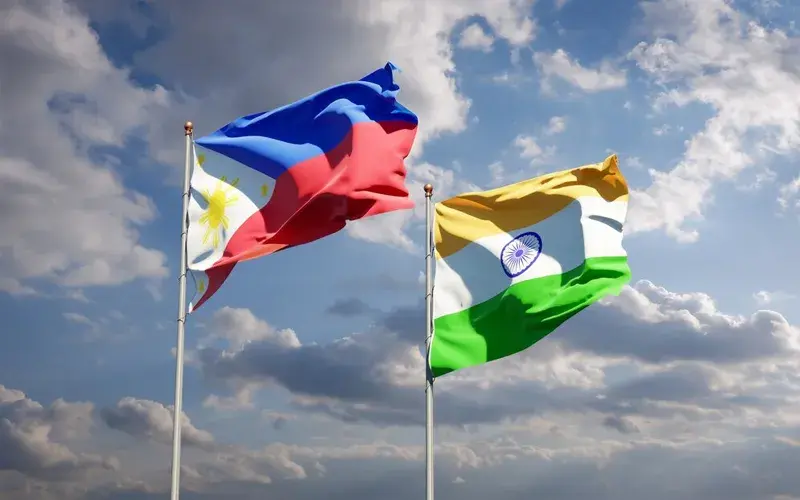
In a significant diplomatic move marking the 75th anniversary of their bilateral ties, India and the Philippines on Tuesday signed 14 Memoranda of Understanding (MoUs) to broaden cooperation across key strategic areas. The agreements were exchanged in the presence of Indian Prime Minister Narendra Modi and Philippine President Ferdinand Romualdez Marcos Jr., who is on his first state visit to India. These new agreements signal a strengthening of ties between the two nations and include a wide range of sectors such as defence, maritime security, space, digital technology, science, tourism, and legal collaboration. One of the key outcomes was the adoption of Terms of Reference for negotiations on a Preferential Trade Agreement (PTA), laying the foundation for deeper economic integration. This step is expected to enhance bilateral trade and investment flows between the two growing economies. The MoUs also include treaties on mutual legal assistance in criminal matters, a Treaty on the Transfer of Sentenced Persons, and structured staff talks between the respective Air Forces, Armies, and Navies. Additionally, the two countries agreed to enhance coordination between their Coast Guards, especially in the context of rising maritime challenges in the Indo-Pacific. The maritime dimension of the partnership was further highlighted by the recent completion of the first India-Philippines Maritime Cooperative Activity (MCA) in the South China Sea — a region rife with overlapping territorial claims. Three Indian naval vessels — INS Delhi (D61), INS Kiltan (P30), and INS Shakti (A57) — participated in the joint patrols. The partnership also takes a leap forward in science, space, and technology. India’s ISRO and the Philippine Space Agency signed a Statement of Intent to collaborate on the peaceful use of outer space, while a new Programme of Cooperation in Science and Technology (2025–2028) was signed to foster joint research and innovation. In tourism, both nations agreed on an Implementation Program for Cooperation in Tourism (2025–2028). As a goodwill gesture, India also announced a gratis e-tourist visa facility for Filipino citizens for one year starting August 2025. Cultural connections were celebrated through a commemorative stamp release, featuring the national flowers — India’s lotus and the Philippines’ Sampaguita — symbolizing enduring ties. A Cultural Exchange Programme was also agreed upon to promote people-to-people connections. Prime Minister Modi emphasized the “ancient cultural bond” between the two countries, citing the Philippine version of the Ramayana — Maharadia Lawana — as a testament to their long-standing relationship. “We are friends by choice and partners by destiny,” Modi said. President Marcos hailed the elevation of the partnership to strategic status, noting India as the Philippines’ fifth strategic partner. He pointed to the growing synergy between the two nations and their alignment on global and regional issues. To guide the growing cooperation, both countries adopted a Strategic Partnership Plan of Action for 2025–2029, which will serve as a roadmap across multiple sectors — including health, pharmaceuticals, fintech, digital economy, infrastructure, culture, and multilateral coordination. India has also extended support to help the Philippines build a Sovereign Data Cloud Infrastructure as part of its digital transformation efforts and has invited the Philippines to participate in the Information Fusion Centre – Indian Ocean Region (IFC-IOR). This wide-ranging set of agreements reflects the shared vision of India and the Philippines to shape a secure, prosperous, and interconnected Indo-Pacific region. Source: ANI

India and Philippines Forge Deeper Ties: 14 MoUs Signed to Boost Defence, Trade, Maritime, and Tourism Cooperation Read More »

Tesla Launches First Showroom in India, Enters World’s Third-Largest Auto Market

Tesla officially entered the Indian automobile market on Tuesday with the opening of its first showroom in the Bandra-Kurla Complex (BKC), an upscale business district in Mumbai. The launch marks the electric vehicle (EV) giant’s much-anticipated foray into the world’s third-largest car market, after years of negotiation and policy roadblocks. The newly opened facility in Mumbai will serve as Tesla’s flagship retail and experience centre, introducing Indian consumers to its global EV portfolio. Initially, the company will import and sell the Model Y, with the rear-wheel-drive long-range variant priced at ₹6.78 million ($79,089). Deliveries are expected to begin in Q3 of 2025. While Tesla vehicles retail for approximately $44,990 in the United States (excluding tax incentives), high import duties and a premium positioning are expected to limit Tesla’s reach in India’s price-sensitive auto market. Despite this, industry observers say Tesla’s entry signifies increasing investor trust and adds momentum to India’s clean mobility goals. “Tesla brings cutting-edge EV technology to India. With deeper local engagement, the company can stimulate the EV ecosystem, support innovation, and align with national sustainability targets,” said Gaurav Vangaal, Associate Director at S&P Global Mobility. Policy Shifts and Delayed Promises Tesla’s arrival follows prolonged delays stemming from India’s steep import duties—previously as high as 100% for fully built imported EVs. In April 2016, Tesla CEO Elon Musk had invited Indian customers to place pre-orders, but no deliveries followed, and the advance payments were eventually refunded. In 2019, Musk expressed concern that India’s tariffs made Tesla cars “unaffordable,” urging for policy reforms. The situation shifted significantly earlier this year after Prime Minister Narendra Modi’s visit to the U.S. in February 2025, prompting the Indian government to launch a revised EV policy. This policy reduced import taxes to 15% for EVs under $35,000, provided manufacturers commit to building local factories within three years. Although Musk initially planned a visit to India in April—widely seen as a precursor to announcing manufacturing plans—the trip was cancelled due to pressing company matters, and Musk instead traveled to China, one of Tesla’s core markets. Since then, Tesla has clarified that it has no immediate plans for domestic production in India. The U.S. government has also weighed in, with President Joe Biden expressing concern that Tesla could potentially use Indian manufacturing to circumvent U.S. tariffs, complicating ongoing bilateral trade negotiations between the two nations. Tesla’s Competition and Market Landscape In India, Tesla is expected to compete with high-end automakers such as BMW and Mercedes-Benz, rather than local budget players like Tata Motors or Mahindra & Mahindra. However, the luxury car segment accounts for just 1% of India’s total car sales, making it a niche but potentially influential market. Currently, EVs form just over 2% of India’s overall car market, but the government aims to increase that share to 30% by 2030 through incentives and infrastructure development. Starlink and Broader India Plans Tesla’s India strategy goes beyond cars. Musk’s other venture, Starlink, which aims to provide satellite-based internet, has seen recent progress in India. The service still requires telecom spectrum allocation from the government—a process expected to take a few months—before commercial operations can begin. In sum, while Tesla’s India debut is a symbolic and strategic milestone, the journey ahead depends on how quickly it can localize operations, navigate regulatory frameworks, and align with India’s evolving EV goals. Source: AP Photo Credit: Reuters

Tesla Launches First Showroom in India, Enters World’s Third-Largest Auto Market Read More »

PM Modi and Cyprus President Hold Strategic Bilateral Talks in Nicosia, Pledge Deeper India-Cyprus Ties

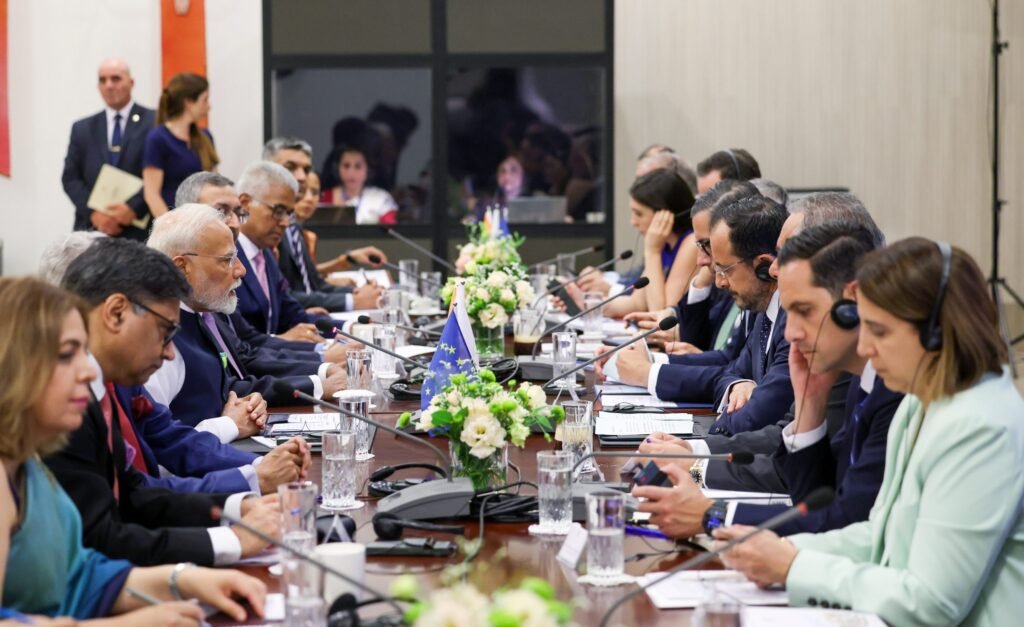
On his official visit to Cyprus, Prime Minister Narendra Modi held extensive bilateral talks with President Nikos Christodoulides at the Presidential Palace in Nicosia on Monday. The meeting, marked by a ceremonial welcome, focused on strengthening ties across multiple domains and underlined both countries’ shared commitment to peace, security, and global cooperation. Expressing gratitude, Prime Minister Modi thanked Cyprus for its firm condemnation of the recent terrorist attack in Pahalgam (April 2025), highlighting the strong solidarity between the two nations in the fight against terrorism. “Cyprus’s unwavering support reflects our mutual commitment to counter-terrorism efforts,” he noted. The leaders reaffirmed their respect for each other’s sovereignty and territorial integrity. PM Modi reiterated India’s continued backing of a unified Cyprus and called for a peaceful resolution of the Cyprus issue in accordance with UN Security Council resolutions, international law, and European Union principles. The talks covered a wide spectrum of bilateral cooperation — from trade and cultural exchange to defence and digital innovation. New areas such as fintech, artificial intelligence, start-ups, and mobility were identified as future avenues for collaboration. Significantly, both sides agreed to formulate a five-year roadmap aimed at boosting strategic cooperation. Key priorities include launching maritime and cyber security dialogues and enhancing intelligence-sharing mechanisms to jointly combat terrorism, arms smuggling, and narcotics trafficking. As Cyprus prepares for its Presidency of the Council of the European Union in early 2026, the leaders committed to further advancing the India–EU relationship. They reviewed progress on the India–EU Strategic Dialogue and stressed the urgency of concluding the long-delayed Free Trade Agreement by the end of 2025. President Christodoulides assured India that Cyprus would champion the EU–India strategic partnership during its presidency, particularly in areas like green energy, defence, maritime security, and space collaboration. Both sides acknowledged the signing of the Bilateral Defence Cooperation Programme earlier in January 2025 as a key step toward deeper defence ties. They also welcomed the formation of the India-Greece-Cyprus Business and Investment Council, seen as a vital mechanism for expanding trilateral engagement. Discussions also touched on the need for improved air connectivity to boost business, tourism, and educational exchange. Prime Minister Modi emphasized the strategic significance of the India-Middle East-Europe Economic Corridor (IMEC), calling it a transformative initiative for long-term regional prosperity. On the global stage, India and Cyprus reaffirmed their shared commitment to reforming international governance institutions. PM Modi appreciated Cyprus’s support for India’s bid for permanent membership in a restructured United Nations Security Council, noting, “The global order must evolve to reflect current realities.” The leaders also exchanged views on international developments, including ongoing conflicts in West Asia and Europe. To bolster cultural ties, both countries signed an MoU to set up an India Studies Chair at the University of Nicosia under the Indian Council for Cultural Relations (ICCR). The meeting underscored a growing convergence of strategic interests between India and Cyprus, setting the tone for a more robust partnership in the years ahead. Source: DD News

PM Modi and Cyprus President Hold Strategic Bilateral Talks in Nicosia, Pledge Deeper India-Cyprus Ties Read More »

CBSE Results 2024 (OUT) Live Updates: CBSE Class 12 Records 87.98% Pass Percentage, Class 10 Secures 93.60%; PM Modi Congratulates Students

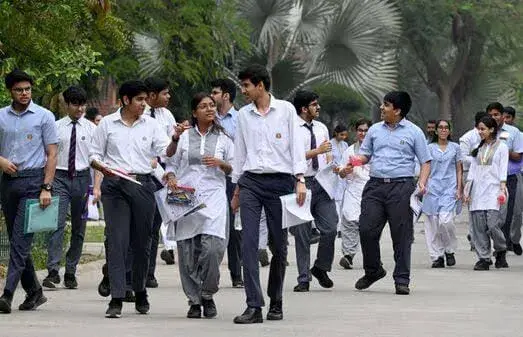
CBSE has announced the results for the Class 10 and Class 12 exams for the year 2024. The pass percentage for Class 12 stands at 87.98%, while for Class 10, it is 93.60%. Students can check their results on the official websites — results.cbse.nic.in, cbse.gov.in, or cbseresults.nic.in. The Class 10 exams took place from February 15 to March 13, while the Class 12 exams were held from February 15 to April 2, 2024. Both exams were conducted in a single shift, from 10:30 AM to 01:30 PM, across various examination centers. A total of 39 lakh students from 26 different countries appeared for the exams, with 5.80 lakh students from the national capital alone. The CBSE has decided to discontinue the tradition of announcing merit lists for the top-performing students in both Class 10th and 12th exams to reduce unhealthy competition among students. Prime Minister Modi has extended his congratulations to the students on their performance in the CBSE exams. Students can access their results online and check their marks and overall performance.

CBSE Results 2024 (OUT) Live Updates: CBSE Class 12 Records 87.98% Pass Percentage, Class 10 Secures 93.60%; PM Modi Congratulates Students Read More »