ArdorComm Media Group

Monday, September 21, 2026 2:34 PM

Type 2 Diabetes

India’s Growing Metabolic Health Crisis: Obesity, Diabetes and Hypertension
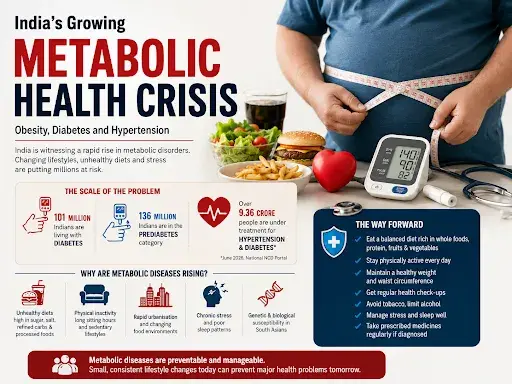
For years, India’s biggest health challenges were closely associated with infectious diseases, malnutrition and limited access to healthcare. But the country is now facing another major public-health challenge: a rapidly growing burden of metabolic and non-communicable diseases. Obesity, diabetes, hypertension and abnormal cholesterol levels are increasingly affecting Indians across age groups and income categories. What makes the situation particularly concerning is that these conditions are closely connected. A person with excess weight may develop insulin resistance, which can increase the risk of type 2 diabetes. High blood pressure and abnormal cholesterol can further increase the risk of heart disease and stroke. The problem is no longer confined to older adults. Younger Indians are increasingly exposed to sedentary lifestyles, calorie-dense diets, poor sleep and chronic stress, creating the conditions for metabolic problems much earlier in life. The World Health Organization identifies unhealthy diets, physical inactivity, tobacco use and harmful alcohol consumption as major behavioural risk factors for non-communicable diseases. These behaviours contribute to metabolic changes such as raised blood pressure, high blood glucose, overweight and obesity. The scale of India’s metabolic health problem One of the clearest pictures of India’s metabolic health comes from the ICMR-INDIAB study, a large population-based study covering adults across 31 states and Union Territories. Published in The Lancet Diabetes & Endocrinology in 2023, the study assessed more than 113,000 participants and examined the prevalence of diabetes, prediabetes, hypertension, obesity and other metabolic conditions. The findings estimated that India had around 101 million people living with diabetes, while another 136 million were in the prediabetes category. The study also highlighted substantial levels of hypertension and obesity, with considerable variation between states and between urban and rural populations. This variation is important. India does not have a single metabolic-health profile. Dietary habits, economic conditions, urbanisation, physical activity, genetics and access to healthcare differ significantly from one region to another. Yet the broader direction is clear: metabolic disorders have become a major component of India’s disease burden. Obesity is becoming a public-health issue Obesity is often discussed as an issue of appearance or weight management. Medically, however, excess body fat can have much broader consequences. India’s Ministry of Health and Family Welfare notes that overweight and obesity are important risk factors for conditions including coronary heart disease, hypertension, stroke, type 2 diabetes, fatty liver disease, certain cancers and osteoarthritis. The concern is also spreading to younger generations. In July 2026, reporting based on the World Obesity Atlas 2026 estimated that approximately 41 million children in India were overweight or obese. Around the same time, ICMR-NIN unveiled policy recommendations focused on improving children’s food environments, including measures involving food advertising, labelling, school canteens and the pricing of unhealthy foods. Childhood obesity is particularly concerning because metabolic risk can accumulate over decades. A child who develops unhealthy eating patterns and low physical activity early in life may carry those behaviours into adolescence and adulthood. That does not mean every overweight child will develop diabetes or hypertension. But it does mean that prevention has to begin much earlier than the traditional idea of starting health checks only in middle age. Diabetes: India’s expanding metabolic challenge Diabetes is perhaps the most visible part of India’s metabolic-health crisis. Type 2 diabetes develops when the body becomes resistant to insulin or does not produce enough insulin to maintain healthy blood glucose levels. Genetics can play a role, but lifestyle and environmental factors also influence risk. India’s dietary transition has become an important part of the discussion. A 2025 study based on ICMR-INDIAB data and published in Nature Medicine examined dietary patterns among more than 18,000 adults. It reported associations between higher consumption of low-quality carbohydrates, including refined grains and added sugars, and increased odds of type 2 diabetes, prediabetes and obesity. The study also found that replacing a portion of dietary carbohydrates with protein, particularly from sources such as pulses, legumes and dairy, was associated with lower diabetes risk. This does not mean that carbohydrates are inherently unhealthy or that Indians should eliminate rice or wheat from their diets. Rather, it highlights the importance of diet quality, portion sizes and dietary balance. For many Indians, the issue is not simply the presence of carbohydrates but a dietary pattern dominated by refined grains and added sugars, combined with insufficient protein, fibre, vegetables and other nutrient-dense foods. Hypertension: The silent component of the crisis If diabetes is often associated with blood-sugar testing, hypertension presents a different challenge. High blood pressure can remain undetected for years because many people experience no obvious symptoms. Persistently elevated blood pressure places additional strain on blood vessels and the heart and increases the risk of cardiovascular disease, stroke and kidney problems. India’s National Programme for Prevention and Control of Non-Communicable Diseases includes population-based screening for hypertension and diabetes among people aged 30 years and above. The screening process includes assessment of risk factors, BMI and blood pressure, among other measures. Government data also indicate the scale of the response required. The National NCD portal reported more than 9.36 crore people under treatment for hypertension and diabetes as of June 2026. Importantly, the number of people receiving treatment should not be interpreted as the total number of Indians living with these diseases. It represents people captured within the government’s treatment system. Why are metabolic diseases increasing? There is no single cause. 1. Changing food habits India’s food environment has changed rapidly. Traditional diets have increasingly been supplemented or replaced by packaged foods, sugary drinks, refined carbohydrates, fried foods and highly processed snacks. Convenience has become an important factor, particularly in urban areas where long working hours and commuting leave less time for preparing meals. 2. Physical inactivity Modern work increasingly involves sitting for prolonged periods. Office jobs, commuting, screen-based entertainment and reduced everyday physical activity can result in people expending far fewer calories than previous generations. Regular exercise cannot completely compensate for an unhealthy diet, but physical activity remains an important component of metabolic health. 3. Urbanisation Urbanisation has brought economic opportunity

India’s Growing Metabolic Health Crisis: Obesity, Diabetes and Hypertension Read More »

ICMR Has Not Studied Whether Ultra-Processed Foods Show Addiction-Like Behaviour: Centre

The Indian Council of Medical Research (ICMR) has not conducted any study to determine whether ultra-processed foods (UPFs) display addiction-like behavioural characteristics similar to tobacco or other habit-forming substances, the government informed the Lok Sabha. Responding to a written question in Parliament, Minister of State for Health Prataprao Jadhav said ICMR’s assessment is based on available global scientific evidence, which links higher consumption of ultra-processed foods with a greater risk of several health problems. These include obesity, type 2 diabetes, cardiovascular diseases and certain mental health disorders. However, the minister clarified that such conditions have multiple contributing factors, with excessive consumption of ultra-processed foods being only one of several modifiable risk factors. The government also pointed out that much of the existing evidence on UPFs and health outcomes is observational. Therefore, the available research does not, on its own, establish a direct cause-and-effect relationship. ICMR Steps Up Nutrition Awareness Jadhav said ICMR has undertaken various measures to educate the public about the potential health risks associated with excessive consumption of ultra-processed foods. The Dietary Guidelines for Indians, 2024, advise people to limit their intake of free sugars, avoid frequent consumption of sugar-sweetened beverages and reduce their intake of ultra-processed foods. The guidelines also encourage consumers to identify such products and read food labels before making purchasing decisions. ICMR has additionally launched the “Let’s Fix Our Food” initiative in partnership with national and international organisations. The programme focuses on creating healthier food environments for children and adolescents by working with schools, parents, policymakers and civil society organisations. The initiative aims to develop evidence-based communication resources, improve food environments in schools and encourage healthier eating habits, while discouraging the consumption of foods high in sugar, fat and salt. The minister said ICMR also conducts nutrition awareness activities through public lectures, workshops, training programmes, National Nutrition Month campaigns and other public health initiatives. Educational material on nutrition is also disseminated in regional languages. FSSAI Campaigns Promote Healthier Eating The Food Safety and Standards Authority of India (FSSAI) has also introduced several initiatives aimed at encouraging healthier dietary choices. These include the “Eat Right India” movement and the “Aaj Se Thoda Kam” campaign, which encourages consumers to reduce their intake of fat, salt and sugar. FSSAI is also using social media campaigns to raise awareness about obesity and related health concerns. In collaboration with MyGov, FSSAI has launched the “Eat Right Quiz on Obesity”. Its #HarLabelKuchKehtaHai campaign seeks to help consumers better understand nutritional information and other details provided on food labels. Jadhav said FSSAI has established quality and safety standards for a range of food products, aligned with international standards including those developed by the Codex Alimentarius Commission. Existing regulations also govern the levels of sugar, salt and fat in food products. Under the Food Safety and Standards (Labelling and Display) Regulations, 2020, food manufacturers are required to disclose nutritional information such as energy, protein, carbohydrates, total sugars, added sugars, total fat and sodium, along with ingredient details. The rules also prohibit false or misleading labels. Meanwhile, the Food Safety and Standards (Advertising and Claims) Regulations, 2018 require food-related advertisements and health claims to be truthful, scientifically supported and not misleading. Claims that a food product can prevent, treat or cure diseases are prohibited unless specifically allowed under the law. The government said violations of these regulations can result in regulatory and punitive action against non-compliant food business operators under the Food Safety and Standards Act, 2006. Source: PTI

ICMR Has Not Studied Whether Ultra-Processed Foods Show Addiction-Like Behaviour: Centre Read More »

Poor Muscle Health Along With Obesity May Significantly Raise Type 2 Diabetes Risk: Study

A combination of poor muscle health and excess body fat may substantially increase the risk of developing type 2 diabetes, according to a new study published in the journal Diabetes Care. Researchers found that individuals with sarcopenic obesity—a condition marked by both obesity and reduced muscle mass and strength—face a considerably higher diabetes risk than those affected by either condition alone. The research, led by Zhongyang Guan, a PhD candidate at Curtin University in Australia, analyzed health data from 479,607 participants in the UK Biobank who were free of diabetes at the start of the study. During an average follow-up period of more than 14 years, nearly 32,950 participants developed type 2 diabetes. According to the findings, people with sarcopenic obesity were more than 3.5 times as likely to develop type 2 diabetes compared to individuals with a healthy body composition. They also had a 19% higher risk than people with obesity alone and a 91% higher risk than those with only sarcopenia. The study revealed that nearly 15% of participants with sarcopenic obesity developed type 2 diabetes within 10 years, compared with around 11% of those with obesity alone and only 3% of individuals without obesity or sarcopenia. Researchers also observed that the association between sarcopenic obesity and diabetes was particularly pronounced among women and adults younger than 60 years. Guan noted that while excess body weight is widely recognized as a diabetes risk factor, the findings highlight that muscle health plays an equally important role in determining an individual’s risk. The authors concluded that evaluating both body fat and muscle health could improve the identification of people at high risk of developing type 2 diabetes. Senior author Professor Mario Siervo from Curtin University’s Faculty of Health Sciences said healthcare providers should consider assessing muscle health alongside body weight. He added that maintaining muscle strength through regular physical activity, resistance training, and healthy lifestyle habits may help reduce the growing burden of type 2 diabetes, particularly as obesity rates continue to rise and populations age. Source: PTI

Poor Muscle Health Along With Obesity May Significantly Raise Type 2 Diabetes Risk: Study Read More »

Novo Nordisk Introduces Once-Weekly Insulin Injection ‘Awiqli’ in India for Adults with Diabetes

Danish pharmaceutical company Novo Nordisk has launched Awiqli, its once-weekly basal insulin injection, in India, offering adults with type 1 and type 2 diabetes an alternative to conventional daily insulin therapy. The company announced the launch on July 9, with the product set to become available across the country next week. Awiqli, also known by its generic name insulin icodec, is the world’s first clinically approved once-weekly long-acting basal insulin. By requiring just 52 injections annually instead of 365, the treatment aims to improve patient convenience and adherence to insulin therapy. Novo Nordisk has priced the weekly dose of 70 insulin units at ₹261. The product will be available in two pre-filled pen formats: a 1 ml pen containing 700 units priced at ₹2,611, and a 3 ml pen with 2,100 units priced at ₹7,833. According to the company, this makes the therapy competitively priced compared to existing daily basal insulin options, which cost between ₹345 and ₹453 for an equivalent weekly dose. The company highlighted the significant diabetes burden in India, where more than 101 million people are living with diabetes, while another 136 million are estimated to have prediabetes. It also noted that insulin therapy is often initiated 7–9 years later than recommended, largely due to concerns over frequent injections, pain, and treatment costs. India currently has around 6 million people receiving insulin therapy, and Novo Nordisk expects that figure to increase to 9 million in the coming years as awareness and access improve. According to market estimates by IMARC, India’s insulin market is projected to expand from $660.5 million in 2025 to $916.4 million by 2034, supported by the rising prevalence of diabetes driven by sedentary lifestyles, unhealthy diets, and genetic factors. Earlier this year, Awiqli received regulatory approval in the United States and has also been cleared for use in the European Union and several other countries. India becomes the seventh country to introduce the once-weekly insulin. The new therapy is expected to compete with established basal insulin brands, including Sanofi’s Lantus, as well as insulin glargine products marketed by Indian pharmaceutical companies such as Biocon, Eris Lifesciences, and Lupin. Novo Nordisk is also strengthening its presence in India’s rapidly growing obesity treatment market, where it faces competition from Eli Lilly and several domestic drug manufacturers. Source: REUTERS

Novo Nordisk Introduces Once-Weekly Insulin Injection ‘Awiqli’ in India for Adults with Diabetes Read More »

India Tightens Oversight on GLP-1 Drugs Amid Rising Misuse Concerns

The Government of India has issued a comprehensive advisory on GLP-1 drugs, cautioning against their inappropriate use while acknowledging their growing role in managing type 2 diabetes and obesity. With demand surging—particularly for weight loss—authorities are stepping up regulation to safeguard public health. GLP-1 (Glucagon-Like Peptide-1) medications are designed to regulate blood sugar levels by enhancing insulin secretion and reducing excess glucose. They also aid in weight management by slowing digestion and curbing appetite, making them increasingly sought after beyond their primary medical purpose. However, officials have emphasized that these are not lifestyle or wellness products, but potent prescription drugs that must only be used under medical supervision. The advisory comes in response to concerns over their easy availability through online platforms and wellness clinics. Health authorities have warned that unsupervised use may lead to adverse effects, including gastrointestinal problems, hormonal disturbances, and other complications. Experts underline that these drugs are not suitable for everyone and should never be used casually for weight loss. As per the guidelines, only qualified specialists—such as endocrinologists, internal medicine physicians, and cardiologists—are authorised to prescribe GLP-1 drugs. Over-the-counter sale is strictly prohibited, and individuals are strongly advised against purchasing them without a valid prescription. Regulatory bodies, including the Drug Controller General of India (DCGI) and State Drug Controllers, have intensified inspections across pharmacies, clinics, and digital platforms. Any violations—ranging from illegal sales to misuse—will invite stringent penalties, including licence suspension and legal action. The government’s move comes at a time when the popularity of these drugs is rapidly increasing, especially as quick weight-loss solutions. Authorities aim to ensure that genuine patients retain access while preventing unsafe and unregulated usage. The advisory reinforces a critical message: GLP-1 drugs are powerful medical treatments, not shortcuts for weight loss. Responsible use, guided by medical expertise and supported by strict regulation, will be essential to ensuring patient safety in India. Source: India Today

India Tightens Oversight on GLP-1 Drugs Amid Rising Misuse Concerns Read More »

Diabetes Driving India’s Silent Liver Disease Crisis, Study Warns

A groundbreaking study has revealed that Type 2 diabetes is emerging as a major cause of advanced liver disease in India, often progressing unnoticed until it becomes life-threatening. Published in The Lancet, the DiaFib-Liver Study is the largest real-world research of its kind in a developing country, highlighting the liver as a critical yet overlooked organ at risk among diabetic patients. The study, which assessed 9,202 adults across 27 healthcare centres, found that nearly 25% of patients had significant liver fibrosis, while about 14% had advanced disease. Alarmingly, around 5% had already reached a stage suggestive of cirrhosis—despite showing no obvious symptoms. Experts note a shift in the primary causes of severe liver conditions, with diabetes and obesity now surpassing viral infections like Hepatitis B and C. The underlying mechanism involves fat accumulation in the liver, leading to insulin resistance, chronic inflammation, and eventual scarring. Interestingly, the research also challenges the belief that liver disease primarily affects overweight individuals. Cases were observed even among lean patients, with a phenomenon termed “burnt-out” liver disease—where fat diminishes as fibrosis worsens—making detection even more difficult. Given that liver damage often remains silent until advanced stages, researchers emphasize the need for improved screening. They recommend tools like the FIB-4 score, derived from routine blood tests, and FibroScan imaging for early detection, instead of relying solely on ultrasounds. Encouragingly, the study highlights that early-stage liver damage can be reversed. A 5% reduction in body weight may reverse fibrosis in many cases, while a 10% reduction can significantly slow disease progression. With India home to over 10 crore diabetics and millions more at risk, integrating liver health checks into diabetes care programs could be key to preventing a large-scale health crisis. Source: TNN

Diabetes Driving India’s Silent Liver Disease Crisis, Study Warns Read More »

Study in India Reveals Link Between Air Pollution and Type 2 Diabetes Risk

News on Health

Air pollution in India has been linked to an increased risk of type 2 diabetes, as revealed in a groundbreaking study published in the BMJ Open Diabetes Research and Care journal. The study, the first of its kind in India, was conducted in Delhi and Chennai, and it found that exposure to elevated levels of fine pollution particles (PM2.5) in the air, which are 30 times thinner than a strand of hair, is associated with higher blood sugar levels and an elevated incidence of type 2 diabetes. While the health impacts of fine particulate matter are known for cardiovascular and cardiometabolic diseases, this study sought to provide evidence from regions with high air pollution levels like India, where noncommunicable diseases are a significant burden. The research team, which included scientists from the Centre for Chronic Disease Control in New Delhi, followed a group of over 12,000 men and women from 2010 to 2017, regularly measuring their blood sugar levels. They also utilized satellite data and air pollution exposure models to assess air quality in the participants’ localities during that period. The results demonstrated that exposure to PM2.5 for just one month led to increased blood sugar levels, and prolonged exposure for a year or more elevated the risk of diabetes. Additionally, for every 10 micrograms per cubic meter (μg/m3) increase in the annual average PM2.5 levels in Delhi and Chennai, the risk of diabetes rose by 22 percent. The study addressed a significant research gap in South Asia, where diabetes is a major health concern, by providing robust exposure assessment and longitudinal data in this population. It underscores the need for tailored, population-specific policies to combat the high diabetes prevalence by reducing ambient air pollution. The research team, which also included scientists from the Public Health Foundation of India, Harvard University, Emory University, the All India Institute of Medical Sciences, and the Madras Diabetes Research Foundation, emphasized the importance of region-specific measures to achieve meaningful public health improvements at the population level.

Study in India Reveals Link Between Air Pollution and Type 2 Diabetes Risk Read More »