


ArdorComm Media Group

Wednesday, November 18, 2026 2:10 PM

Infrastructure

Punjab Government Proposes ₹3,000 Crore Action Plan for Samagra Shiksha Program
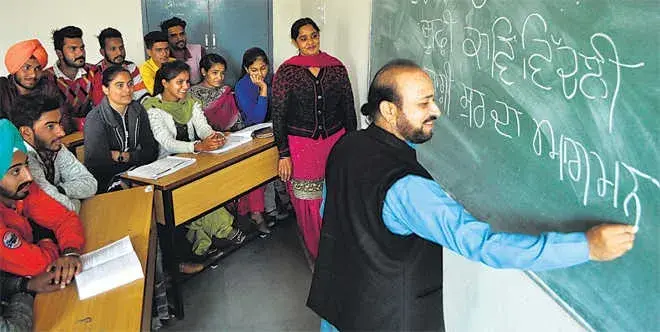
The Punjab government has presented a comprehensive ₹3,000-crore action plan under the Samagra Shiksha program. This flagship centrally sponsored initiative for school education aims to address various facets, including quality education, access and retention, and vocational education. The proposed budget spans the financial years 2024-25 and 2025-26, with an annual allocation of ₹1,476 crore for each year. This marks a commendable 14% increase compared to the current year’s budget. The Samagra Shiksha program operates on a joint funding model, with the central and state governments contributing on a 60:40 sharing basis, emphasizing their commitment to transforming the education landscape. Outlined in the action plan are specific allocations for key areas of focus. An earmarked ₹503 crore is dedicated to initiatives and interventions related to quality education, emphasizing the importance of an enriched learning experience. Additionally, ₹225 crore has been allocated for measures addressing access and retention, ensuring that more students can benefit from an inclusive education system. Another significant chunk of ₹188 crore is set aside for the promotion and implementation of vocational education, equipping students with practical skills for the future. The proposed initiatives include the construction of new classrooms and toilets, improved drinking water facilities, the promotion of commerce and science education, teacher training, digital initiatives, strengthening school libraries, and the installation of solar panels. Furthermore, the plan envisions introducing vocational education in all high and senior secondary schools, reflecting a forward-looking approach to skill development. The Samagra Shiksha Project Approval Board, led by Union school education and literacy secretary Sanjay Kumar, will review the budget proposals in the upcoming month. The central government’s share of ₹886 crore, coupled with the state government’s commitment of ₹590 crore, underscores the collaborative effort to create a robust educational framework.

Punjab Government Proposes ₹3,000 Crore Action Plan for Samagra Shiksha Program Read More »

PM Modi Reviews Progress of Rs 31,000 Crore Worth of Key Projects Across Seven States

News on Gov

Prime Minister Narendra Modi conducted a PRAGATI meeting on Wednesday to assess the progress of eight significant projects spanning seven states, collectively valued at approximately Rs 31,000 crore, according to a statement from his office. PRAGATI, a multi-modal platform for Pro-Active Governance and Timely Implementation of projects involving both the central and state governments, marked its 43rd edition during this meeting. These projects encompassed various domains, with four focusing on water supply and irrigation, two centred on expanding national highways and connectivity, and two related to rail and metro rail connectivity. The statement specified, “These projects have a cumulative cost of around Rs 31,000 crore and relate to 7 states: Bihar, Jharkhand, Haryana, Odisha, West Bengal, Gujarat, and Maharashtra.” Prime Minister Modi stressed the importance of leveraging the PM Gati Shakti National Master Plan Portal in conjunction with technologies like satellite imagery to address implementation and planning challenges regarding project location and land requirements. He recommended that stakeholders involved in projects within densely populated urban areas appoint nodal officers and establish teams to enhance coordination. For irrigation projects, the Prime Minister advised organizing visits to areas where successful rehabilitation and reconstruction work had been carried out, with the intention of showcasing the transformational impact of these projects to inspire early execution. During the meeting, he also examined the progress of ‘Mobile Towers and 4G Coverage under USOF Projects.’ These projects aim to provide mobile coverage to 33,573 villages through 24,149 mobile towers under the Universal Service Obligation Fund (USOF). Modi instructed officials to ensure that mobile towers are installed in all uncovered villages within the current financial year, emphasizing the importance of regular meetings with all stakeholders to achieve full mobile coverage even in remote areas. According to the statement, up to the 43rd edition of PRAGATI meetings, a total of 348 projects with a combined cost of Rs 17.36 lakh crore have undergone review.

PM Modi Reviews Progress of Rs 31,000 Crore Worth of Key Projects Across Seven States Read More »

TRAI Launches Consultation Paper on 5G Ecosystem’s Role in India’s Digital Transformation

The Telecom Regulatory Authority of India (TRAI) has released a consultation paper titled “Digital Transformation through 5G Ecosystem.” The primary aim of this paper is to address policy challenges and propose an appropriate policy framework to expedite the adoption and effective use of new technologies within the 5G ecosystem, contributing to the comprehensive and sustainable development of India’s economy. The Ministry of Communications has emphasized that India is currently undergoing a rapid digital transformation, significantly impacting its economy and society. Reliable mobile communication technologies play a pivotal role in achieving the objectives set forth by the Digital India program. These technologies are bolstering the economy and empowering citizens by enabling services like the unified payment interface (UPI) and various innovative government-to-business (G2B) and government-to-citizen (G2C) applications. With the emergence of technologies like 5G, Internet of Things (IoT), Artificial Intelligence (AI), Augmented/Virtual Reality (AR/VR), and the Metaverse, India stands on the cusp of unlocking new opportunities for growth and innovation. India initiated its 5G services on October 1, 2022, with telecom service providers actively expanding the 5G network across the entire nation. The government has launched multiple initiatives to develop 5G infrastructure and promote research and development in this domain. TRAI has also issued recommendations to accelerate the deployment of 5G networks and services in the country. Collaborative efforts spanning various sectors have been undertaken to expedite the rollout of 5G. Beyond just infrastructure deployment, it is crucial to develop and deploy new use cases for both consumers and enterprises to realize the full potential of 5G technology. When 5G is combined with AI, extended reality (XR), and IoT, it will enable businesses and society to fully harness the benefits of these technological advancements. However, achieving this vision necessitates effective collaboration across the ecosystem, involving Telecom Service Providers (TSPs), Original Equipment Manufacturers (OEMs), infrastructure providers, and the government. Adequate infrastructure upgrades, fiberization for 5G deployment, and network densification are essential elements to fully reap the benefits of this technology across various industries. The adoption of 5G will depend on factors like dedicated research and development investments to create India-specific use cases, increased enterprise involvement, affordable devices, and consumer adoption. To accomplish these goals, TRAI has proactively released this consultation paper to identify policy challenges and propose a suitable policy framework. The objective is to expedite the adoption and effective utilization of new technologies, ultimately contributing to the holistic and sustainable development of India’s economy through the 5G ecosystem. The consultation paper is available on TRAI’s website, www.trai.gov.in, for input from stakeholders. Interested parties are invited to submit written comments on the issues under consideration by October 30, 2023, and counter-comments, if any, by November 13, 2023. Comments and counter-comments should preferably be submitted electronically via email to advadmn@trai.gov.in, with a copy to vibhatomar@trai.gov.in. For further clarification or information, stakeholders may reach out to Vandana Sethi, Advisor (Admin & IR), at 11-23221509.

TRAI Launches Consultation Paper on 5G Ecosystem’s Role in India’s Digital Transformation Read More »

Flipkart Boosts Infrastructure and Workforce for Expansion

Flipkart is actively pursuing its expansion plans by investing in infrastructure and building a highly skilled workforce. The company aims to utilize its Kirana delivery program for over 40% of its shipping operations. To support this initiative, Flipkart has increased its infrastructure by more than 19 lakh square feet in various states such as Uttar Pradesh, Bihar, Gujarat, Rajasthan, and Telangana. New hires are undergoing comprehensive training tailored to their roles, including knowledge about supply chain processes, scanners, handheld devices, mobile applications, point-of-sale machines, and other relevant technologies. This strategy not only involves physical expansion but also focuses on developing a skilled workforce capable of efficiently managing the complexities of the supply chain. Flipkart’s commitment to training its employees in advanced technology and providing them with the necessary tools reflects its dedication to streamlining the delivery process and ensuring a smooth customer experience. Additionally, the expansion of warehousing space in key Indian states signifies a strategic move to strengthen Flipkart’s storage and distribution capabilities. With this expansion and a well-trained workforce, Flipkart is poised for growth and enhanced efficiency as it continues to compete in the online retail landscape.

Flipkart Boosts Infrastructure and Workforce for Expansion Read More »