ArdorComm Media Group

Thursday, January 1, 2026 3:31 AM

Science and Technology

CSIR, ICMR Chart Joint Roadmap to Boost Collaborative Health Research

The Council of Scientific and Industrial Research (CSIR) and the Indian Council of Medical Research (ICMR) held a high-level strategy meeting to advance a unified roadmap for collaborative health research, the Ministry of Science & Technology said on Tuesday. The session took place at the CSIR Science Centre in New Delhi and was co-chaired by N. Kalaiselvi, Director General of CSIR, and Rajiv Bahl, Director General of ICMR and Secretary, Department of Health Research. The two organisations reviewed progress on major joint initiatives, including CSIR-developed molecules progressing toward clinical trials, updates on ICMR-supported Centres of Advanced Research within CSIR labs, and implementation of large-scale national projects. The meeting also emphasised expanding wastewater surveillance for a wider range of pathogens across cities, hospitals and communities, aligning with the One Health Mission. Discussions included defining the roles of CSIR and ICMR in drug development, clinical trials, and leveraging ICMR’s large-animal toxicity testing infrastructure. The joint AcSIR–ICMR Ph.D. programme was also reviewed, with a focus on widening opportunities for young researchers by integrating ICMR and CSIR fellowship pathways. Both Dr. Kalaiselvi and Dr. Bahl stressed the importance of combining CSIR’s scientific and technological expertise with ICMR’s public health capabilities to deliver national-scale outcomes. They highlighted the need for structured, time-bound collaboration, particularly for co-developing technologies such as a digitally operated medical emergency drone service. Experts concluded by reaffirming plans to deepen cooperation in biomedical sciences, diagnostics, digital health, environmental surveillance, and other emerging healthcare domains. Source: IANS

CSIR, ICMR Chart Joint Roadmap to Boost Collaborative Health Research Read More »

Government to Support 100 Engineering Colleges with ₹1 Crore Each for Quantum Research Labs

The Centre will extend financial assistance of ₹1 crore each to 100 engineering colleges to establish quantum research laboratories aimed at strengthening undergraduate minor programmes, according to Department of Science and Technology (DST) Secretary Prof Abhay Karandikar. Speaking at Indian Institute of Technology Bombay on Monday, he revealed that over 500 proposals have already been submitted, from which the final 100 institutions will be chosen. Prof Karandikar also announced that the DST plans to create a specialised quantum algorithms technical group to enhance capacity building, aid start-ups, and accelerate research and technological development in the quantum domain. He highlighted the significant strides made under the National Mission on Interdisciplinary Cyber Physical Systems and the National Quantum Mission (NQM), with IIT Bombay playing a pivotal role. He noted that the Technology Innovation Hub at IIT Bombay has been instrumental in supporting start-ups, driving innovation, and initiating work on Indian-language large language models. Under the NQM, all four quantum hubs—Indian Institute of Science Bengaluru, Indian Institute of Technology Madras, Indian Institute of Technology Delhi and IIT Bombay—have shown rapid advancement, with IIT Bombay’s quantum sensing hub earning particular recognition. During his visit to IIT Bombay, Union Minister for Science and Technology Jitendra Singh announced two major state-of-the-art quantum fabrication and central facilities under the NQM. With an investment of ₹720 crore, these facilities at IIT Bombay and IISc Bengaluru aim to indigenise the fabrication of quantum computing chips and sensors—reducing dependence on foreign infrastructure. Two smaller facilities will also be set up at IIT Delhi and Indian Institute of Technology Kanpur. These fabrication centres will be open to academia, industry, start-ups, MSMEs, and strategic agencies, enabling faster prototyping, technology development, and small-scale production. The minister added that these advancements will significantly strengthen India’s capabilities in superconductivity, cryogenic engineering, quantum computing, sensing, photonics, healthcare applications, and green energy devices. A new cryogenics facility, equipped with an efficient helium recovery system, is also expected to substantially reduce the cost of cryogenic experiments while conserving the scarce resource. Singh emphasised that as global demand for quantum technologies grows, India must expand its cryogenics infrastructure accordingly. He further remarked that IIT Bombay exemplifies how collaboration between academia, government, and industry can build a world-class scientific ecosystem capable of shaping future technologies. Source: PTI Photo Credit: Getty Images

Government to Support 100 Engineering Colleges with ₹1 Crore Each for Quantum Research Labs Read More »

PM Modi Unveils ₹1 Lakh Crore R&D Fund, Calls for Ethical and Inclusive Innovation at ESTIC 2025

Prime Minister Narendra Modi addressed the Emerging Science, Technology and Innovation Conclave (ESTIC) 2025 at Bharat Mandapam on Nov 3, highlighting India’s growing leadership in science, technology, and innovation. Welcoming participants from India and abroad — including scientists, innovators, academics, and policymakers — the Prime Minister celebrated India’s landmark achievements in both sports and science. Opening his remarks, PM Modi congratulated the Indian women’s cricket team for their historic ICC Women’s World Cup victory, saying the nation was “immensely proud” of their achievement, which will inspire millions of young Indians. The Prime Minister also hailed India’s scientists for successfully launching the heaviest communication satellite, commending ISRO for its continued contribution to India’s space advancements. He noted that both achievements reflected India’s growing spirit of excellence and innovation. R&D Boost: ₹1 Lakh Crore RDI Scheme Announced Underscoring the government’s commitment to strengthening India’s research ecosystem, PM Modi formally launched the ₹1 lakh crore Research, Development and Innovation (RDI) Scheme Fund, designed to boost private sector–led R&D. He emphasized that, for the first time, capital will be made available for high-risk, high-impact research projects, and reaffirmed that the government is “building a modern innovation ecosystem” by easing financial rules, procurement norms, and regulatory frameworks to accelerate the journey from lab to market. He also referred to the establishment of the Anusandhan National Research Foundation (ANRF) to expand research and innovation across Indian universities. India’s Innovation Momentum PM Modi highlighted India’s transformation into a global innovation hub — noting that R&D spending has doubled in the past decade, patent registrations have risen 17-fold, and India now ranks as the world’s third-largest startup ecosystem. Over 6,000 deep-tech startups are driving progress in areas such as clean energy, materials science, and semiconductors, while India’s bio-economy has grown from $10 billion in 2014 to $140 billion today. He said, “India is no longer a consumer of technology — it is a driver of technological transformation,” citing the nation’s indigenous vaccine success during the COVID-19 pandemic and the reach of its Digital Public Infrastructure, which connects over two lakh gram panchayats with optical fibre. Empowering Women in Science Highlighting inclusive innovation, the Prime Minister celebrated the rising participation of women in STEM. He noted that women now make up 43% of STEM students in India — above the global average — and that annual patent filings by women have increased from fewer than 100 to over 5,000. He added that Indian women scientists are now at the forefront of space research and innovation. Encouraging the Next Generation PM Modi underscored the importance of nurturing scientific curiosity among youth. Recalling the public excitement around Chandrayaan and the recent Indian space station mission, he said these moments have inspired young minds to explore science. He announced plans to expand Atal Tinkering Labs from 10,000 to 25,000 labs, giving over one crore students a platform for hands-on innovation. The Prime Minister also shared that 10,000 new research fellowships will be awarded over the next five years under the Prime Minister’s Research Fellowship to further empower young scientists. India’s Vision for Ethical AI and Future Technologies Speaking about the future of emerging technologies, PM Modi stressed that science and technology must remain ethical, inclusive, and human-centric. He cited the India AI Mission, with an investment of ₹10,000 crore, aimed at making AI accessible and beneficial for all. He also announced that India will host the Global AI Summit in February 2026, focusing on inclusive and safe AI governance. Calling for innovation in critical areas such as nutrition security, biofortified crops, clean energy storage, bio-fertilisers, and genomic medicine, the Prime Minister urged scientists to work towards achieving self-reliance in key inputs and technologies. Concluding his address, PM Modi invoked the spirit of “Jai Vigyan, Jai Anusandhan”, reaffirming the government’s full support for researchers and innovators. He expressed confidence that the outcomes of ESTIC 2025 will chart a new roadmap for India’s scientific and technological future. Source: PIB


PM Modi Unveils ₹1 Lakh Crore R&D Fund, Calls for Ethical and Inclusive Innovation at ESTIC 2025 Read More »

India and Philippines Forge Deeper Ties: 14 MoUs Signed to Boost Defence, Trade, Maritime, and Tourism Cooperation

In a significant diplomatic move marking the 75th anniversary of their bilateral ties, India and the Philippines on Tuesday signed 14 Memoranda of Understanding (MoUs) to broaden cooperation across key strategic areas. The agreements were exchanged in the presence of Indian Prime Minister Narendra Modi and Philippine President Ferdinand Romualdez Marcos Jr., who is on his first state visit to India. These new agreements signal a strengthening of ties between the two nations and include a wide range of sectors such as defence, maritime security, space, digital technology, science, tourism, and legal collaboration. One of the key outcomes was the adoption of Terms of Reference for negotiations on a Preferential Trade Agreement (PTA), laying the foundation for deeper economic integration. This step is expected to enhance bilateral trade and investment flows between the two growing economies. The MoUs also include treaties on mutual legal assistance in criminal matters, a Treaty on the Transfer of Sentenced Persons, and structured staff talks between the respective Air Forces, Armies, and Navies. Additionally, the two countries agreed to enhance coordination between their Coast Guards, especially in the context of rising maritime challenges in the Indo-Pacific. The maritime dimension of the partnership was further highlighted by the recent completion of the first India-Philippines Maritime Cooperative Activity (MCA) in the South China Sea — a region rife with overlapping territorial claims. Three Indian naval vessels — INS Delhi (D61), INS Kiltan (P30), and INS Shakti (A57) — participated in the joint patrols. The partnership also takes a leap forward in science, space, and technology. India’s ISRO and the Philippine Space Agency signed a Statement of Intent to collaborate on the peaceful use of outer space, while a new Programme of Cooperation in Science and Technology (2025–2028) was signed to foster joint research and innovation. In tourism, both nations agreed on an Implementation Program for Cooperation in Tourism (2025–2028). As a goodwill gesture, India also announced a gratis e-tourist visa facility for Filipino citizens for one year starting August 2025. Cultural connections were celebrated through a commemorative stamp release, featuring the national flowers — India’s lotus and the Philippines’ Sampaguita — symbolizing enduring ties. A Cultural Exchange Programme was also agreed upon to promote people-to-people connections. Prime Minister Modi emphasized the “ancient cultural bond” between the two countries, citing the Philippine version of the Ramayana — Maharadia Lawana — as a testament to their long-standing relationship. “We are friends by choice and partners by destiny,” Modi said. President Marcos hailed the elevation of the partnership to strategic status, noting India as the Philippines’ fifth strategic partner. He pointed to the growing synergy between the two nations and their alignment on global and regional issues. To guide the growing cooperation, both countries adopted a Strategic Partnership Plan of Action for 2025–2029, which will serve as a roadmap across multiple sectors — including health, pharmaceuticals, fintech, digital economy, infrastructure, culture, and multilateral coordination. India has also extended support to help the Philippines build a Sovereign Data Cloud Infrastructure as part of its digital transformation efforts and has invited the Philippines to participate in the Information Fusion Centre – Indian Ocean Region (IFC-IOR). This wide-ranging set of agreements reflects the shared vision of India and the Philippines to shape a secure, prosperous, and interconnected Indo-Pacific region. Source: ANI

India and Philippines Forge Deeper Ties: 14 MoUs Signed to Boost Defence, Trade, Maritime, and Tourism Cooperation Read More »

PM Modi Declares August 23 as ‘National Space Day’ After Chandrayaan-3’s Lunar Success

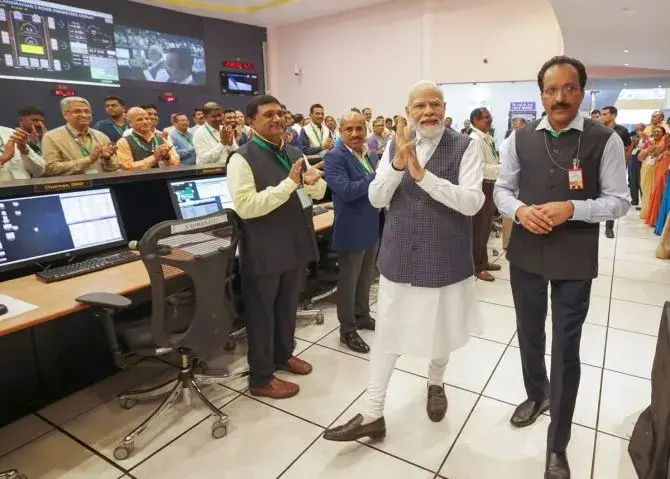
In a momentous announcement, Prime Minister Narendra Modi declared August 23rd as ‘National Space Day,’ during his address to the accomplished scientists at the Indian Space Research Organisation (ISRO) command centre in Bengaluru. The significance of this date stems from the successful soft landing of Chandrayaan-3 on the Moon’s south pole, a remarkable achievement celebrated as a milestone in India’s space exploration journey. Prime Minister Modi expressed his admiration for the Chandrayaan-3 team and particularly lauded the contributions of women scientists who played a pivotal role in the mission’s success. He revealed that the precise spot on the lunar surface where Chandrayaan-3 touched down would be named ‘Shivshakti,’ serving as an inspiration for future generations to utilize science for the betterment of humanity. He also designated the location where its predecessor, Chandrayaan-2, had landed as the ‘Tiranga’ point. Highlighting the importance of advancements in science, technology, and space exploration, PM Modi emphasized that nations leading in these fields are scripting history. To encourage the youth’s involvement in science, technology, and space endeavours, he proclaimed August 23rd, the day of Chandrayaan-3’s lunar landing, as National Space Day. Modi celebrated the fact that India’s national pride now resides on the Moon, marking an unprecedented achievement. He commended the scientists for taking the ‘Make In India’ initiative to the lunar surface, underscoring the boost to indigenous production resulting from Chandrayaan-3’s success. Despite not being physically present during the Chandrayaan-3 landing, PM Modi virtually attended the event, congratulating ISRO chairman S Somanath and the entire team for their historic achievement in the lunar south pole region. Chandrayaan-3, a follow-up mission to Chandrayaan-2, aims to accomplish three key objectives: a safe and soft landing on the lunar surface, rover mobility on the Moon, and in-situ scientific experiments. Following its successful landing on August 23rd, the lander (Vikram) and rover (Pragyan) will conduct a series of experiments on the lunar surface over the next two weeks. On a significant note, Pragyan rover has already made its debut on the Moon, covering a distance of 8 meters. While Chandrayaan-2’s soft-landing attempt didn’t succeed, ISRO’s orbiter from that mission continues to provide valuable data. ISRO’s historic achievement positions India among the world’s top four nations to achieve a soft landing on the Moon’s surface, and notably, it’s the first country to reach the unexplored southern polar region of the Moon.

PM Modi Declares August 23 as ‘National Space Day’ After Chandrayaan-3’s Lunar Success Read More »