ArdorComm Media Group

Wednesday, August 26, 2026 12:23 AM

Social Media

From Scrolling to Storytelling: Why India Is Falling for Microdramas and the Rise of the One-Minute Episode
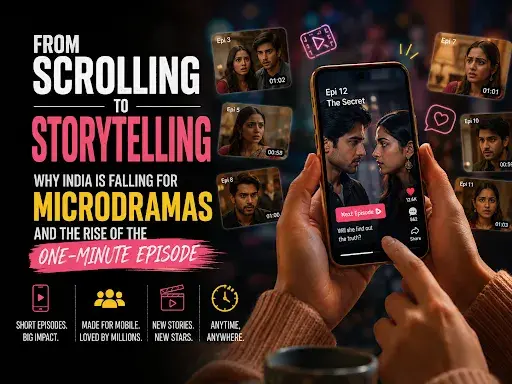
For years, the Indian entertainment industry operated on a familiar rhythm: television serials filled the evening, films dominated weekends and OTT platforms competed for hours of uninterrupted viewing. Then came the reel. What started as a quick way to consume comedy, music, fashion and creator content has gradually changed something deeper — the way Indians expect stories to be told. Today, audiences are increasingly moving from watching isolated short videos to following short, episodic stories designed specifically for the smartphone screen. Microdramas — usually vertical, fast-paced episodes that can run for just a few minutes — are emerging as one of the most interesting developments in India’s digital entertainment economy. And the appeal is surprisingly simple: viewers no longer need to find an hour for entertainment. Entertainment can now find them in the few minutes between meetings, during a commute, while waiting for food or before going to bed. The smartphone has become India’s television screen India’s enormous smartphone and internet ecosystem has created the perfect environment for short-form entertainment. By September 2025, India had nearly 1.02 billion internet users and around 750 million smartphones, while average monthly mobile-data consumption had climbed to about 24 GB per user. That infrastructure has changed the economics of attention. A viewer does not necessarily sit down and decide, “I am going to watch a show now.” Instead, entertainment increasingly appears inside the same feeds used for messaging, shopping, news and social interaction. Meta and Ormax’s 2026 research on India’s microdrama audience found that 89% of viewers discover microdramas through social feeds, while viewers spend a median of 3.5 hours a week watching them, often across multiple short sessions. The study surveyed 2,000 viewers aged 18-44 across 14 states. This is perhaps the biggest difference between microdramas and traditional television or OTT. The viewer doesn’t have to go looking for the programme. The programme finds the viewer. From “scroll” to “what happens next?” The evolution is particularly interesting because microdramas combine two seemingly different entertainment habits. The first is the infinite scroll. The second is the serialised story. Reels trained audiences to expect immediate gratification. Traditional television trained them to return tomorrow for the next episode. Microdramas bring those two behaviours together. An episode might establish a conflict in the first few seconds, introduce a dramatic twist and end precisely when the viewer wants an answer. Then comes the next episode. And the next. Instead of asking viewers to commit to a 45-minute episode, microdramas repeatedly ask for a much smaller commitment: just another two minutes. That seemingly insignificant decision can become a surprisingly powerful retention mechanism. The cliffhanger is the new hook Traditional television often used the commercial break to create suspense. OTT platforms use episode endings and season arcs to encourage binge-watching. Microdramas take the idea to an extreme. Almost every episode has to work as a miniature marketing device for the next one. A confrontation may begin in Episode 12 and be resolved only in Episode 13. A secret is revealed halfway through an episode and explained later. A character receives a message — and the episode ends before the audience sees the reply. The objective is not simply to tell a story. It is to create a reason to tap again. This makes microdrama storytelling fundamentally different from conventional short-form creator content. A reel can succeed because it is funny, informative or visually striking. A microdrama needs another ingredient: narrative momentum. Why younger audiences are responding The strongest concentration of microdrama viewers in India is among younger audiences, particularly those aged 18-34, although the format is also attracting students, working professionals, homemakers and viewers outside major metropolitan centres. That demographic profile makes sense. Younger viewers have grown up in an environment where entertainment is available continuously and where the smartphone is often the first screen of the day. But the appeal isn’t necessarily limited to Gen Z. A working professional may not have the time or patience to begin a full-length series after a long day. A student may want entertainment during a short break. Someone travelling on public transport can watch several episodes without needing to dedicate an entire evening. Microdramas effectively turn dead time into entertainment time. India is particularly suited to the format There is another reason microdramas could become much bigger in India: linguistic diversity. A traditional OTT series requires significant investment in production, marketing and distribution. Microdramas can potentially be produced and adapted for different languages and audience segments at a much faster pace. That opens the door to stories built specifically for Hindi, Tamil, Telugu, Bengali, Marathi and other regional audiences rather than treating India as one homogeneous market. The rise of Tamil microdramas, for example, illustrates how quickly the format can develop within a regional entertainment ecosystem. Short dramas lasting roughly one to five minutes are increasingly attracting younger audiences and creating opportunities for new actors, writers and creators. This could eventually produce an entertainment landscape where the next major digital star doesn’t necessarily emerge from television or cinema. They could emerge from a 90-second episode watched on a phone. Bollywood’s biggest competition may not be another film The rise of microdramas also raises an important question for the broader entertainment industry. What exactly are OTT platforms competing against? For years, the answer was Netflix versus Amazon Prime Video versus Disney+ Hotstar and other streaming services. But the competition is increasingly about attention rather than platforms. A viewer deciding whether to watch a 50-minute drama, scroll through Instagram, watch YouTube Shorts or follow a 20-episode microdrama is making an attention decision. That is why major streaming and entertainment companies are increasingly interested in the category. Industry reporting in 2026 has highlighted growing investment in microdramas from major players, as platforms look at short episodic content as both a discovery mechanism and a potential new entertainment business. In other words, the microdrama isn’t necessarily trying to replace the blockbuster series. It is fighting for the moments when the blockbuster series is simply too


From Scrolling to Storytelling: Why India Is Falling for Microdramas and the Rise of the One-Minute Episode Read More »

Children Under 13 May Need Parental Consent to Join Social Media, Gaming Platforms Under Proposed Bill

Children below the age of 13 may be prohibited from creating accounts on social media and online gaming platforms without verified parental consent under a proposed private member’s bill introduced by BJP MP Baijayant Panda. The Safeguarding Healthy Internet Environments for Little Digital-Natives (SHIELD) Bill, 2025, seeks to establish stronger safeguards for children using digital platforms. The proposed legislation would also prevent platforms from tracking, profiling or serving personalised advertisements to minors. The bill was listed for introduction in Parliament on Friday but could not be taken up as proceedings were disrupted by repeated adjournments. Another private member’s bill on preventing the misuse of artificial intelligence to generate realistic replicas of individuals was also scheduled for introduction. Under the proposed legislation, platforms accessible to minors would be required to implement age-verification mechanisms and provide parental-control dashboards. These tools would enable parents or guardians to monitor online activity, adjust privacy settings and control children’s screen time. The SHIELD Bill defines a child as an individual below 18 years of age and proposes specific safety obligations for social media networks, online gaming services and other digital intermediaries. The legislation seeks to prohibit platforms from collecting or using children’s data for tracking, profiling or personalised advertising. It would also require platforms to take measures to limit minors’ exposure to potentially harmful material, including pornography, gambling and simulated betting, violent or extremist content, and information related to drugs. Companies found violating the proposed provisions could face fines of up to ₹10 crore. In cases involving repeated or deliberate violations, authorities could potentially order the temporary suspension or blocking of services under Section 69A of the Information Technology Act. However, the proposed legislation still faces a long legislative path. Private members’ bills are rarely enacted into law, with only a small number having successfully cleared Parliament since Independence. Source: Hindustan Times  

Children Under 13 May Need Parental Consent to Join Social Media, Gaming Platforms Under Proposed Bill Read More »

Survey: Germans See Social Media as the Main Source of Fake News

A recent study by the Bertelsmann Foundation reveals that 81% of Germans view the spread of disinformation as a significant threat to democracy, with social media emerging as the primary source of fake news. The survey highlights widespread concerns about the impact of online misinformation on elections, social cohesion, and contentious topics like migration, health, climate change, and war. Approximately 78% of respondents worry that such falsehoods could influence electoral outcomes and deepen societal divisions. Two-thirds of participants identified active social media users and bloggers as the main culprits behind the spread of misinformation. Additionally, 53% pointed to foreign governments, and half of the respondents even accused the German government of contributing to the problem. Despite these concerns, the study found that 93% of respondents trust the media but believe fake news is deliberately propagated to undermine confidence in politics and democracy. Some social media users have proposed that Germany adopt measures similar to Türkiye’s “Disinformation Combat Center,” a government initiative designed to counteract false information. The rise of misinformation on social media has become a global concern, with many nations grappling with its impact on political polarization and public trust. Germany’s experience underscores the urgent need for robust strategies to combat fake news and safeguard democratic processes. As disinformation continues to grow, Germany and other nations face increasing challenges in balancing free speech with efforts to protect their democracies from the erosion of public trust.  

Survey: Germans See Social Media as the Main Source of Fake News Read More »

Australia to Ban Social Media for Under-16s to Support Youth Mental Health

Australia has introduced a sweeping measure to protect young people’s mental health by restricting social media access for those under 16, placing the onus on social media platforms—not parents—to prevent underage users. Prime Minister Anthony Albanese announced that companies failing to enforce these new age restrictions will face heavy penalties. “Social platforms must demonstrate reasonable steps to prevent access,” he stated, underscoring that penalties would target companies rather than families. This restriction forms part of a broader government agenda to tackle the influence of social media on mental health, including addressing misinformation. Australia has already taken significant tech regulation steps, such as requiring Google and Facebook to compensate for news content and challenging X Corp in court for its response to online content issues. These measures echo similar initiatives in Europe, where France and the UK are also enforcing social media age restrictions, further aligning with the EU’s GDPR. However, enforcing age restrictions globally remains complex due to varied regulations and technical challenges in age verification. Source: Business Standard Photo Credit: Business Standard  

Australia to Ban Social Media for Under-16s to Support Youth Mental Health Read More »

Shruti Haasan and Santanu Hazarika Split After Four Years of Relationship

Shruti Haasan and Santanu Hazarika have decided to end their relationship after four years together, with reports suggesting that they were living together before the breakup. The news was confirmed by paparazzo Viral Bhayani on Instagram, who shared a picture of the couple along with details about their separation. The Instagram post by Viral Bhayani mentioned that Shruti Haasan and Santanu Hazarika, who had been living together for the past couple of years, have now parted ways. Additionally, it was noted that they have unfollowed each other on Instagram, further solidifying the news of their split. Shruti also removed all pictures with Santanu from her Instagram account and took a brief hiatus from social media. Reports indicate that Shruti and Santanu’s relationship blossomed during the COVID-19 pandemic, initially sparked through social media interactions. In a previous interview, Shruti referred to Santanu as her best friend, stating that they were together by chance. She shared that they connected over their shared interests, with Shruti sending Santanu one of her poems, and he reciprocating by sharing his artwork. On the professional front, Shruti Haasan was last seen in the film ‘Salaar’, starring alongside Prabhas and Prithviraj Sukumaran. She is set to appear in the Telugu film ‘Dacoit: A Love Story’, opposite Advi Shesh. Additionally, she has notable projects lined up, including her father Kamal Haasan’s directorial ‘Sabaash Kundu’ and an untitled project with filmmaker Lokesh Kanagaraj.

Shruti Haasan and Santanu Hazarika Split After Four Years of Relationship Read More »

Princess Kate Announces Cancer Diagnosis: A Story of Courage and Resilience

Blog on Health

In a poignant and courageous announcement, Catherine, the Princess of Wales, revealed in a heartfelt video message the discovery of cancer following her recent abdominal surgery. Facing widespread speculation about her health and controversy over doctored images, the 42-year-old princess shared that she is now undergoing preventative chemotherapy on the advice of her medical team. The news, which came after months of public scrutiny and silence from Kensington Palace, shed light on the princess’s journey towards healing and resilience. With her characteristic grace and strength, Kate expressed gratitude for the outpouring of support from well-wishers worldwide, while emphasizing the importance of privacy and family during this challenging time. In her message, Kate underscored the shock of her diagnosis and the subsequent efforts to process and manage the news for the sake of her young family. With unwavering support from her husband, Prince William, and the love of her children, George, Charlotte, and Louis, she navigates the complexities of treatment and recovery with courage and determination. The announcement also sparked conversations about cancer awareness and early detection, as medical experts weighed in on the significance of preventative chemotherapy in Kate’s case. Despite the uncertainty surrounding her diagnosis, the princess’s resilience and optimism serve as a beacon of hope for those facing similar challenges. As messages of support pour in from across the globe, the royal family rallies around Kate, offering words of encouragement and solidarity. With her strength and grace, she reminds us all of the power of resilience and the importance of facing adversity with courage and determination. Her story serves as a testament to the indomitable spirit of the human heart and the enduring power of hope in the face of adversity. In the midst of uncertainty, Kate’s unwavering courage and resilience shine brightly, inspiring us all to embrace each day with hope, gratitude, and unwavering determination.

Princess Kate Announces Cancer Diagnosis: A Story of Courage and Resilience Read More »

Maharashtra Unveils ‘MAHASWAYAM’ Portal for Online Higher Education Courses

The state government of Maharashtra is gearing up to launch ‘MAHASWAYAM,’ a dedicated portal for higher education courses. Drawing inspiration from the central government’s SWAYAM portal, ‘MAHASWAYAM’ aims to create a comprehensive platform for online courses, aligning with the evolving landscape of education. Chandrakant Patil, the Minister of Higher and Technical Education, chaired a meeting on Friday to deliberate on the effective implementation of the National Education Policy (NEP) in the state. Professor Shailendra Deolankar, the Director of Higher Education, underscored the active involvement of state universities in offering online courses. To ensure inclusivity for all students, the decision was made to launch ‘MAHASWAYAM’ as a state-centric portal. Under the NEP, students now have the flexibility to pursue online courses for minor subjects, earning valuable credits towards their final scores. Addressing concerns related to academic calendars and fees on the existing SWAYAM portal, Deolankar emphasized that ‘MAHASWAYAM’ aims to provide a holistic solution for both students and administrators. “To implement this initiative, the state government has formed a consortium comprising Yashvantrao Chavan Maharashtra Open University, Savitribai Phule Pune University, University of Mumbai, and Shivaji University, Kolhapur. Over the next three months, the consortium will collaboratively design the portal, focusing on courses related to Indian Knowledge Systems (IKS),” said Deolankar. Minister Patil stressed the importance of leveraging social media for information dissemination, urging the department to comprehensively update the web portal in multiple languages. Additionally, he directed the creation of a dedicated Twitter handle for the Higher and Technical Education Department to ensure regular updates reach a wider audience. The imminent launch of ‘MAHASWAYAM’ is anticipated to reshape the higher education landscape in Maharashtra, offering students a versatile and accessible platform for online learning.  

Maharashtra Unveils ‘MAHASWAYAM’ Portal for Online Higher Education Courses Read More »

Mobilizing Global Education and Cultural Exchange through Technology

Blog on Edu

The world is more interconnected than ever before, and technology has played a pivotal role in bridging geographical gaps. In the realm of education and cultural exchange, technology has revolutionized the way we learn, share, and experience different cultures. Global education and cultural exchange are no longer confined to textbooks and classroom walls; they have evolved into dynamic, interactive experiences thanks to the power of technology. In this blog, we will explore how technology is mobilizing global education and cultural exchange, breaking down barriers and opening doors to a world of knowledge and understanding. Online Learning Platforms The rise of online learning platforms has transformed education into a global endeavour. These platforms provide access to high-quality educational resources, courses, and interactive experiences, connecting learners from all corners of the world. Notable platforms like Coursera, edX, LinkedIn Learning and Khan Academy offer a vast range of courses and materials, allowing learners to explore new subjects and perspectives. Moreover, these platforms facilitate cross-cultural learning by offering courses on diverse topics and bringing together instructors and students from various backgrounds. Also Read: Top 12 Daily Habits for a Healthier Lifestyle Virtual Reality (VR) and Augmented Reality (AR) Virtual and augmented reality technologies have revolutionized cultural exchange. With VR and AR, learners can immerse themselves in virtual environments and experience different cultures first-hand. For example, students can take virtual field trips to ancient historical sites, explore foreign museums, or participate in language exchange programs without leaving their homes. These technologies offer an unparalleled level of engagement and immersion, making it easier for individuals to appreciate and understand cultures different from their own. Language Learning Apps Language is a fundamental aspect of culture, and technology has significantly impacted language learning. Mobile apps like Duolingo, Babbel, and Rosetta Stone provide accessible and interactive language learning experiences. They offer various language courses and tools for learners of all levels, promoting cross-cultural communication and understanding. Technology simplifies language learning by incorporating gamified elements and real-time feedback, making the process enjoyable and effective. Also Read: Nurturing 21st Century Skills in Education: Fostering Critical Thinking and Digital Literacy Social Media and Video Conferencing Social media and video conferencing platforms like Facebook, Instagram, WhatsApp, Skype, and Zoom connect people worldwide in real time. These tools facilitate cross-cultural interactions, allowing individuals to meet and communicate with people from different backgrounds and share their experiences. Additionally, educators can organize virtual international exchange programs or pen-pal initiatives, enabling students to connect with peers from different countries and learn about their cultures through direct conversations. Online Collaborative Projects Technology enables educators and students to engage in collaborative projects with peers from around the world. Virtual teamwork has become increasingly accessible, and platforms like Google Workspace, Microsoft Teams, and other project management tools allow students to work together on assignments, research projects, or even cultural exchange initiatives. This fosters cooperation, understanding, and appreciation of different cultural perspectives. Also Read: ArdorComm ‘New Normal – Education Leadership Summit & Awards 2023’ to be held at Pune, Maharashtra on 24th November 2023 #ELSAPune #ELSAMaharashtra E-Libraries and Digital Archives Access to information is a crucial aspect of global education. E-libraries and digital archives like Google Books, Project Gutenberg, and national libraries have digitized vast collections of books, manuscripts, and cultural artifacts. This wealth of knowledge allows learners to explore historical texts and cultural materials from different regions, helping them gain insights into diverse cultural heritages. Online Cultural Experiences Various organizations and museums now offer virtual cultural experiences through live-streamed events and digital exhibits. Whether it’s exploring art galleries, attending cultural festivals, or participating in cooking classes, these online experiences bring the world’s cultures to your doorstep. Technology allows you to engage with different traditions, art, and customs, fostering a deep appreciation for cultural diversity. Also Read: The Rise of Podcasts: Exploring the Audio Entertainment Revolution Conclusion Technology has truly mobilized global education and cultural exchange, making the world a smaller, more interconnected place. It has not only expanded access to education but has also enriched our understanding of the world’s diverse cultures. As we continue to harness the power of technology, it is crucial to leverage it responsibly, emphasizing respect, empathy, and open-mindedness in our global education and cultural exchange efforts. By doing so, we can truly benefit from the immense potential technology offers in bridging cultural gaps and promoting a more interconnected and harmonious world. The author, Pratik Ghosh is associated with ArdorComm Media

Mobilizing Global Education and Cultural Exchange through Technology Read More »