ArdorComm Media Group

Sunday, April 12, 2026 4:06 AM

community

Q3 Results: New Labour Codes Dent IT Majors’ Profits by ₹5,400 Crore

India’s leading IT services firms reported a sharp one-time earnings impact in the December quarter as the implementation of the new labour codes forced changes in employee benefit provisioning. Collectively, the country’s top six IT companies—TCS, Infosys, HCLTech, Wipro, Tech Mahindra and LTIMindtree—absorbed a cumulative hit of around ₹5,400 crore, significantly weighing on their Q3 FY26 profit numbers. The new labour framework, which consolidates 29 existing laws, has altered the way companies account for benefits such as gratuity and leave encashment, resulting in substantial upfront provisions. Tata Consultancy Services (TCS), India’s largest IT exporter, faced the biggest impact. The company reported a statutory charge of ₹2,128 crore, leading to a 13.9% fall in net profit to ₹10,657 crore. CFO Samir Seksaria explained that the provision included roughly ₹1,800 crore towards gratuity and ₹300 crore for leave encashment. He also cautioned that the new codes are expected to reduce margins by 10–15 basis points on an ongoing basis. Infosys reported an exceptional one-time charge of ₹1,289 crore, which pushed its net profit down 2.2% year-on-year to ₹6,654 crore. CEO Salil Parekh said the labour codes would have a continuing annual margin impact of about 15 basis points. HCLTech recorded a one-off provision of ₹956 crore, dragging net profit down 11.2% to ₹4,076 crore. The company noted that, excluding this impact, profits would have registered growth. Wipro’s net profit declined 7% to ₹3,119 crore, affected by a ₹302.8 crore labour code-related charge along with restructuring costs. Tech Mahindra was the only major IT player to post profit growth during the quarter, with net profit rising 14% to ₹1,122 crore on improved margins. However, it too set aside around $30 million (approximately ₹272 crore) for compliance with the new wage codes. CFO Rohit Anand warned of a quarterly margin impact of about 20 basis points. LTIMindtree accounted for a one-time cost of ₹590 crore in Q3 due to the labour code implementation, adding to the sector-wide earnings pressure. Despite the near-term impact on profitability, IT leaders struck an optimistic note on business fundamentals, citing strong deal pipelines and accelerating demand driven by artificial intelligence (AI). Infosys posted an 8.9% rise in revenue to ₹45,479 crore in Q3 FY26 and raised its full-year revenue growth guidance to 3–3.5% in constant currency terms. The company reported large deal wins worth $4.8 billion during the quarter, with over half coming from new clients. Parekh highlighted strong momentum in AI adoption across customers, particularly in financial services, energy and utilities. Wipro’s revenue grew 5.5% year-on-year to ₹23,555.8 crore, supported by vendor consolidation and AI-led modernisation deals. CEO and MD Srini Pallia said enterprises globally are increasingly treating AI as a board-level priority, positioning the company well for future growth. Tech Mahindra secured new deals worth $1.096 billion in Q3, with CEO Mohit Joshi describing the demand environment as strong across regions and industry verticals. TCS reported a 4.86% increase in revenue to ₹67,087 crore. CEO K Krithivasan said AI and data-led services were key growth drivers, while COO Aarthi Subramanian noted that AI revenues rose 17% quarter-on-quarter to an annualised run rate of $1.8 billion. HCLTech posted a 13.3% rise in revenue to ₹33,872 crore, driven by a sharp sequential increase in advanced AI revenues and solid growth in engineering and R&D services. The company recorded $3 billion in net new bookings, up 43.5% year-on-year. CEO C Vijayakumar emphasised the firm’s focus on AI-powered offerings such as robotics, AI factories, custom silicon and large-scale digital transformation programmes. Hiring trends during the quarter were mixed. TCS reported a net reduction of over 11,000 employees, while Infosys and Wipro added 5,043 and 6,529 staff respectively. HCLTech indicated a strategic shift towards hiring “elite engineers,” offering significantly higher compensation to attract top AI talent. Source: PTI

Q3 Results: New Labour Codes Dent IT Majors’ Profits by ₹5,400 Crore Read More »

Spotify India Posts Profit in FY25 as Subscriptions Drive Turnaround

Spotify’s India business returned to profitability in FY25, reporting a net profit of ₹75 crore, a sharp reversal from a net loss of ₹143 crore in the previous fiscal year. The turnaround was driven by strong revenue growth, led by a surge in paid subscriptions, along with a significant cut in advertising and marketing expenses, according to regulatory filings. Spotify India LLP recorded a 48% year-on-year increase in revenue from operations to ₹514 crore in FY25, up from ₹348 crore in FY24. Including other income, total revenue climbed 50% to ₹527 crore from ₹351 crore in the previous year. Subscription revenue emerged as the key growth engine, jumping 89% to ₹317 crore, as the music streaming industry increasingly nudged users towards paid plans by limiting free-tier consumption. In India, Spotify currently offers three subscription options: Lite at ₹139 per month, Standard priced at ₹99 per month for the first three months and ₹199 per month thereafter, and Platinum at ₹299 per month. Advertising revenue also showed healthy growth, rising 38.5% to ₹187 crore during the year. Spotify is estimated to have a user base of around 70–80 million in India. The company did not respond to queries seeking comment on the results. The Indian entity operates as a limited liability partnership, with Spotify AB holding a 99.99% stake and Spotify Ltd owning the remaining 0.01%. Improved profitability was further aided by strict cost management. Total expenditure fell to ₹451 crore in FY25 from ₹494 crore a year earlier. Advertising and marketing expenses declined sharply to ₹243 crore from ₹387 crore, delivering substantial savings. However, personnel costs rose to ₹100 crore from ₹85 crore due to higher hiring and compensation, while other expenses increased to ₹100 crore from ₹13 crore, partially offsetting the reduction in marketing spends. On the balance sheet front, total assets increased to ₹896 crore as of March 31, 2025, compared with ₹851 crore a year earlier. Cash and cash equivalents also rose to ₹634 crore from ₹599 crore, reflecting a stronger liquidity position. Despite the return to profitability, Spotify India continued to carry accumulated losses. Reserves and surplus remained negative at ₹1,221 crore at the end of FY25, though this improved from ₹1,312 crore in FY24. As per Spotify Technology SA’s global annual report, the India unit had net operating loss carry-forwards of €117 million as of December 2024. These losses can be offset against future taxable profits, subject to applicable laws and regulations. Source: Economic Times

Spotify India Posts Profit in FY25 as Subscriptions Drive Turnaround Read More »

IIT Delhi Introduces Executive Programme in Healthcare Entrepreneurship and Management

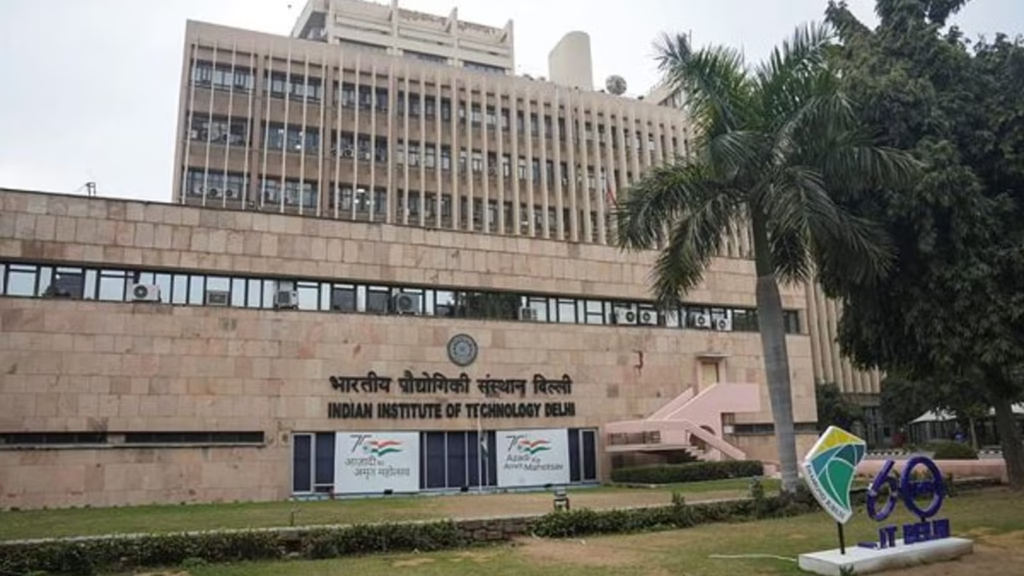
The Indian Institute of Technology (IIT) Delhi has rolled out a new executive programme focused on healthcare entrepreneurship and management, aimed at nurturing professionals who can drive innovation in India’s rapidly evolving healthcare sector. The programme will be conducted under IIT Delhi’s Continuing Education Programme (CEP), a statutory body authorised to run certificate courses and award credentials. According to IIT Delhi, the initiative is designed to equip participants with the skills and mindset required to navigate and shape the future of healthcare innovation. Applicants must possess a bachelor’s degree, while prior professional experience or exposure to projects in related domains will be considered an added advantage. The five-month programme will be delivered through live online classes held on weekends, complemented by dedicated hours for project work. The institute noted that India’s healthcare ecosystem is witnessing transformative changes, driven by the rise of digital health solutions, medical devices, artificial intelligence–enabled diagnostics, wearable technologies and a stronger focus on patient-centric care. However, persistent challenges such as fragmented service delivery, regulatory hurdles, limited commercialisation avenues and the demand for cross-disciplinary leadership continue to affect the sector. Against this backdrop, the executive programme aims to provide a comprehensive understanding of the entire healthcare innovation lifecycle. Through interactive online sessions and guided projects, participants will learn how to identify healthcare challenges and translate them into viable, market-ready solutions using design thinking, prototyping, testing and sound commercial strategies. The programme will be anchored by IIT Delhi’s Centre for Biomedical Engineering and supported by clinical expertise from specialists at AIIMS Delhi. Faculty members including Dr Arnab Chanda and Dr Biswarup Mukherjee will lead the sessions, integrating engineering, clinical practice, management and entrepreneurship to foster practical and scalable healthcare innovations. A major feature of the course is its strong emphasis on project-based learning. Participants will work on real-world healthcare problems, developing deployable prototypes with the help of structured mentoring, peer collaboration and continuous expert feedback. On successful completion, learners will receive an e-certificate from CEP, IIT Delhi, and gain access to a network of IIT Delhi faculty, AIIMS clinicians and industry professionals, enhancing both learning outcomes and professional opportunities. Source: Indian Express

IIT Delhi Introduces Executive Programme in Healthcare Entrepreneurship and Management Read More »

NASA Astronaut Sunita Williams Retires After 27 Years of Distinguished Service

Veteran NASA astronaut Sunita Williams has officially retired from the US space agency, bringing to a close an extraordinary 27-year career in human spaceflight. Her retirement, which took effect on the 27th of last month, was confirmed by NASA in an announcement issued today. In a statement, NASA highlighted Williams’ exceptional achievements, noting that she flew on three missions to the International Space Station (ISS) and spent a cumulative 608 days in space—the second-highest total for any NASA astronaut. She also carried out nine spacewalks, logging more than 62 hours outside the station, a record for the most spacewalking time by a woman. Among her many firsts, Williams also became the first astronaut to run a marathon while in orbit. Williams, who is of Indian origin, made her space debut in 2006 aboard Space Shuttle Discovery. She later went on to command the ISS during Expedition 33. Her final mission took place during 2024–2025, when she flew aboard Boeing’s Starliner and SpaceX Crew-9, serving as commander of Expedition 72. Beyond her time in orbit, Williams played a key role in several ground-based assignments at NASA. Her contributions included astronaut training, mission operations in Russia, and preparing crews for upcoming lunar exploration missions. A former US Navy captain, she has accumulated more than 4,000 flight hours across helicopters and fixed-wing aircraft. Commending her legacy, NASA described Sunita Williams as a pioneer in space exploration whose leadership, dedication and achievements have inspired generations and significantly advanced scientific discovery and human spaceflight. Source: newsonair

NASA Astronaut Sunita Williams Retires After 27 Years of Distinguished Service Read More »

JioHotstar Revises Super & Premium Subscription Prices, Introduces Monthly Plans

JioHotstar has announced a revision in its subscription pricing, increasing rates for its Super and Premium tiers while rolling out monthly plans across all categories. The new pricing framework will come into effect from January 28, 2026. Under the updated structure, quarterly and annual plans for Super and Premium users will cost more, reflecting changing viewing habits. According to the platform, a growing number of users are shifting towards connected TVs and multi-device viewing, leading to a sharp rise in large-screen consumption over the past year. While Mobile plan users will see no change in their quarterly and annual prices, higher-tier subscribers will pay more for longer-term packs. The Premium annual plan has been increased from ₹1,499 to ₹2,199, and the Super annual plan has gone up from ₹899 to ₹1,099. Quarterly prices for both tiers have also been revised upward. At the same time, JioHotstar has introduced monthly entry-level plans, starting at ₹79 for Mobile users, aimed at first-time and short-term viewers seeking flexibility. Additionally, Hollywood content will now be included for new Super and Premium subscribers, while Mobile users can access international titles through a paid add-on. Existing subscribers will continue at their current rates as long as auto-renewal remains enabled. JioHotstar currently boasts over one billion downloads on Google Play and reaches more than 450 million monthly active users across India. Commenting on the change, Sushant Sreeram, Head – SVOD Business & CMO, JioStar, said the revised pricing aligns with evolving audience preferences. He noted that the update is designed to offer greater choice and flexibility, while supporting continued investment in premium content, live sports, and a high-quality streaming experience at scale. Source: Economic Times

JioHotstar Revises Super & Premium Subscription Prices, Introduces Monthly Plans Read More »

Wipro Cuts FY26 Fresher Hiring Outlook After Soft Q3 Performance

Wipro has scaled back its fresher recruitment plans for the ongoing financial year FY26, now expecting to hire 7,500–8,000 graduates, compared to its earlier guidance of 10,000–12,000. The revision follows a subdued performance in the third quarter, during which the IT major onboarded only around 400 freshers. Addressing analysts during the company’s Q3 earnings call, Saurabh Govil, Chief Human Resources Officer at Wipro, said campus hiring remained slow in the quarter, prompting the company to reassess its annual intake target. Despite the moderation, Wipro’s cumulative fresher hiring for the year so far has crossed 5,000. While overall volume hiring has eased, the company is sharpening its focus on AI and deep-tech talent. Wipro has partnered with universities to set up nearly 50 Centres of Excellence, where it co-develops specialised curricula in areas such as artificial intelligence, cybersecurity and data analytics, and recruits students trained through these programmes. The company is also offering premiums for candidates with relevant client-facing experience and investing heavily in upskilling existing employees through certifications. During the October–December quarter, Wipro added 6,529 employees, taking its total workforce to 2,42,021. The headcount increase was largely due to the integration of the Harman DTS acquisition and the rebadging of staff from a major deal signed in the previous fiscal year. On compensation, Wipro said decisions on salary hikes are still under consideration. Financially, the company reported a 7% year-on-year drop in consolidated net profit to ₹3,119 crore in Q3 FY26, impacted by one-time restructuring costs and the implementation of labour codes. Revenue from operations, however, grew 5.5% to ₹23,555.8 crore, up from ₹22,318.8 crore in the same quarter last year. Source: PTI  

Wipro Cuts FY26 Fresher Hiring Outlook After Soft Q3 Performance Read More »

Tamil Nadu Drugs Control Warns Against Ethylene Glycol–Adulterated Cough Syrup

The Tamil Nadu Directorate of Drugs Control has issued a public alert cautioning citizens against the purchase, sale, or use of a specific batch of Almont-Kid Syrup after laboratory tests confirmed contamination with ethylene glycol, a highly toxic chemical. In the interest of public safety, the directorate has banned Almont-Kid Syrup (Levocetrizine Dihydrochloride and Montelukast Sodium Syrup), Batch No. AL-24002, manufactured in January 2025 and expiring in December 2026. The product is manufactured by Tridus Remedies, Vaishali, Bihar. Authorities have warned that consumption of this adulterated syrup poses serious health risks. Ethylene glycol is a poisonous substance that can lead to severe complications such as acute kidney failure and even death if ingested. Following the alert, all retailers, distributors, hospitals, and pharmacies across Tamil Nadu have been instructed to immediately withdraw the affected batch from circulation and report any instances of supply or sale. Consumers have been advised to verify batch details before use and strictly avoid consuming the identified product. Anyone in possession of the syrup is urged to hand it over to authorities for safe disposal. Healthcare professionals have also been asked to remain vigilant and watch for symptoms of ethylene glycol poisoning in patients who may have consumed the syrup. Any adverse reactions or suspected cases should be reported promptly to the Directorate of Drugs Control. To curb further distribution, intensified inspections and surveillance are being carried out at medical stores and healthcare facilities across the State. For assistance or to report concerns, consumers can contact the directorate via WhatsApp at 94458 65400. Source: The Hindu

Tamil Nadu Drugs Control Warns Against Ethylene Glycol–Adulterated Cough Syrup Read More »

UP Board to Make Vocational Education Mandatory for Classes 9 and 11 from 2026

The Uttar Pradesh Madhyamik Shiksha Parishad (UPMSP) has announced that vocational education will become a compulsory part of the curriculum for students of Classes 9 and 11 starting from the academic year 2026. The initiative is aimed at strengthening the link between school education and employability by introducing skill-based, job-oriented learning at an early stage. UP Board Secretary Bhagwati Singh said that subject committees have approved and submitted curricula for various vocational trades, including information technology and allied sectors, electronics, apparel, and beauty and wellness. These employment-focused courses were developed through multiple rounds of deliberations by subject experts, under the guidance of Additional Secretary Satyendra Kumar Singh and Skand Shukla. The approved curricula emphasize practical training, current technological requirements, and industry expectations to enhance students’ employability. By integrating hands-on and competency-based learning, the move aligns with the objectives of the National Education Policy and aims to promote skill development, self-reliance, and vocational proficiency among students. Singh added that work is underway to develop curricula for additional vocational trades. The Central Institute of Vocational Education, Bhopal, supported the course design process, with contributions from experts including Sanjeev Kumar Arya, Virendra Nath Shukla, Dr Aditi Goswami, Dr Dilip Singh, and Dr Avinash Pandey. Source: Indian Express

UP Board to Make Vocational Education Mandatory for Classes 9 and 11 from 2026 Read More »

All Higher Education Institutions Mandated to Set Up Equity Committees Under New UGC Rules

The Union government has notified fresh regulations making it compulsory for all colleges and universities across the country to establish equity committees aimed at addressing discrimination and promoting inclusivity on campus, officials said. Under the University Grants Commission (Promotion of Equity in Higher Education Institutions) Regulations, 2026, every higher education institution (HEI) must constitute an Equal Opportunity Centre (EOC) along with an Equity Committee. These bodies will handle complaints related to discrimination and ensure fair treatment of students, faculty, and staff from disadvantaged groups. The regulations require that equity committees include representatives from Other Backward Classes (OBCs), Scheduled Castes (SCs), Scheduled Tribes (STs), persons with disabilities (PwDs), and women. Members will serve a two-year term, while special invitees will hold office for one year. The draft version of these regulations was released for public consultation in February last year. The final notification follows directions from the Supreme Court, which had asked the UGC to frame new rules while hearing petitions filed by the mothers of Rohith Vemula and Payal Tadvi. The petitions questioned the implementation of the earlier 2012 UGC regulations on equity. As per the notification, every HEI must set up an Equal Opportunity Centre to ensure the effective implementation of policies for disadvantaged groups, offer academic, financial, social, and personal guidance, and encourage diversity on campus. In cases where a college does not have at least five faculty members, the responsibilities of the centre will be handled by the Equal Opportunity Centre of the affiliated university. The EOC is also expected to coordinate with civil society organisations, local media, law enforcement agencies, district administrations, non-governmental organisations, parents, and institutional staff to fulfil the objectives of the regulations. Additionally, it will work with District and State Legal Services Authorities to provide legal assistance in deserving cases. The head of the institution will appoint a senior faculty member or professor with a demonstrated commitment to the welfare of disadvantaged communities as the coordinator of the centre. The Equity Committee, formed under the EOC, will oversee its functioning and investigate complaints of discrimination. The regulations also call for the creation of ‘Equity Squads’, smaller groups tasked with maintaining vigilance on campus and preventing discriminatory practices. The move comes in the backdrop of high-profile cases such as that of Rohith Vemula, a PhD scholar at the University of Hyderabad who died by suicide in 2016, and Payal Tadvi, a resident doctor who died in 2019, both allegedly after facing caste-based harassment. Source: PTI

All Higher Education Institutions Mandated to Set Up Equity Committees Under New UGC Rules Read More »

BookMyShow Reports ₹192 Crore Profit Driven by Strong Live Events Growth

Big Tree Entertainment, the company behind online ticketing major BookMyShow, has reported a consolidated net profit of ₹192 crore for the financial year ended March 2025, marking a sharp rise from ₹109 crore recorded in the previous fiscal. The growth was largely fuelled by robust performance in ticketing and a rapidly expanding live events business. As per filings with the Registrar of Companies (RoC), the company’s total income increased significantly to ₹1,869 crore in FY25, compared with ₹1,430 crore in FY24. During the same period, total expenditure also rose to ₹1,704 crore from ₹1,320 crore, reflecting higher operating costs associated with scaling up large-format live events. The surge in revenue and expenses was primarily attributed to the expansion of live entertainment offerings, including major music festivals, touring concerts, and comedy shows. BookMyShow, however, declined to officially comment on its financial performance. India’s largest online entertainment ticketing platform, BookMyShow competes with players such as Zomato-backed District. Beyond movie ticketing, the company has built a strong live events portfolio, hosting and managing popular properties like Lollapalooza India. Online ticketing continued to be the company’s biggest revenue contributor, generating ₹828 crore in FY25, up from ₹741 crore a year earlier. Meanwhile, revenue from live events saw a steep jump to ₹756 crore from ₹455 crore, highlighting growing consumer demand for concerts and on-ground experiences. In 2025, BookMyShow served as the ticketing partner for British rock band Coldplay’s India concerts under the Music of the Spheres World Tour. The company also benefited from a strong film release calendar during the year. Source: Economic Times

BookMyShow Reports ₹192 Crore Profit Driven by Strong Live Events Growth Read More »