ArdorComm Media Group

Monday, July 13, 2026 10:26 AM

Gujarat

Private Universities Drive India’s Higher Education Expansion, Growing Three Times Faster Than Public Institutions Over a Decade

India’s higher education landscape has witnessed a major transformation over the past decade, with private universities emerging as the primary drivers of institutional growth. According to the Ministry of Education’s All India Survey on Higher Education (AISHE) 2023-24, the number of private universities increased from 219 in 2013-14 to 546 in 2023-24, registering a remarkable 149.3% growth. In comparison, government universities rose from 504 to 733 during the same period, reflecting a comparatively modest 45.4% increase. Overall, the total number of universities in the country climbed from 723 to 1,279, marking a 76.9% rise over the decade. The data indicates that private universities expanded at more than three times the pace of their government counterparts. At the state level, Gujarat recorded the highest increase in private universities, adding 51 institutions to reach 67 private universities in 2023-24, overtaking Rajasthan, which now has 57. Madhya Pradesh followed with 52 private universities, while Uttar Pradesh and Maharashtra reported 45 and 42, respectively. Government universities, however, continued to maintain a strong presence across the country. Uttar Pradesh remained the leading state in terms of public universities, increasing its count from 35 to 58, followed by Karnataka, which expanded from 32 to 51 government institutions. Despite the rapid rise in private universities, public institutions continue to educate the majority of university students. Government university enrolment increased from 51.9 lakh students in 2013-14 to 73.9 lakh in 2023-24, although their share of total enrolment declined from 81.3% to 68.1% over the decade. Private universities, on the other hand, recorded a much sharper increase in student numbers. Enrolment nearly tripled from 11.9 lakh to 34.6 lakh students, representing a 191.8% growth. Their share of total university enrolment rose from 18.6% in 2013-14 to 31.9% in 2023-24, highlighting their growing role in India’s higher education ecosystem. The AISHE findings also point to broader progress in higher education participation. India’s Gross Enrolment Ratio (GER) for the 18–23 age group improved from 23.0 in 2013-14 to 30.0 in 2023-24. Female participation continued to outpace that of males, with the female GER reaching 31.2, compared to the male GER of 28.9, marking the seventh consecutive year in which women recorded a higher enrolment ratio. Source: Indian Express  
Private Universities Drive India’s Higher Education Expansion, Growing Three Times Faster Than Public Institutions Over a Decade Read More »

Five Semiconductor Plants Expected to Be Operational in India by End of 2026: Ashwini Vaishnaw

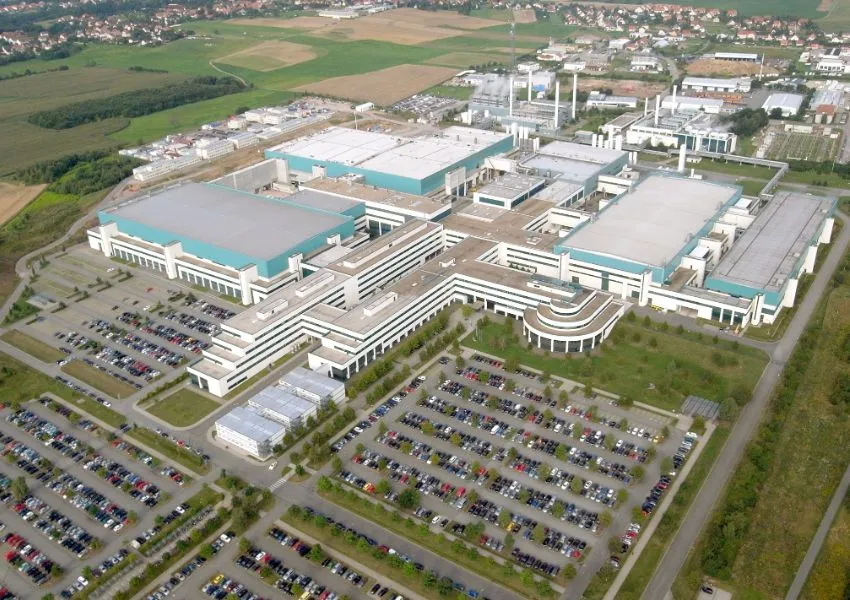
India is on track to have five semiconductor manufacturing plants operational by the end of 2026, Union Minister Ashwini Vaishnaw has said, marking a significant milestone in the country’s efforts to build a strong domestic semiconductor ecosystem. According to the minister, the Centre has approved 12 semiconductor projects, of which three facilities have already entered commercial production, while two more are expected to be inaugurated in the coming months. Prime Minister Narendra Modi had earlier inaugurated the country’s first and second semiconductor plants on February 28 and March 31, 2026, respectively. Vaishnaw noted that the commercial launch of the CG SEMI (OSAT) facility in Sanand, Gujarat, has further strengthened global confidence in India’s semiconductor manufacturing capabilities. He said the country is steadily building a world-class semiconductor ecosystem that will support India’s long-term economic and technological growth. The minister also praised the Gujarat government for its efficient execution, highlighting that the CG SEMI facility progressed from groundbreaking to commercial production in just 27 months. Beyond manufacturing, the plant has also generated employment opportunities for young women from states including Jharkhand, Chhattisgarh, Madhya Pradesh, Bihar, Jammu & Kashmir, Kerala, and Gujarat, many of whom received specialised semiconductor training in Malaysia. Vaishnaw added that as India’s semiconductor ecosystem expands, advanced training programmes are expected to become increasingly available within the country. Semiconductor products manufactured at the Sanand facility will cater to the automotive, two-wheeler, and industrial equipment sectors, while also being exported to markets such as Japan, the United States, and Europe, reinforcing India’s position in the global semiconductor supply chain. The CG SEMI project, launched in March 2024 with an investment exceeding ₹7,600 crore, has been developed in collaboration with Renesas Electronics of Japan, enabling access to advanced semiconductor technologies, manufacturing expertise, and global quality standards. Vaishnaw also highlighted the rapid growth of India’s electronics manufacturing industry, which is now valued at nearly ₹13 lakh crore and supports employment for over 25 lakh people. Source: IANS  

Five Semiconductor Plants Expected to Be Operational in India by End of 2026: Ashwini Vaishnaw Read More »

Gujarat CM Disburses ₹370 Crore in Scholarships to Over 13 Lakh Students via DBT

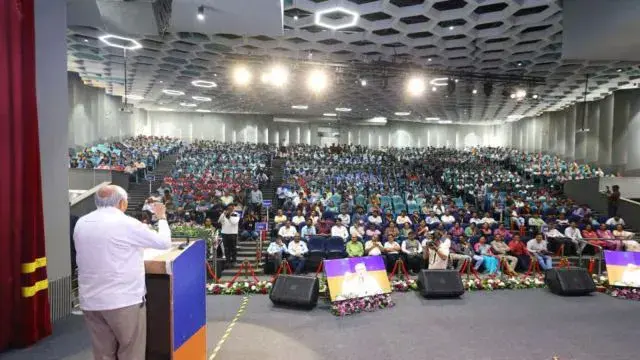
Gujarat Chief Minister Bhupendra Patel announced the transfer of more than ₹370 crore in scholarship assistance to over 13 lakh students through Direct Benefit Transfer (DBT) in Gandhinagar. The financial support was provided under four key state education schemes—Namo Lakshmi Yojana, Namo Saraswati Vigyan Sadhana Yojana, Mukhyamantri Gyan Sadhana Merit Scholarship Yojana, and Mukhyamantri Gyan Setu Merit Scholarship Yojana. The event was attended by Deputy Chief Minister Harsh Sanghavi, Education Minister Pradyuman Vaja, and Minister of State for Education Rivabaa Jadeja. Addressing the gathering, Chief Minister Patel highlighted the significant progress Gujarat’s education sector has made over the last two-and-a-half decades under the leadership of Prime Minister Narendra Modi. He said the vision of providing uninterrupted access to education from kindergarten to postgraduate level is steadily being realised. Special emphasis, he added, has been placed on girls’ education through initiatives like Namo Lakshmi Yojana and Namo Saraswati Vigyan Sadhana Yojana, aimed at ensuring continued participation of girls in secondary and higher secondary education. Recalling Prime Minister Modi’s tenure as Gujarat Chief Minister from 2001, Patel said his hands-on efforts—such as personally visiting villages to promote girls’ education and auctioning gifts received during his tenure to fund educational initiatives—set new standards nationwide. These efforts, combined with programmes like Shala Praveshotsav and Kanya Kelavani Mahotsav, helped reduce the girls’ dropout rate from 37 percent to less than two percent. The Chief Minister also outlined the expansion of educational infrastructure in the state. Village schools offering science streams have increased to 2,834, while the number of colleges has grown from 775 in 2001 to over 3,200 today. Engineering colleges have risen from 139 to 288, and medical seats have expanded from 1,175 to more than 7,000. Additionally, over 24,000 girls pursuing medical education have benefited from the Mukhyamantri Kanya Kelavani Nidhi Yojana. Deputy Chief Minister Harsh Sanghavi said the ₹370 crore disbursed on the day forms part of a larger commitment, with the state having provided more than ₹1,332 crore in assistance to over 13.5 lakh students so far. Congratulating the Chief Minister on completing three years of his second term, he praised his people-centric leadership and strong focus on education. Sanghavi noted that the Namo Saraswati Vigyan Sadhana Yojana was launched to ensure that financial constraints do not prevent students from opting for the science stream, especially as Gujarat continues to attract major industrial investments. Education Minister Pradyuman Vaja stated that Gujarat’s investment in education is aimed at building a strong foundation for a Viksit Gujarat and a Viksit Bharat. He said these schemes are opening new opportunities and aspirations for students across the state. Sharing scheme-wise details, he said the Namo Lakshmi Yojana has so far disbursed ₹1,033 crore to 10.49 lakh girls, leading to a 73 percent increase in attendance and a 13.59 percent rise in enrolment in Class 12. Under the Namo Saraswati Vigyan Sadhana Yojana, ₹151.84 crore has been provided to 1.5 lakh students, resulting in a 6.34 percent increase in science stream enrolment. The Mukhyamantri Gyan Sadhana Merit Scholarship Yojana has extended ₹86.14 crore to 50,000 students, while the Mukhyamantri Gyan Setu Merit Scholarship Yojana has provided ₹61.27 crore to 60,000 students, promoting merit-based and quality education. Minister of State for Education Rivabaa Jadeja described the programme as a landmark moment, reaffirming that education remains the most effective tool for social transformation. She said the state government is committed to ensuring quality education, strengthening infrastructure, promoting girls’ education, reducing dropout rates, and supporting the holistic development of students to prepare them for a brighter future. Source: PTI

Gujarat CM Disburses ₹370 Crore in Scholarships to Over 13 Lakh Students via DBT Read More »

India Set to Become World’s 3rd Largest Economy by 2028: Morgan Stanley

India is on course to become the third-largest economy in the world by 2028 and is expected to more than double its GDP to $10.6 trillion by 2035, according to a new report by Morgan Stanley released on Wednesday. The report highlights that several Indian states — notably Maharashtra, Tamil Nadu, Gujarat, Uttar Pradesh, and Karnataka — could individually near the $1 trillion GDP mark, placing them among the globe’s top 20 economies by the next decade. “Currently, Maharashtra, Gujarat, and Telangana lead the economic race among states,” the report noted, adding that states like Chhattisgarh, Uttar Pradesh, and Madhya Pradesh have climbed significantly in economic rankings over the past five years. India to Drive Global Growth Morgan Stanley projects that India will account for roughly 20% of global economic growth over the next ten years. As a result, the country is positioned to become a major growth engine for global corporations and investors. The report underscores the pivotal role of India’s federal structure — with 28 states and eight Union Territories — in propelling economic progress. It points out that each state manages its fiscal policies independently and competes to attract business and investment through favourable industrial policies and ease-of-doing-business reforms. “Every investment decision, factory setup, or enterprise ultimately lands in a particular state,” the report explains. Competitive Federalism as a Growth Catalyst The study places strong emphasis on “competitive federalism” — a model in which states innovate and vie with one another for economic advancement. This approach, Morgan Stanley argues, will be critical for India to become a global manufacturing powerhouse, significantly raise per capita income, and maintain a robust capital market performance over the coming years. As India moves toward its projected $10.6 trillion economic size, the role of states will become even more vital. Their ability to legislate independently and shape business environments allows them to create conducive ecosystems for growth. Infrastructure Boom Underway The report also points to a decade of strong infrastructure development. Central government capital expenditure has surged, growing from 1.6% of GDP in FY15 to 3.2% in FY25. This investment has led to a 60% increase in national highway length, a doubling of airports, and a fourfold expansion of metro rail systems. National-level programs such as PM Gati Shakti, the National Infrastructure Pipeline, Bharatmala, Sagarmala, and UDAN have all complemented state-led initiatives in infrastructure, energy, water, and urban development. For India to realize its long-term economic aspirations, the report concludes, continuous collaboration between the central and state governments will be essential. Source: IANS

India Set to Become World’s 3rd Largest Economy by 2028: Morgan Stanley Read More »

New COVID-19 Subvariants NB.1.8.1 and LF.7 Detected in India: INSACOG Report

India has recorded the presence of two newly emerging COVID-19 subvariants—NB.1.8.1 and LF.7—according to recent data released by the Indian SARS-CoV-2 Genomics Consortium (INSACOG). While these variants are currently categorized as Variants Under Monitoring by the World Health Organization (WHO), they have been linked to the recent surge in COVID-19 cases across China and parts of Asia. As per the INSACOG data, a single case of NB.1.8.1 was identified in Tamil Nadu in April, while four cases of LF.7 were reported from Gujarat in May 2025. Despite these new detections, the dominant strain circulating in India remains JN.1, accounting for approximately 53% of the tested samples. It is followed by BA.2 (26%) and other Omicron-related variants (20%). Preliminary assessments by WHO suggest that NB.1.8.1 poses a low global public health risk, but the subvariant carries spike protein mutations—A435S, V445H, and T478I—that may enhance both transmissibility and the ability to evade immune responses. As of May 19, India reported 257 active COVID-19 cases. A high-level review meeting was recently convened, chaired by the Director General of Health Services, with participation from the ICMR, National Centre for Disease Control, and other leading health agencies to monitor the evolving situation. Meanwhile, certain states have shown localized spikes. Delhi reported 23 new cases, Andhra Pradesh had four, Telangana confirmed one, and Bengaluru recorded a positive case in a nine-month-old infant, reflecting a steady rise over the last 20 days. Kerala, in particular, reported 273 cases in May alone. Source: PTI

New COVID-19 Subvariants NB.1.8.1 and LF.7 Detected in India: INSACOG Report Read More »

61.6% of India’s Schools Follow Three-Language Policy; Gujarat & Punjab Lead, TN & Arunachal Lag

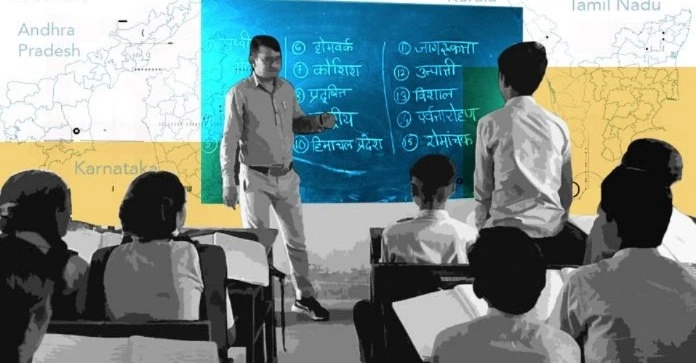
The Union Education Ministry has revealed that 61.6% of schools in India follow the three-language formula, covering 74.7% of students nationwide. Gujarat and Punjab lead in implementation, while Arunachal Pradesh, Nagaland, and Tamil Nadu rank among the lowest. The data, presented in Parliament on Monday in response to DMK MP Kanimozhi Karunanidhi’s query, highlights the ongoing conflict between Tamil Nadu and the Centre over the National Education Policy (NEP) 2020. Tamil Nadu’s DMK-led government opposes the three-language policy, calling it a move toward “Hindi imposition.” Key Insights from the Report: Schools Offering Three Languages: 906,225 (61.6%) Schools Offering Two Languages: 416,601 (28.3%) Schools Offering One Language: 149,065 (10.1%) Students Studying Three Languages: 185.3M (74.7%) Students Studying Two Languages: 41.6M Students Studying One Language: 21M Union Minister of State Jayant Chaudhary emphasized that no language would be imposed on any state, and flexibility would be provided to choose languages. However, analysis shows that Hindi-speaking states predominantly offer Sanskrit as the third language, while non-Hindi states often include Hindi. Meanwhile, private schools are increasingly offering foreign languages due to rising demand. The debate over language education remains heated, particularly in states like Tamil Nadu, where linguistic identity plays a central role in politics. The data highlights the diverse linguistic landscape of India’s education system and the ongoing policy challenges in balancing national and regional priorities.

61.6% of India’s Schools Follow Three-Language Policy; Gujarat & Punjab Lead, TN & Arunachal Lag Read More »

Centre Postpones Good Governance Index 2023, Next Release Scheduled for 2025

The release of the Good Governance Index (GGI) 2023, originally planned during Good Governance Week from December 19 to 25, has been deferred to 2025. The decision, as confirmed by the Department of Administrative Reforms and Public Grievances (DARPG), reflects the need for updated data to ensure accurate and relevant governance assessments. The GGI, launched in December 2019 on the birth anniversary of former Prime Minister Atal Bihari Vajpayee, evaluates states and Union Territories (UTs) across over 50 indicators in sectors such as agriculture, economic governance, public health, and citizen-centric governance. In the 2019 and 2021 editions, Tamil Nadu and Gujarat emerged as top-performing states, respectively. The last index, unveiled on December 25, 2021, by Union Home Minister Amit Shah, assessed states on 58 indicators spanning 10 sectors. Gujarat secured the highest ranking, with 20 states showing improved composite scores compared to the inaugural 2019 index. DARPG Secretary V. Srinivas clarified the rationale behind the deferment: “Using data collected earlier in 2023 for a release at the end of 2024 would render the findings outdated. The GGI is a biennial publication, and the next edition will be published in December 2025.” In the interim, the DARPG has released District Good Governance Indices for states like Maharashtra, Uttar Pradesh, Jammu and Kashmir, and Arunachal Pradesh, showcasing its ongoing commitment to governance reforms. The Centre’s decision underscores the importance of aligning governance indices with current data to enhance their utility in shaping effective policy decisions. Source: Financial Express Photo Credit: Financial Express

Centre Postpones Good Governance Index 2023, Next Release Scheduled for 2025 Read More »

University of Wollongong Launches Inaugural Scholarships and Advanced Courses at New India Campus in GIFT City

Australia’s University of Wollongong (UOW) has become the second foreign university to establish a campus in India’s GIFT City, Gujarat, and has officially commenced classes, offering unique scholarships for its inaugural batch. All full-time students enrolled in the first batch are eligible for “InAugural Scholarships,” which include a 50% tuition fee waiver for Masters and Masters Extension students and a 25% waiver for Graduate Certificate students in their first trimester. According to Nimay Kalyani, director of UOW India, the scholarships are designed to support the initial group of students as they begin their academic journey at the institution. Kalyani added that the university will continue to introduce additional scholarship programs, with the “Women Leaders in FinTech” scholarship set to launch in November 2024. This initiative provides three top Indian students with a 50% tuition fee reduction across the program duration, with the final trimester offering a 100% waiver. UOW India’s academic focus is on high-demand fields such as IT, STEM, business, and FinTech, with plans to broaden its course offerings in response to India’s educational needs. Faculty includes both local experts and international instructors from UOW’s campuses in Australia and Dubai. The university also announced a corporate collaboration with IBM, which offers students advanced training in artificial intelligence, cybersecurity, blockchain, and more through IBM’s Innovation Centre for Education (ICE). This partnership ensures UOW India’s students receive industry-relevant skills and exposure to global job markets, with IBM ICE providing access to in-demand technical resources and courses tailored for industry readiness. “This collaboration aims to equip our students with essential skills, internships, and career pathways across sectors ranging from multinational corporations to entrepreneurial ventures,” Kalyani shared, emphasizing UOW India’s commitment to fostering a skilled workforce ready for global opportunities. Source: Financial Express

University of Wollongong Launches Inaugural Scholarships and Advanced Courses at New India Campus in GIFT City Read More »

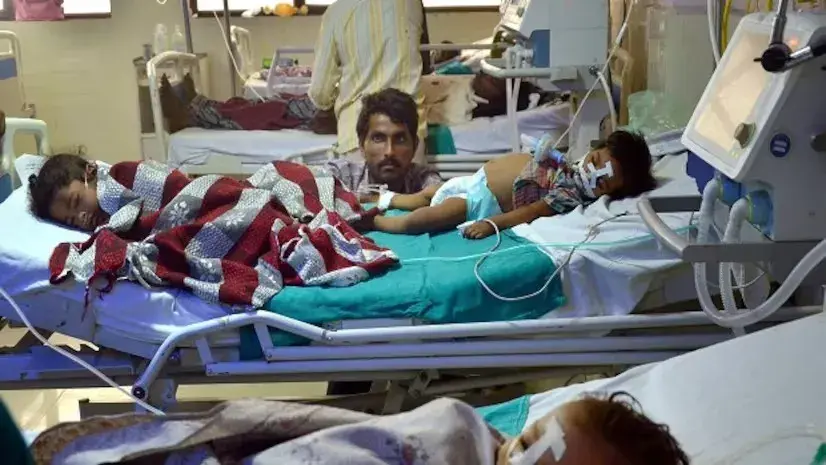
Six Children Die of Suspected Chandipura Virus in Gujarat Since July 10

Six children have died due to suspected Chandipura virus in Gujarat since July 10, with the total number of cases of the infection rising to 12, state Health Minister Rushikesh Patel has said. “Samples of the 12 patients have been sent to Pune’s National Institute of Virology (NIV) for confirmation,” he said on Monday. Chandipura virus causes fever, with symptoms similar to flu, and acute encephalitis (inflammation of the brain). It is transmitted by vectors like mosquitoes, ticks, and sand flies. The pathogen is a member of the Vesiculovirus genus of the family Rhabdoviridae. Patel said that four of the 12 patients were from Sabarkantha district, three from Aravalli, one each from Mahisagar and Kheda in Gujarat, while two patients were from Rajasthan and one from Madhya Pradesh. They received treatment in Gujarat. “Six deaths due to suspected Chandipura virus have been reported in the state, but only after results of the samples it will be clear whether they were caused by the Chandipura virus,” he said in a statement. “Five out of six deaths have been reported from the civil hospital in Himatnagar in Sabarkantha district. All 12 samples, including eight of patients at the civil hospital in Sabarkantha, have been sent to Pune’s National Institute of Virology (NIV) for confirmation,” Patel said. Paediatricians at the Himatnagar civil hospital had suspected Chandipura virus as the cause of death of four children on July 10 and sent their samples to NIV for confirmation. Later, four more children at the hospital showed similar symptoms. “Chandipura virus is not contagious. However, intensive surveillance has been undertaken in the affected areas. We have screened 18,646 persons in 4,487 houses. The health department is working round-the-clock to prevent the spread of the disease,” Patel said.

Six Children Die of Suspected Chandipura Virus in Gujarat Since July 10 Read More »

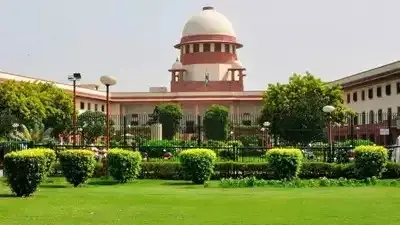
Students to move Supreme Court after centre cancelled controversial-NEET exam

Over 50 successful Gujarat-based NEET-UG candidates, including several top rankers, have moved the Supreme Court seeking a direction to restrain the Centre and the National Testing Agency (NTA) from cancelling the controversy-ridden exam. They have requested the top court to direct the Union education ministry to investigate and take strict action against students and others who indulged in unfair practices like paper leak and impersonation in the NEET-UG exam conducted on May 5 this year. A fresh plea by 56 students was filed just days before a Supreme Court bench headed by Chief Justice of India DY Chandrachud is scheduled to hear 26 petitions seeking various reliefs, including a re-test and a probe into the conduct of the exam, which has been plagued by allegations of malpractices. These allegations, including paper leaks, have led to protests in several cities and disputes between rival political parties. The pleas seeking the cancellation of the exam, a re-test, and a high-level probe are listed for hearing on July 8 in the Supreme Court.

Students to move Supreme Court after centre cancelled controversial-NEET exam Read More »